Somewhere in the domhan thuaidh, as the northern world was known in old Ireland, the frosty realms of the Arctic Circle, where polar bears roam and snowy owls soar, lies the secret headquarters of Santa Claus.
Santa delivers an enormous number of present in one night, He covers 82 million kilometres (or 50.9 million miles in some estimates) with a sleigh laden over 200,000 tonnes (if each gift weighs 1 kilogramme, the size of Royal Caribbean’s Icon of the Seas and Star of the Seas), demands colossal energy, over 110 times Ireland’s annual consumption.
But how? When scientists started probing, they were astonished to find there was more to there than meets the eye. The folklore of reindeer and their mysterious Arctic origins set the context and grounded the investigation. Maglev train technology and quantum theory propelled it skyward. Quirky calculations, working off a 100-gramme chocolate Santa that requires six hours’ walking or two weeks’ kissing gave the mavuale levity in their quest. The answer delves into ancient traditions and cutting-edge science, blending folklore with physics to explain one of Christmas’s greatest enigmas.
The Arctic Circle, encompassing swathes of Canada, the United States, Greenland, Sweden, Norway, Finland, and Russia, teems with wildlife including Arctic foxes, hares, and crucially, reindeer. According to the 2018 Arctic Report Card from NOAA’s Arctic Programme, approximately two million reindeer thrive in 23 major herds across these icy expanses. For centuries, indigenous peoples like the Sami and Nenets have harnessed reindeer for transporting people and goods over vast distances. Santa Claus, it seems, is merely perpetuating this time-honoured tradition, adapting it for his global gift-giving odyssey.
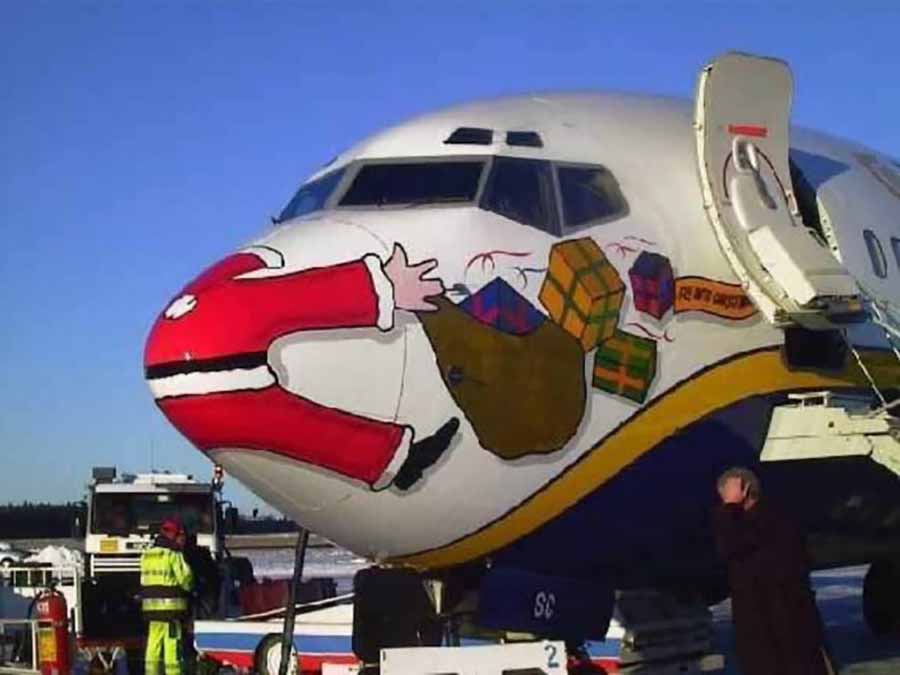
But the puzzle does not stop there: how do these reindeer achieve flight without wings or jet engines? Aircraft, after all, were a 20th-century invention, with the Wright Brothers’ inaugural powered flight occurring on 17 December 1903, in Kitty Hawk, North Carolina. Every day aviation problems like turbulence have not been solved by the technological advances, impressive as they are like ailerons, elevators, rudders, flaps, slats, spoilers, stabilisers and winglets, impressive as they are. Fuel burn, while being reduced, has still a long way to go. Aviation has a lot to learn from Santa.
Santa’s elf-scientists, crafting their system that was first noted in the early 18th century but may have been thousands of years old by then, predated such innovations. Instead of cumbersome mechanical wings, which would prove awkward for closely harnessed reindeer, they turned to magnetic levitation, or maglev technology.
Magnetic levitation harnesses the principle that like magnetic poles repel. Magnets, with their north and south poles, create forces that can lift objects, much like maglev trains that float above tracks. In electrodynamic suspension (EDS), superconducting electromagnets cooled to ultra-low temperatures generate magnetic fields, repelling those in the track to achieve levitation. Modern maglev trains, such as Japan’s JR Central L0, have clocked speeds of 603 kilometres per hour, hovering about 10 centimetres above the rails due to this frictionless propulsion.
Santa’s sleigh elevates this concept. Eschewing cryogenic cooling systems reliant on liquid helium or nitrogen, his team developed the holy grail of materials: room-temperature superconductors. These function at ambient temperatures around 20°C, eliminating the need for energy-intensive cooling. Installed on the sleigh’s runners and the reindeers’ shoes, these superconductors generate a magnetic field when electrified, repelling Earth’s own magnetic field, albeit weak, roughly 100 times fainter than a fridge magnet.
To initiate this, Santa’s sleigh employs an advanced, recyclable sodium-based battery, sidestepping lithium alternatives (laureates of the 2019 Nobel Prize in Chemistry). This powers the magnetic field, allowing altitude and speed adjustments: stronger fields for higher, faster flights; weaker for descent. Remarkably, this carbon neutral sleigh emits no greenhouse gases, a boon for the environment, though reindeer flatulence, methane-laden as it is, poses a minor hitch, purportedly mitigated by elf ingenuity.
But speed is the crux. Scientists worldwide have crunched the numbers on Santa delivery speed.
Researchers at the NSAI’s National Metrology Laboratory in Glasnevin, in their ‘Santa Equation’, summarise: Santa traverses 1.5 billion kilometres to 900 million homes (averaging 2.4 children each) in 31 hours, at 45 million kilometres per hour or 12,000 kilometres per second. The payload? Over 4 million tonnes for 2-kilogramme gifts per child. Noise levels hit 200 decibels, louder than a rocket launch, but Santa’s magic dampens it to 20 decibels over populated areas.
Assuming deliveries to well-behaved Christian children under 10, Santa must visit 234 million households. In 24 hours, that’s 2,708 visits per second; extending to 32 hours by flying against Earth’s rotation reduces it to about 2,000.

Velocity like this would incinerate reindeer and sleigh alike, evaporating in seconds due to air friction and G-forces.
Or maybe we are looking in the wrong place. Santa Claus has accomplished something in the space time equilibrium that science has not yet figured out. As the German physicist Metin Tolan says, Santa can be simultaneously in every house in every country on the planet at the same time, without any reindeer being incinerated by the velocity conundrum.
In his book “Silent Night, Hasty Night,” Tolan positions Santa as red-coated wave of quantum matter. Quantum theory asserts matter exhibits wave properties, enabling superposition, existing in multiple states simultaneously. The’Santa Claus wave’ spans all space, delivering to every home at once. Tolan writes: This means he is in all houses simultaneously, delivering presents everywhere at once. This is why he can never be seen; observation would cause the wave function to collapse, ending the magic.
This quantum superposition nearly sidesteps all related physical problems, and ensure Santa will survive for ever, or until the universe’s end. Tolan estimates Santa’s defiance of all physical constraints shortcuts a journey of 20 octillion years (a 1 followed by 48 zeros), and reshapes notions of reality, time, and consciousness.
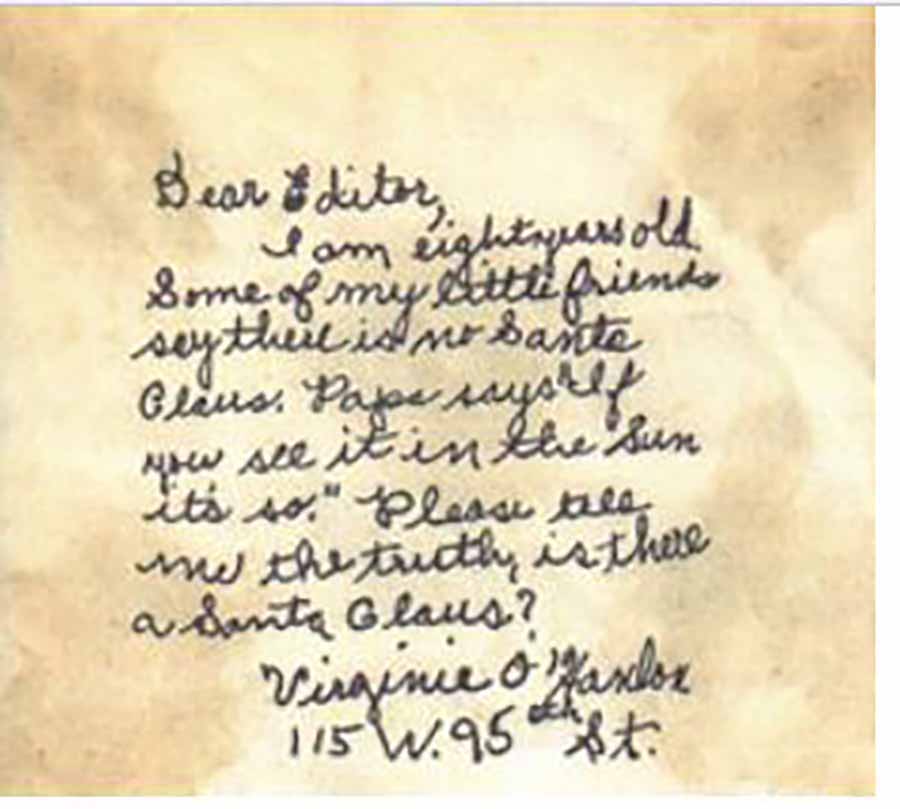
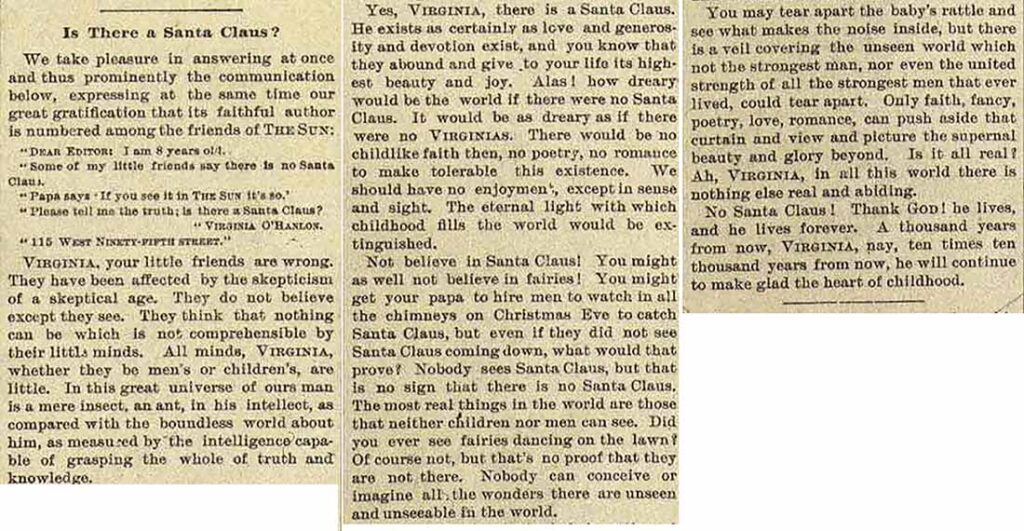
In 1897, eight-year-old Virginia O’Hanlon, a third generation Cavan girl, wrote to the New York Sun asking: “Is there a Santa Claus?” The newspaper ran an the editorial in response which endures as an oft-reprinted classic, sometimes claimed as the most famous editorial in newspaper history.: “You may tear apart the baby’s rattle and see what makes the noise inside, but there is a veil covering the unseen world which not the strongest man, nor even the united strength of all the strongest men that ever lived, could tear apart. Only faith, fancy, poetry, love, romance, can push aside that curtain and view and picture the supernal beauty and glory beyond. Is it all real? Ah, Virginia, in all this world there is nothing else real and abiding. No Santa Claus? Thank God, he lives, and he lives forever. A thousand years from now, Virginia, nay, ten times ten thousand years from now, he will continue to make glad the heart of childhood.“
In 1955, a misprinted mail-order advert led children to ring the US Air Force’s emergency line, birthing NORAD Tracks Santa, now tracking his position annually at noradsanta.org.
Ultimately, as Tolan notes, this knowledge is delightfully useless, yet perfect for enlivening festive gatherings. So, as reindeer magnetic levitation and Santa quantum wave theories illuminate the improbable, remember: quantum theory is not just for Christmas, it’s for life.