
Waterford was designated European city of Christmas. We were w-intrigued. So we headed to the wintery southeast to find out why.
Travor Darmody is the festival director of Winterval, a celebration of Waterford winteriness that runs for eight weeks from end of November until three kings day in January. He sees the Europe badge of honour as an opportunity to network.
“Winning European City of Christmas gave us a network of cities across Europe. Last year we had our own portal linking live to Brno in the Czech Republic; people here could wave to people there and see each other’s festivals in real time.”
“The budget is around €1.8 million for the six weeks. Funding comes in three main pillars: sponsorship, Waterford City and County Council, and concessions from the fifty outdoor traders and indoor markets plus the fairground and food stalls.”
“Visitor numbers went from about 550,000 in the early years to 650,000 until two years ago, then jumped to 2.8 million last year when we won European City of Christmas, and we keep that title forever.”
The festival is now in its 13th year. “It started as an economic driver for the city, to extend the shopping season, but it has progressed to being much more than that. People plan their Christmas around Winterval; families who moved away come home specifically for it, and people who came as children thirteen or fourteen years ago are now bringing their own kids.”
“It’s squarely a family festival. Everything during the day until about 8 o’clock is focused on young families. We have the big attractions, ice skating, the vintage fairground, parades, fireworks, drone shows, but I think the smaller, quieter things are just as important: gingerbread decorating workshops where you sit with your child for an hour, wreath-making, the Draw Your Own Hero animation where your drawing becomes the central character in a short film that gets emailed to you.”
“We run about sixty events; twenty-five are completely free, the rest range in price so you can do Winterval on a shoestring or splash out on river cruises or the Taste of Winterval food tours.”
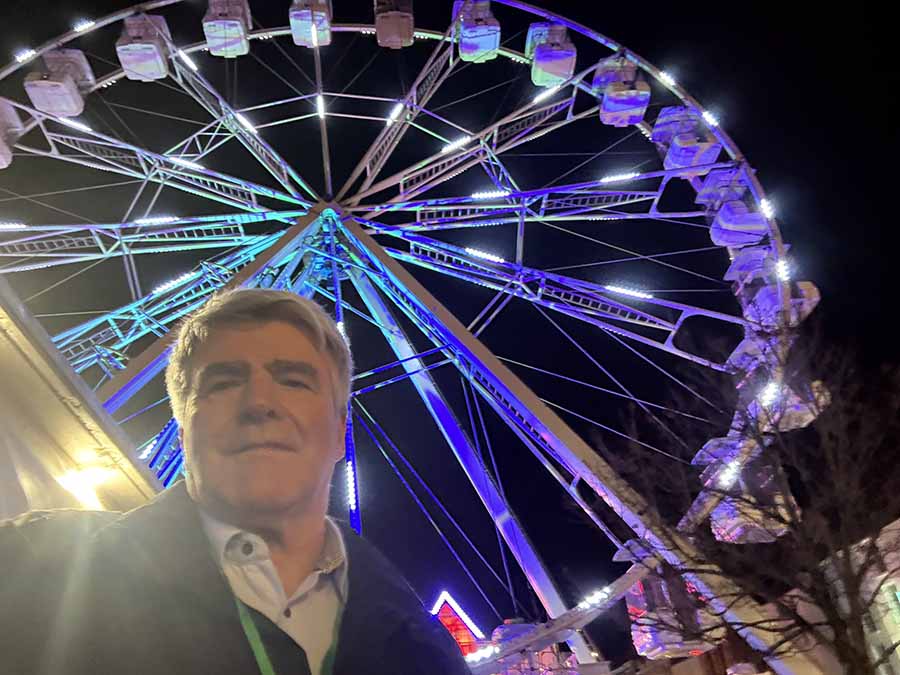
A stroll around the city shows what he means. The streets have acquired a carpet of children, Glow Gardens and the Winterval Illuminates on offer every 30 minutes from 5pm at Cathedral Square, fairground carousels and Ferris wheels (vintage fairground is the qualification to be included the celebrations) including the biggest, the eye on the post of Waterford, which takes things, ahem, to another level.
A little teensy train ferries the entranced children around the area. Santa’s VR Sleigh Ride gives a suggestion of the navigational skills required to traverse the globe of Chirstmas Eve. A wreath making workshop keeps little hands busy. A group of Viking re-enactors are on hand to talk games, weapons and coins, curtsey of Déise Medieval. “We keep the Dane axe at the back” says re-enactor Barabar Power, “for people’s safety, especially my own.”
Blaas and beer
A high proportion of the stalls are dispensing food and hot chocolate. Food is what makes most modern tourism tick, a fact acknowledged (finally) by the government in its new tourism policy. Well-fed winetervallers and happy wintervallers.
We joined Sinead Reil of Tasteful Tour for a food tour of the city. She brought us to the Garanry to taste Blaas, not just a local speciality but a UNESCO designated local speciality, and to the craft beer and whiskey bar Revolution for a tasting, owned by the gregarious and improbably named Flash Gordon. Sinéad fileld our palates with goodness and our heads with history as she marched us up to the old fair green and marched us down again, like the Grand Old Duke of Fork.
If you think all this is cream crackers, you are in the right place. This is where the idea roignated. The Jacobs brothers decided to double bake a biscuit for the sailors who stopped her and faced long and arduous voyages on a poor diet. The rest is biscuitry.
Even the cavernous book centre, three stories of reading has a café and bar in the mezzanine. Heere you can sip and read. Have yez no tomes to go to.
All of this activity is parcelled into a compact zone along the quays and adjoining streets as far along the quays as the 90-degree turn at the end where you find Reginald’s `tower and the Tower Hotel. Waterford has a problem. The scale of the problem only becomes apparent when you travel by train, which I had never done. The train station is on the opposite side of the river. to where the city lies.
City being an overstatement, because it is basically one quayside street with the buildings on one side and the river on the other, like one of those frontier fotrress cities on the Danube.
A new masterplan, which everyone in the city will tell you about, is going to bring an end to a situation which one of the city’s many famous writers described as “flying on one wing.” According to the designs, there are going to be hotels and shops, and all sorts of palaces of excess, on the left bank of the river, which, until now, has been basically confined to a few brutalist concrete structures, and derelict hotel, which was a good idea at the time.
It is coming, like Christmas. The pedestrian bridge they recently finished will not be opened until 2027, so it may be some time.
Pleasures and treasures
Not that the existing Lár Láirge, on the right bank is without its pleasures and its treasures. A scuttering of streets descend at increasingly awkward angles down to the quayside. Within these can be found the facades of the Catholic and Protestant cathedrals of which the city is rightly proud.
A collection of museums that should be in a museum follow. Who thought it was a good idea to have a museum of clocks? Waterford did, and it has been hugely successful, despite the scepticism of everyone involved in tourism in Ireland, from Fáilte Ireland down.
Waterford Treausres museum builds its storyline up from ancient vaults underground and will convincingly persuade you that Waterford is the capital of wine, so good were they at importing the stuff, that they ended up supplying the vinerati in England and the military in London.
The signature of the city is a circular tower named for Reginald. Somewhat mysteriously, we do not know how significant he was. but he appears to have been imprisoned there. His name pops up on nearby hostelries, “meet you at the Reg” prolonging the sentence in a way.
The Magnificent Mall, ironically visited by busloads of American who only recognise the word in its Stateside shopping dimension, is where you will find the House of Waterrford. It still offers factory tours and €30,000 piece of glass art which are occasionally purchased. Somebody bought the harp the week before I arrived. Beyond that is the city as it has grown since the 1700s the twin schools of De La Salle and Newtown, and long straight roads to the university, a world apart from Reginald. The old city hugs the river, not the flood plain behind.
Trevor has been involved since the very start. “The original festival director taught guitar at my music school, and he asked if we could put together the postbox collection show with elves and dancers. That was my first couple of years, I was the postbox collection guy.”
“I progressed to music programmer, then during the COVID years the festival directors were struggling, I got a call to jump in and help, and I ended up programming about a third of it. That’s when the council asked me to take over. This is my fourth full year as director.”
“I run the Waterford Academy of Music and Arts, that’s my day job. A lot of the workshops and technical side come from my own staff, and we keep the fairground vintage on purpose, 1970s chair-o-planes, galloper carousel, rather than modern thrill rides.”
“We’re starting to expand Winterval After Dark a little, free outdoor gigs, indoor theatre shows with Walking on Cars, Frances Black, late-night bars in the big wheel, but the heart of the festival stays with families and children.”
“The moments that stay with me are the small ones, on the opening night a little child walked straight up to Santa after the lights switch-on and handed him a letter. That was perfect.”
When December comes
And when December comes, or even the last 10 days of November, all of this becomes a designated Winter Zone. It is full of noise and music and laughter and the hum of hot chocolate and carousels, reinstating Waterford’s case to be truly a northern European city unlike any other on the island, closer to Bergen than to either Boston or Berlin.
When the Romans sailed here and found a notable lack of vineyards, olives trees, and sunshine, they designate this island with an official name, the island of winter, for that is how Hibernia translates.
All roads no longer lead to Rome. They lead to Brussel before. There is nothing particularly new in Europeans designating an Irish city as “the city of winter.”
Waterford is renewing a tradition.
We should celebrate its winternational success.