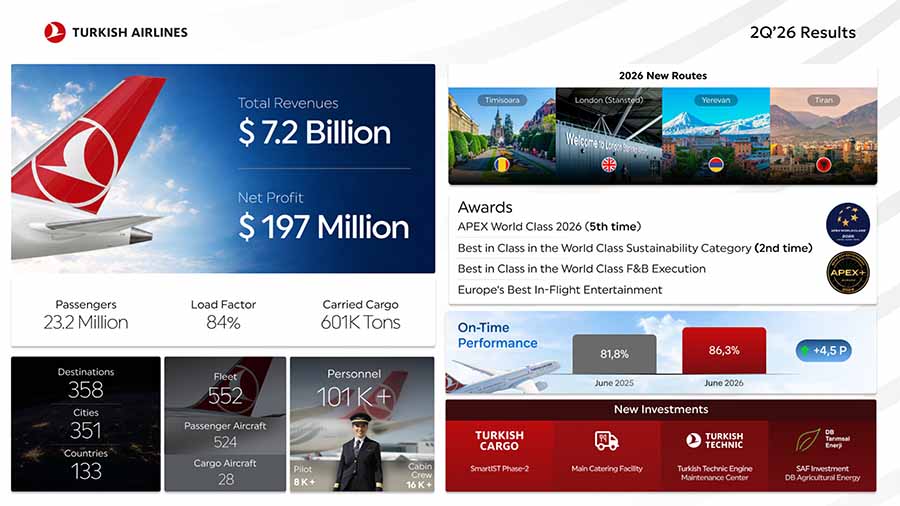
- Turkish Airlines net profit of USD 197m in Q2 2026 despite Middle East conflict
- Total Revenues up 20.5pc to USD 7.2bn; cargo revenues up 58pc to USD 1.3bn
- EBITDAR margin at 12.6pc exceeding guidance of 8pc
- Fleet expanded 14pc to 552 aircraft by end of June 2026
- Q3 EBITDAR margin expected 20-25pc range
Turkish Airlines has recorded a net profit of USD 197m in the second quarter of 2026 despite the adverse effects of the war in the Middle East. Total Revenues increased by 20.5pc year-on-year to USD 7.2bn during the second quarter. Cargo revenues increased by 58pc compared to 2025, reaching nearly USD 1.3bn. EBITDAR margin exceeded the Company’s guidance of 8pc, reaching 12.6pc. Passenger load factor increased by 1.8 percentage points to 84.0pc, marking the highest second-quarter load factor in Turkish Airlines’ history.
As Europe’s leading network carrier by number of flights, Turkish Airlines continued to expand its fleet in line with its sustainable growth targets despite uncertainties resulting from the war in the Middle East and bottlenecks in aircraft production. Expanding its fleet by 14pc year-on-year to 552 aircraft as of the end of June 2026, Turkish Airlines increased its Total Revenues by 20.5pc year-on-year to USD 7.2bn. Although geopolitical developments in the Middle East placed significant pressure on global air cargo capacity during the second quarter of 2026, Turkish Cargo responded effectively to demand through its strong infrastructure and strategic geographical position. Cargo volume increased by 11.3pc, while cargo revenues rose by 58pc to nearly USD 1.3bn.
The impact of the war in the Middle East was reflected noticeably in the second-quarter financial results due to the delayed effect of the sharp increase in jet fuel prices on costs. Higher passenger and cargo unit revenues served as an important balancing factor, driven by the Company’s selective growth strategy with a continued focus on profitability. Through selective investment decisions in line with its strategic priorities, Turkish Airlines invested a total of USD 3.1bn in the first six months of the year. Consolidated Total Assets amounted to USD 51bn and total employment including all subsidiaries exceeded 101 thousand. Third-quarter EBITDAR margin is expected to be in the range of 20–25pc as robust passenger and cargo demand is expected to limit the adverse impact of higher jet fuel prices resulting from renewed geopolitical tensions.,
Murat Şeker shared: “Despite the uncertainty caused by geopolitical developments in the Middle East and the sharp increase in fuel prices, we have successfully managed this challenging period, as we have in previous crises. This was made possible by our extensive flight network, diversified business model and agile operational capabilities. At the same time, we continued to implement end-to-end efficiency initiatives across all units of our Company while maintaining our disciplined cost management approach. As Turkish Airlines, we will continue to bring continents, cultures and people together through our products and services while keeping flight safety and customer satisfaction at the center of our focus.”