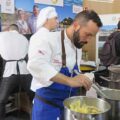
El regreso al hogar. The 2026 World Paella Day Cup Grand Final takes place today, Sunday, 20 September 2026, in the heart of Valencia, Spain. Twelve world-class chefs from across the Americas, Europe, and Asia (including a historic first-ever finalist representing England) will go head-to-head live over wood fires.
The jury, composed of Michelin-starred chefs, will award the trophy around 2:00 PM. Starting at 12:00 PM, visitors can purchase authentic portions of paella directly at the stands for approximately €6 per serving (and drinks for €2). If you cannot attend in person, the entire showdown is being broadcast live on the World Paella Day Official Website and their YouTube channel. For those in Valencia, a ticketed official afterparty called “After Paella” will follow the tournament at the same location.
This gathering of culinary talent in Valencia represents more than a competition among skilled practitioners of a single rice dish. It offers an opportunity to examine the ways in which a regional preparation rooted in the agricultural rhythms of eastern Spain has come to occupy a position of international recognition while still retaining its connection to local methods and ingredients. The presence of a first-time finalist from the United Kingdom among the twelve competitors drawn from the Americas, Europe and Asia illustrates the geographic spread of interest in authentic paella technique.
The decision to cook over wood fires rather than gas or electric sources further situates the contest within traditional practice, where the smoke and variable heat of open flame contribute flavour compounds that modern kitchens often struggle to replicate. The jury of Michelin-starred chefs will evaluate not only flavour balance and rice texture but also fidelity to established principles of preparation, thereby reinforcing standards that have evolved over centuries rather than decades. Visitors who arrive from midday onwards can obtain a portion for approximately €6, an accessible price that allows direct engagement with the finished product rather than passive observation alone.
The parallel live stream on the official website and YouTube channel extends the event beyond the physical confines of the Valencia venue, enabling remote audiences to follow the progress of each pan from the initial sofrito through to the final socarrat. The subsequent ticketed afterparty under the name After Paella provides a structured conclusion to the day, keeping participants and spectators in the same location and sustaining conversation around the dishes that have been prepared.
Rice and waterfowl
Paella itself emerges from a specific set of historical and environmental conditions in the province of Valencia. The flat, irrigated lands surrounding the Albufera lagoon supplied both the rice and the waterfowl that featured in early versions of the dish. Rice cultivation reached the Iberian Peninsula with the arrival of Arab agricultural knowledge in the eighth century, and by the fifteenth century the crop had become established in the wetlands near Valencia.
Farmers and labourers working the rice fields developed a one-pan meal that could be cooked outdoors over an open fire using whatever ingredients were immediately available. Rabbits, snails, beans and seasonal vegetables formed the basis of these early preparations, with chicken added later as poultry farming expanded. The large, shallow pan known as the paellera allowed the rice to cook in a thin layer, promoting even evaporation and the formation of the prized caramelised crust at the bottom.
Saffron, introduced through Mediterranean trade routes, supplied both colour and a distinctive aromatic note that distinguished Valencian rice dishes from those prepared elsewhere on the peninsula. By the nineteenth century, the combination of short-grain rice, local proteins and the characteristic cooking vessel had solidified into a recognisable form that residents of the region identified as their own.
Documentary references from the late eighteenth and early nineteenth centuries describe outdoor rice meals prepared in the countryside around Valencia, often associated with agricultural festivals or communal gatherings after the harvest. These accounts emphasise the communal nature of the cooking process, with several people contributing ingredients and sharing the finished pan directly from the vessel itself.
Social dimension
The absence of individual plates in many early descriptions underlines the social dimension of the meal. As transport networks improved during the nineteenth century, visitors from other parts of Spain and from abroad began to encounter the dish in Valencia and carried descriptions of it back to their home regions. Restaurants in Madrid and Barcelona adapted the preparation, sometimes substituting seafood for the original land-based proteins or altering the ratio of broth to rice.
These modifications produced regional variants that eventually acquired their own identities, yet the Valencian original continued to insist upon a specific set of ingredients and techniques. The insistence on Bomba or similar short-grain varieties that absorb liquid without becoming sticky, the careful control of the sofrito of tomato, garlic and paprika, and the final resting period that allows the socarrat to develop remained markers of authenticity for practitioners in the source region.
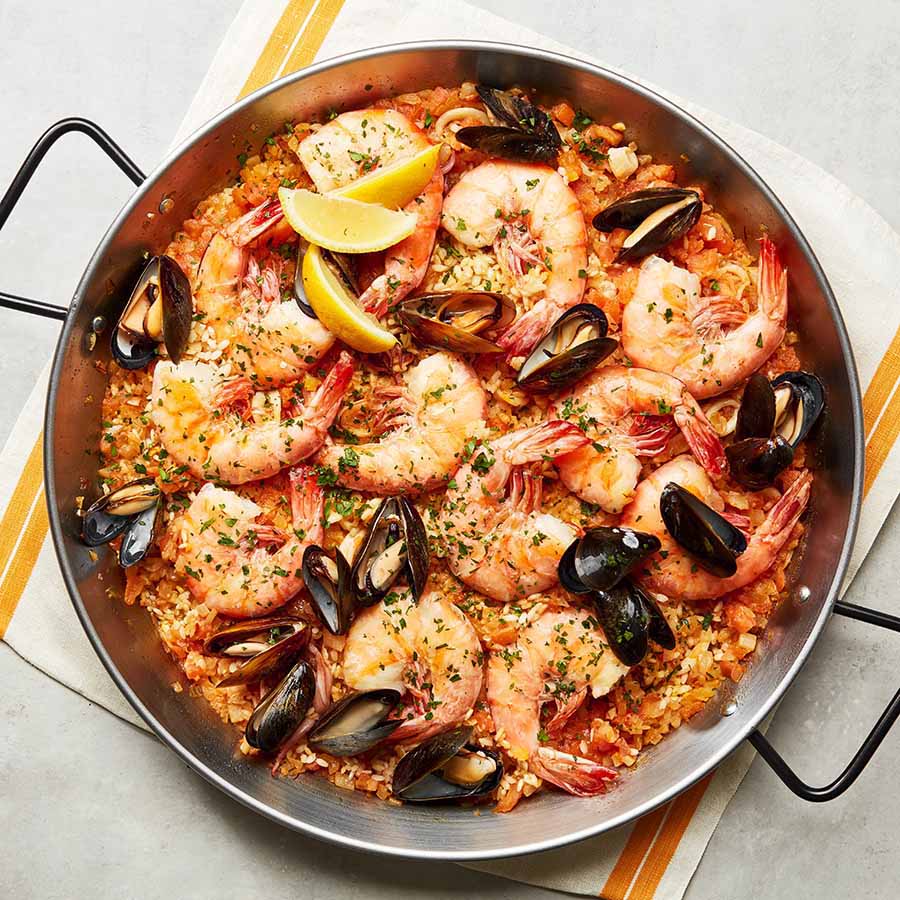
The twentieth century brought both standardisation and diversification. Recipe books published in Spain after the 1920s began to codify a version that included rabbit, chicken, green beans, garrofó beans and saffron, establishing what many Valencians still regard as the classic composition. At the same time, coastal communities developed seafood versions that replaced land proteins with prawns, mussels and squid, reflecting the availability of Mediterranean fish.
Tourist demand after the middle of the century accelerated the spread of these seafood adaptations, particularly in coastal resorts where visitors expected a rice dish associated with the Spanish Mediterranean. The result was a proliferation of interpretations that sometimes drifted far from the original proportions and cooking methods. Critics within Valencia responded by emphasising the importance of local rice varieties, wood-fired cooking and restrained seasoning.
Protecting the tradition
Organisations dedicated to the defence of traditional paella emerged, seeking to document techniques and to educate both professional chefs and home cooks. These efforts contributed to the eventual creation of competitive events that tested participants against agreed criteria rather than against purely subjective taste.
The establishment of World Paella Day and the associated Cup competition can be understood as an extension of this longer process of definition and promotion. By bringing together finalists from multiple continents and subjecting their work to the judgement of established chefs, the organisers create a public forum in which technical skill and respect for historical practice can be assessed side by side.
A dish that originated as a practical meal for agricultural workers now travels through competition circuits, digital broadcasts and international media coverage.
The risk of dilution remains present whenever a preparation leaves its region of origin, yet the structure of the World Paella Day Cup Grand Final attempts to counter that risk by insisting upon live demonstration under conditions that approximate historical practice. The jury’s composition of Michelin-starred chefs introduces a professional standard of evaluation that is recognised across borders. A plate with no end.
- The 2026 World Paella Day Cup Grand Final takes place today, Sunday, 20 September 2026, in the heart of Valencia, Spain.
- Twelve world-class chefs from across the Americas, Europe, and Asia (including a historic first-ever finalist representing Enland) will go head-to-head live over wood fires. The jury, composed of Michelin-starred chefs, will award the trophy around 2:00 PM. Starting at 12:00 PM, visitors can purchase authentic portions of paella directly at the stands for approximately €6 per serving (and drinks for €2).
- The entire showdown is being broadcast live on the World Paella Day Official Website and their YouTube channel. For those in Valencia, a ticketed official afterparty called “After Paella” will follow the tournament at the same location.
- Plaça de l’Aigua / Tinglado No 2, La Marina de València,10:00 AM to 3:00 PM (local time). Free to attend and watch. No advance tickets or bookings are required for spectators.