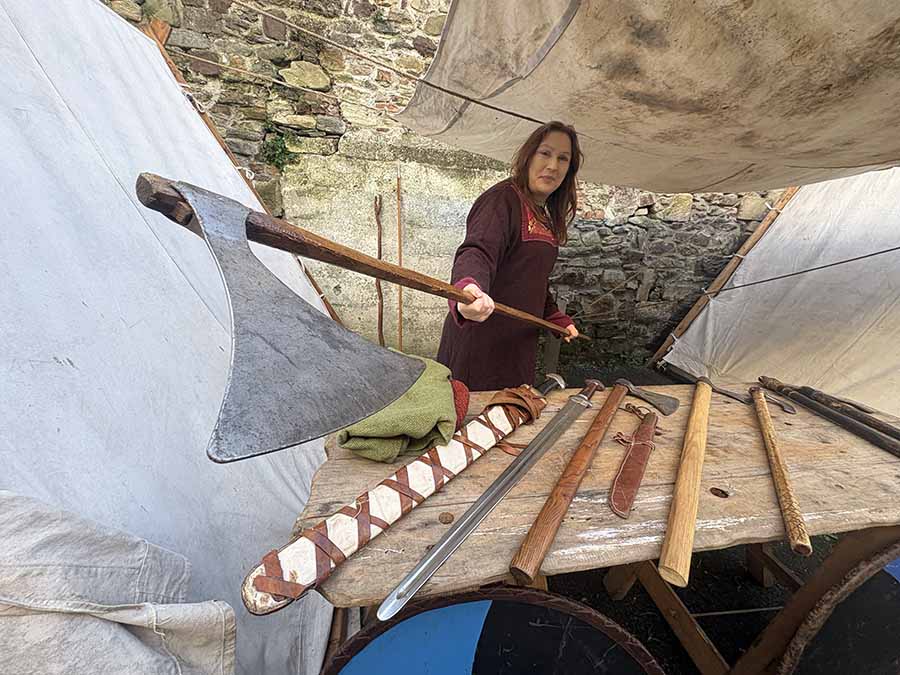
“This is your Dane axe. See the head. And you do serious damage with that? Serious damage.”
Barbara Power of the Déise Medieval History Group is giving a presentation on Viking weaponry clarified common misconceptions, noting that swords were not common and were typically reserved for chiefs or wealthy individuals. The axe was the prevalent tool and weapon due to its practical utility in daily life. The display included a variety of axes, from light to heavy types, as well as spears and shields that formed the standard equipment for most Viking-age individuals.
Barbara told visitors to the Winterval festival in Waterford that the collection demonstrated the range of period weaponry, from short spears used with a shield to two-handed long spears. She explained the functional difference, noting that a shield offered no protection when wielding a long spear. The presentation aimed to educate the public on the historical accuracy of Viking combat equipment beyond popular portrayals.
The most formidable weapon displayed was Barbara’s Dane axe, a two-handed weapon noted for its capacity to inflict serious damage. This item was stored with particular care for safety during the demonstration. The group uses such presentations to illustrate the realities of Viking-age warfare and tool use, countering modern media depictions with historically informed examples.
The approach underscores the group’s educational mission within living history, using authentic replicas to facilitate understanding of the period’s material culture. By explaining the social and economic factors behind weapon ownership, such as the cost and status associated with a sword, the presentation adds a layer of social history to the physical artefacts.
The weaponry demonstration served to demystify Viking arms, emphasising the commonality of axes and the strategic use of spears and shields. It provided factual context about the accessibility and function of weapons, contributing to a more nuanced public interpretation of Viking history through direct engagement with replica items.
Barbara Power shared “Everybody LOVES a Viking sword, and assumes that ALL Vikings had swords which was not the case at all. The swords for the Jarl or the chief or someone very rich. Mostly, people had their axes. Everybody had an axe, because it was a practical tool as well as a weapon.”
Waterford’s latter day Vikings
Barbara and other members of the Déise Medieval History Group are presenting a Viking village at the Winterval festival in Waterford, depicting life in the 10th and 11th centuries. The display featured historical games such as Hnefatafl, described as Viking chess, alongside tug of war and Kubb. The group’s activities extend beyond games to include demonstrations of weapons, herb medicine, archery, food preparation, carpentry, and crafts like nalbinding, a single-needle sewing technique used to make items such as gloves.
Patrick Dunne and Shane O’Connor of the Déise Medieval History Group told visitors to the Winterval festival in Waterford that the organisation operates as a hobby, with members meeting weekly in Tramore. They travel nationally and internationally for events, including major festivals at Slane Castle, the Kerry Museum, and heritage parks in Wexford and Clare. Members also participate in large-scale European reenactments in Iceland, Denmark, and Sweden, involving thousands of participants.
The group’s presentations use authentic, though not sharpened, weapons for display and educational purposes. The limitation of space at events like Winterval prevents the staging of full battle reenactments. The core objective is to provide an immersive, living history experience that educates the public on aspects of daily life, crafts, and games from the Viking age through hands-on interaction.
Their participation in large international gatherings, such as events in Trelleborg, Denmark, connects the local group with a wider community of historical reenactors. This network facilitates the exchange of knowledge and contributes to the scale and authenticity of displays both at home and abroad. The group’s work exemplifies community-based heritage tourism that adds a specialised, interactive dimension to regional festivals.
The Déise Medieval History Group functions as a volunteer organisation that enhances cultural festivals with detailed Viking-era living history. Their activities combine local community engagement with participation in an international reenactment circuit, using demonstrations of crafts, games, and displays to make medieval history accessible and engaging for public audiences.
Patrick Dunne shared “Well, this is the Déise medieval Viking village… a little bit of a slice of kind of 10th and 11th century life here. We travel around the country, Europe, we do living history. So apart from the games we have today… we also have our weapons display tables, herb medicine, we have our archery, we have food, carpentry, constructing, kind of different things going on. We do this in our spare time as a hobby. You can find us in Tramore on every Thursday, meeting each other and chatting to each other.“
Is it silver or is it tin?
Further down the alley Gavan Murphy is telling visitors the first official coinage in Ireland was introduced by Sitric Silken Beard, Brian Boru’s adversary, who modelled his ‘Sitric penny’ on a successful English design. The advantage of coinage was the establishment of a trusted, standardised weight of silver, though counterfeiting with base metals like tin or lead was a common concern, requiring verification.
Viking-age Ireland initially used a ring currency system, where stamped silver bracelets, neck rings, and arm rings functioned as money by being cut into pieces for transactions. Coins were not introduced until the late 10th century, following the establishment of extensive Viking trade networks that flooded Ireland with silver. Cities like Dublin and Waterford became central hubs in this economy, where decorated items such as penannular brooches also served as stored wealth that could be broken apart for payment.
To address this issue of trust, merchants used portable coin balances to test the purity of silver currency. A replica of such a balance, based on an artefact in Waterford’s museum, was demonstrated. By weighing a coin, a trader could determine if it was authentic silver or a lighter or heavier forgery, a practical solution in daily market transactions, though not an exact science.
The presentation highlighted the role of Ireland, and Waterford in particular, within the vast Viking trading network that stretched from Northern Europe to Constantinople. The influx of silver transformed the local economy and material culture, with ornate items serving dual purposes as displays of status and potential currency. Archaeological hoards often contain fragmented pieces of these rings and brooches, evidence of their economic use.
evolution from hack-silver ring currency to standardised coinage under Sitric Silken Beard marked a shift towards a more formalised economic system in Viking-age Ireland. The need to verify the silver content of coins led to the use of practical tools like balances, underscoring the complexities of early medieval commerce and the central role of silver in Viking trade and society.
“Coins didn’t come into this country until the late 10th century. But before that, ring currency was very much the norm. So the Vikings would have used ring bracelets and neck rings and arm rings… Each one of these lines is not just decoration, but it’s where you would cut the silver to pay for something.”
“It was the Vikings who brought coinage to Ireland… Sitric Silken Beard, he was the person who brought coinage to Ireland for the first time. This is what they would use to balance the exact amount of silver… if it is too light, it’s probably tin, too heavy, it’s probably lead. That is how you knew.”
The Viking virtues of maggot medicine
Viking herbal medicine, medieval surgery techniques, natural diuretics history, linen stitch antibacterial, maggot therapy wound care, pine resin cough remedy, honey burn treatment, medieval medicinal plants, Viking age healthcare, Déise history group medicine, historical surgical tools, beeswax medical use
David McDonagh explained that Viking-age medicine relied on plants and natural materials for treatment, with common herbs serving specific therapeutic functions. Dandelion leaves were used as a diuretic for kidney function, pine resin treated coughs, honey addressed burns, and mint freshened breath. These remedies were sourced from local gardens and hedgerows, representing an early form of phytotherapy integrated into daily life.
David told visitors to the Winterval festival in Waterford that surgical practices included the use of curved needles and linen thread, which is naturally antibacterial, for stitching wounds. The linen was coated in beeswax to ensure smooth passage through skin and to provide additional antibacterial properties. This approach demonstrated practical, effective solutions developed through observation and tradition, even if the scientific rationale was not understood at the time.
For infected wounds, a method of maggot therapy was employed, where maggots were introduced to consume dead and infected tissue, thereby cleaning the wound. This practice, noted as still in use in modern medicine, was described as causing an intense tickling sensation. The process involved removing the maggots after a day to allow the wound to heal properly, highlighting a pragmatic approach to infection control.
The presentation illustrated the convergence of herbal knowledge and basic surgical intervention in the period. Materials like linen and beeswax were selected for their functional properties of strength and infection resistance, showing an empirical understanding of material science. The reuse of maggot therapy underscores how some historical medical techniques have been validated by contemporary practice.
In summary, Viking-era medicine combined readily available herbal remedies with rudimentary but effective surgical techniques, including sterile stitching and biological debridement. This system was built on observable outcomes and the practical properties of natural materials, forming a foundation of healthcare that utilised both internal and external applications for treatment and recovery.
David shared: “We had those in our back gardens, and in the hedgerows… your dandelion leaves… they’re a natural diuretic, and they’re really good for your kidneys, they flush out your system. I use linen for the stitches, because linen is naturally antibacterial, and it’s strong, so we hold the wound together until it heals. I rub the linen in beeswax… the beeswax is also naturally antibacterial. I take some maggots, I put them into the wound… the maggots eat all the dead infected flesh, cleaning out the wound. And the maggots are still used today.”