Drew, Call Coordinator, Ryanair Holdings PLC: Hello, welcome everyone to Ryanair Holdings PLC Q1 FY 2027 earnings release. My name is Drew, and I’ll be the coordinator for the call today. If you would like to ask a question, you may do so by pressing star followed by one on your telephone keypad. Please limit yourself to two questions. Owen, I’ll hand you over to Michael O’Leary, Group CEO of Ryanair Holdings to begin. Michael, please go ahead when you are ready.
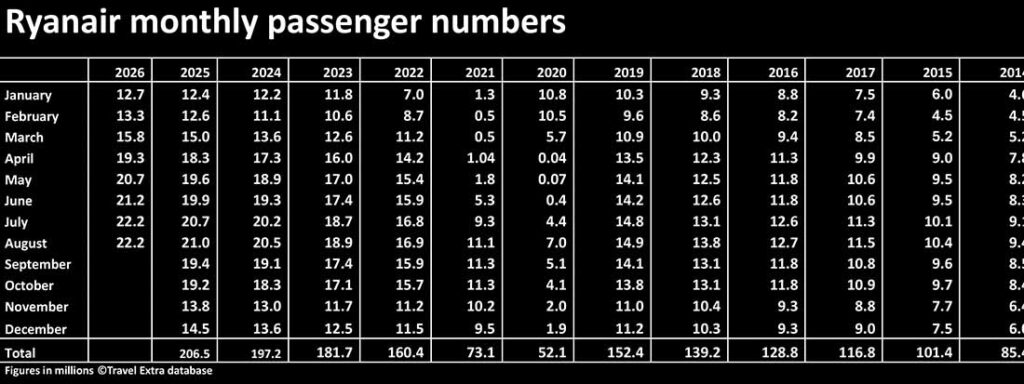
Michael O’Leary, Group CEO, Ryanair Holdings PLC: Okay. Good morning, everybody. Welcome to the Q1 results call. You’ll have seen the results issued this morning. Q1 profit after tax of €538m. That’s a 34pc decline on last year’s Q1 of €820m, primarily due to the impact of the large spike on oil prices on our 20pc unhedged, and also the fact that the first half of the Easter holiday fell into the prior year Q4. Q1 highlights include traffic growth on track grew 6pc to 61.3m. Revenue per passenger fell 5pc. Average fares were down 6pc, ancillary revenues were flat. Unit cost rose 5pc, which is an impressive number as the unhedged Q1 jet fuel prices doubled to $151 per barrel.
FY 2027 jet fuel remains 80pc hedged at $67 a barrel, a development in recent weeks as we took advantage of some price weakness on the forward rates, and we’re now 15pc hedged for the entirety of FY 2028 at about $85 a barrel. The underlying growth into the summer continues. We’re operating three new bases this summer, Rabat in Morocco, Tirana in Albania, Trapani in Southern Italy, and in total over 130 new routes. We’re pleased that the final €1.2bn bond was repaid in full out of internally generated cash flow, leaving the group essentially debt-free. Touching briefly on a couple of points, and then before I hand over to Neil. Schedule revenue dipped 1pc in Q1 to €2.91bn as traffic grew 6pc, but at 6pc lower fares.
Q1 fares, which benefited from a full Easter during April 2025, required stimulation as the Middle East conflict led to consumer hesitancy, concerns about EU jet fuel shortages, economic uncertainty, and later bookings. However, our conservative hedging policy means with 80pc of our fuel hedged at $67 a barrel, the group’s earnings are largely insulated from periods of extreme volatile oil prices as currently, and this will materially widen our cost advantage over all of our other EU competitors. As I said, we’ve recently extended those fuel hedges for the first time into FY 2028, now 15pc hedged at $85 a barrel. Having repaid the €1.2bn bond in May, at the quarter end, gross cash was just over €2.8bn. Again, an impressive figure after €1.3bn of debt repayments and half abn in CapEx.
Liquidity is further boosted by the group’s €1.1bn revolving credit facility, which is mostly undrawn, a sensible strategy at this time of the year when cash flows are strong. We are now 90pc through the €750m share buyback program. The average price is €26.35 per share. However, over the coming year, following the main repayment of our last bond, our funding priorities are, one, the MAX 10 aircraft CapEx and the first 50 of those aircraft are coming in the spring of 2027. Shareholder dividends, the completion of the current buyback program, which we think will run out until around the AGM in September, while rebuilding gross cash back to €4bn, which is where we were when we entered the COVID, and we believe that’s a sensible number to help us cope with unforeseen eventualities such as COVID or the current war in the Middle East.
In terms of touching on fleet, Boeing continues to expect the MAX 10 certification in late summer 2026. I spoke to them about two weeks ago, and they expect the MAX 7 to be certified in the coming weeks, and they are reasonably confident that the MAX 10 will be certified either in late September or mid-October. They have protected our first 15 delivery slots in the spring of 2027. So we are growing increasingly confident that we will have the first of those aircraft in advance of summer 2027. And with 300 of these super fuel-efficient aircraft, remember, 20pc less fuel, but offering 20pc more seats per flight, due to deliver by March 3034, it leaves us in very good shape long term for cost efficiency or cost-efficient growth, and we believe profitable growth. As I said, this summer, top line growth is strong.
Three new bases in Rabat, Tirana and Trapani. But with only 4pc of FY 2027 traffic growth, our scarce capacity is being switched away to those states, regions and airports, cutting aviation taxes, lowering fees to incentivize growth. The examples we have given are Albania, Morocco, regional Italy, Slovakia and Sweden, and we are withdrawing material capacity, flights and traffic away from high tax, high cost markets like Vienna in Austria, Dublin here in Ireland, where costs have gone up 10pc this year. Germany, we are closing the Berlin base at the end of the summer and regional Spain. Over the medium term, we expect European short-haul capacity to remain constrained until at least 2030, principally as the two main manufacturers remain well behind on aircraft deliveries.
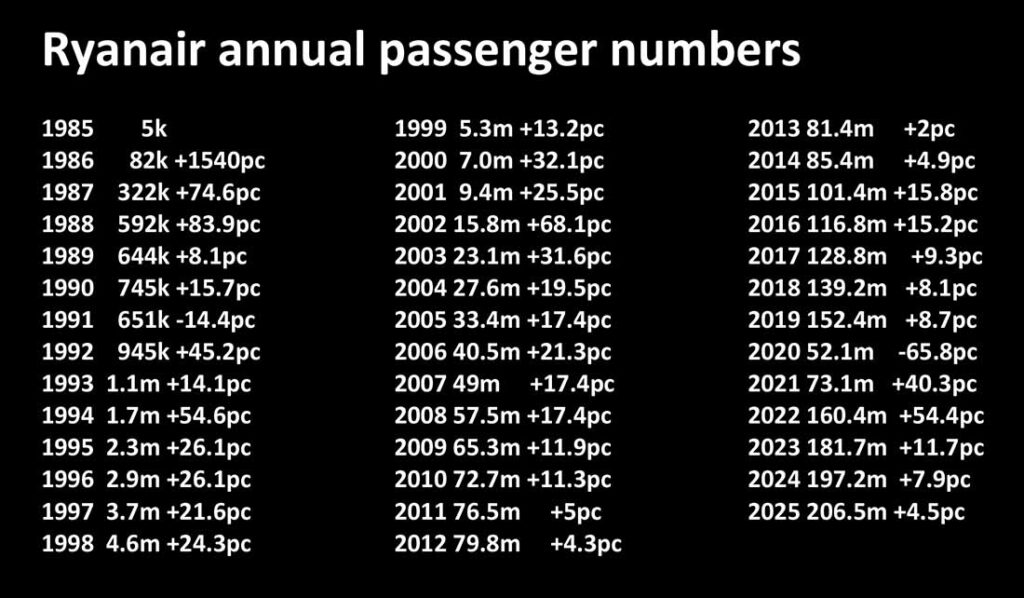
Those industry capacity constraints, combined with our very widening cost advantage, our strong balance sheet, low cost fuel efficient aircraft order book, and industry leading ops resilience will, we believe, facilitate Ryanair’s sustainable, profitable growth to over 300m passengers by 2034. In terms of outlook, FY 2027 traffic remains on track to grow 4pc to 216m passengers. Much of that growth is front-ended, so in H1, we expect to grow by 6pc. We will cut back our schedules into the winter, and we expect to deliver only 2pc traffic growth in the second half of the year. Our unit cost leadership continues to widen. We have seen the results reported by many competitors in recent weeks, who have seen unit cost increases of high single digit, low double digit. We are this morning reporting low single digit cost inflation.
Jet fuel remains 80pc hedged to March 27 at $67 a barrel. That helps us to offset a €300m increase this year in EU and bureau taxes, significant crew pay increases under new multi-year CLAs and higher maintenance costs. While summer 2026 volumes are strong, the booking window remains closer in than last year, which further reduces visibility. Despite a recent slight uptick in volumes and less price stimulation, Q2 pricing is trending modestly down year-over-year. That is a decline from where we were on the full-year results. We were hoping that Q2 pricing would be flattish year-over-year. They are now trending modestly down at low to mid single digits.
The final H1 fare outcome remains heavily dependent on the strength of close-in bookings in August and September, but they will not be sufficient to make up for what will now be a fare decline in the second quarter. As is normal this year, we have zero H2 visibility, so there’s no point in trying to provide any meaningful guidance for full-year profit after tax guidance at this time. With that, I’m going to hand over to Neil Sorahan, CFO. Neil, take us through the key points of the MD&A, please.
Neil Sorahan, CFO, Ryanair Holdings PLC: Okay. Thanks, Michael. Not a huge amount to add to what you’ve already said there other than to guide people back to the fortress balance sheet that we have. Quite uniquely 620 fully unencumbered Boeing 737s on the balance sheet. Very pleased at going debt-free back in May. A rock solid balance sheet, which puts us in a very strong position over the next number of years to capitalize on every opportunity that comes to us. Hedging, again, well insulated for the current financial year, 80pc hedging at $67 a barrel. The key swing factor, as was the case in Q1, for the rest of the year is going to be where the 20pc unhedged fuel goes. Otherwise, unit costs strong. I would guide people to slide four in our presentation. You can see the gap between ourselves with easyJet and everybody else is only getting wider.
I’d expect that to continue to be the case, particularly as we start to take in the MAX 10 aircraft, 20pc more seats, 20pc more fuel efficient from next year. Good cost control in the business. Some of that was down to having the extra aircraft. You recall we were left short last summer. We’d better productivity as a result of having all those aircraft in there. Equally grew by 6pc. We were spreading the cost over more passengers. It might tick up slightly into the second half. We’re only growing by 2pc, but expect very strong cost control on a full-year basis. Ancillary sales grew pretty much in line with traffic, €24 per passenger delivered in the quarter. The buyback, as Michael said, progressing very well. Thanks, Michael.
Michael O’Leary, Group CEO, Ryanair Holdings PLC: Thanks, Neil. Just before we open up the Q&A, I want to touch on a couple of more recent news events. The Thessaloniki aircraft, where we had the fan blade issue and depressurization event Friday, 10 days ago. We welcome the NTSB is now in charge of the investigation. They have released the aircraft to us yesterday. We’re now engaged in replacing the engine and repairing the skin of the aircraft. That was a dramatic event, particularly for passengers on board. A depressurization is always a frightening event, particularly when all the masks come down. It took place in the climb of the aircraft. All passengers and cabin crew were belted in at the time. Some of the more salacious reports that one passenger was halfway out the window, head out the window. Nobody was out any window.
They were all belted in. One passenger did suffer minor injuries. One pregnant lady was taken to hospital. They both since been released. We are actively supporting the NTSB investigation into what happened in that aircraft. Initial indication would suggest that it looks like a foreign object damage to the engine on takeoff out of Thessaloniki. We can’t say that definitively. There will be a draft report issued in about 28 days, and then a more detailed report. The U.S. NTSB has done a couple of these before. Two of them took place in Southwest. We think they’re the best people to investigate and report on the issue. The aircraft was 18 years old. It has nothing to do with aging aircraft. The engine had been fully serviced and overhauled, I think, within the last two years.
There’s nothing to do with either age of aircraft or engines. We welcome in the last week, the Irish government has finally, 18 months after the program for government, has passed the legislation enabling the Minister of Transport to lift the Dublin Airport cap. We welcome that. It is badly needed given that the cap was 32m and traffic at Dublin Airport this year is heading for 37m. We now call on the minister to actually abolish the cap. We do not want it raised as 40m or 42m and have to go back to all this nonsense again. Abolish the cap. There is a physical limit on traffic at Dublin Airport. Two runways gives you capacity for about 60m passengers. That should be what the cap is at 60m passengers.
We should now get on with growing traffic at Dublin Airport, growing tourism and economic activity on and off the island of Ireland using its main gateway. We also welcome the IAA’s provisional recommendations last week. They recommended that Dublin Airport fees be cut from summer 2027 onwards on the basis that traffic is ahead of the daa’s projections. Surprise, surprise, their capital expenditure is way behind what they had included in the previous projections, and we believe that all airlines will commit to growing at Dublin Airport if the high fees at Dublin are reduced. We’ve already stepped forward with our commitment. We will add twom seats at Dublin next year. Some of those aircraft will be churned away from higher cost airports like Vienna, like Berlin.
There’s no doubt in our mind that Dublin and Ireland is set for a period of rapid new route and traffic growth led by Ryanair if the IAA recommendations are implemented in their final report, which we think is due in September, October. Pricing this summer is softer than we had hoped for. We had hoped that the close-in bookings would dramatically recover. Close-in bookings remain strong, but they’re not sufficient to make up for the amount of price discounting we’ve had to do in the first half of the year. We think pricing will continue to be soft. If I were guiding you, I’d be moving to low to mid-single-digit decline, certainly through in the second quarter. We don’t see any significant fall off, the resumption of hostilities in the Middle East don’t help the situation.
Clearly, oil prices have taken off again, it also creates that consumer hesitancy, that nervousness about people traveling and booking. We think the rest of Q2 will be strong. The second half of the year will need more discounting. Although we expect a lot of capacity to be taken out of the European system in the second half of this year, particularly by our competitors who are losing money hand over fist, are copiously losing money, and can’t compete with us at these low prices. Nevertheless, it would be what it would be. The one little bit of upside I would give you on second half pricing is both halves of Easter will fall into March. Easter is very early next year, so we’ll have almost all of Easter in March.
Easter will come into this year’s Q4, which should be positive for pricing in the second half of the year. Lastly, it wouldn’t be a quarterly set of results without some more utterly useless regulation out of the European Union. The European Union last week are considering amendments to the ETS legislation, which will bizarrely extend the damaging, harmful, and discriminatory ETS to places like Morocco, Turkey, and Greece. Sorry. Morocco, Turkey, and Albania, which currently are exempt. They, of course, don’t have the bottle to extend it out to American, Asian, and other carriers landing and taking off in Europe, who still account for the majority of Europe’s CO2 emissions. The one way to fix this utter discrimination of Europeans is to abolish ETS or at least move it into line with CORSIA.
No, that would improve the competitiveness of European aviation and the European economy and useless Ursula von der Leyen couldn’t come up with anything that would actually improve the competitiveness of the European economy other than giving speeches about it. There’s also a missell by the European Parliament. They are introducing new legislation again, which makes European airlines less competitive in order to bring their family seating and family pricing. Sorry, not the family seating, the carry-on bags. You’ve had the lunatics in the European Parliament running around trying to assert the right of passengers to carry two free carry-on bags despite the minor quibble that there isn’t enough space on board the aircraft for them.
The solution of these geniuses is that we’ll now change the advertising so that airlines in Europe in about the next 12 or 18 months will now have to advertise a price that includes the two free carry-on bags, despite the fact that more than 50pc of our passengers don’t pay and don’t want two free carry-on bags. Europe’s airlines will now have to advertise a higher fare than the lowest available airfares. More than 50pc of passengers we know will opt out of those higher airfares by opting out of the second or the free carry-on bag. We have yet more bullshit, useless regulation coming out of Europe.
Instead of making Europe more competitive, they now have required the airlines to advertise fares that are higher than the lowest available fares in the system, and we will be extending ETS instead of abolishing it or bringing it into line with CORSIA. The Parliament are overselling this as everybody would be entitled to bring two free cabin bags on board. You won’t. Airlines, if we’re advertising fares, will have to advertise fares that include the second free or the second carry-on bag. We continue to believe that more than 50pc of passengers will still opt out of the free second carry-on bag because they want the lowest airfares, which is we will no longer be allowed to advertise because those geniuses in the European Parliament would prefer that we advertise higher fares than are available in the system. Welcome to Europe, where things never get more competitive.
They just get further more regulated and more bullshit regulation getting in the way of actually offering people the lowest available airfares. This is a solution to a problem that doesn’t exist. 99pc of passengers want the lowest airfare, and there’s been no complaints from passengers who want to pay for it. If they wish to bring a second carry-on bag, they’re happy to pay for it. That wouldn’t stop the clowns in the European Parliament from inventing a regulation. Anyway, that’s my quarterly rant over. We’ll now move on to the Q&A session. As we have already said, limit yourself to two questions and we’ll zip through this as quickly as possible. Back to the moderator, please, for the Q&A.
Drew, Call Coordinator, Ryanair Holdings PLC: Thank you. If you would like to ask a question, you may do so by pressing star followed by one on your telephone keypad now. If you do change your mind, please press star followed by two. When preparing to ask your question, please ensure your line is unmuted locally and please limit yourself to two questions. Our first question today comes from Jamie Rowbotham from Deutsche Bank. Your line’s now open. Please go ahead.
Michael O’Leary, Group CEO, Ryanair Holdings PLC: Jamie, hi.
Jamie Rowbotham, Analyst, Deutsche Bank: Hi, Michael. Two from me. Just coming back on the unit revenues for the September quarter. When I read that you’ve seen an uptick in vols and less price stimulation, I thought the guide for summer fares might be nudging up. You’ve seen the need to downgrade it from broadly flat to modestly down. Can you just explain the apparent disconnect there? What’s changed exactly? It seems like better trends, but inferior guidance. On the unit costs in the June quarter, maybe for Neil, obviously fuel is what it is. Airport and handling and staff look very well controlled. Maintenance is up 15pc. Bless you. That’s partly the non-repeat of the supply compensation. I wanted to ask about ownership. It’s up about 15pc on a per passenger basis. Are there any material one-offs in the D&A that you’d care to pull out?
I saw there was a comment about increased NG maintenance and a provision for midlife LEAP engine shop visits. Thank you.
Michael O’Leary, Group CEO, Ryanair Holdings PLC: Okay. Thanks, Jamie. I’ll deal with the revenues and ask Neil then to deal with the cost. Couple of things on the revenue side. Yeah. Look, we have been saying all from the start of the year. We started before the war kicked off in Ukraine at the end of February. Pricing into the summer looked like it was going to be up mid-single digits. Pricing in Q1 was always going to be slightly down, partly because the first half of Easter moving out. Prices weakened once the war in Ukraine started in February, March. Nothing own significant, but we’ve had to open up or keep stimulating forward bookings. Closing bookings and the booking pattern is moving later. The people are making up their mind to travel slightly later and then paying slightly higher fares.
It’s not sufficient to make up the discounting we’ve had to do or the discounting we do well in advance. We go into every month typically with about, say, between 75pc or 80pc of the seats sold on the first day of the month. Therefore, we have only 20pc of the seats left to sell during the month. When we had the 60-day ceasefire about a month ago, we did notice, and now part of that is also we’re moving into the summer schedule. We did notice a little bit stronger on the close-in bookings. The pricing is a little bit better on the close-in bookings, but it’s not sufficient to make up for the high bar or the volume of discounting we’ve done well in advance. We did say at the end of the full-year results in May, we were hopeful that Q2 would be flattish.
It’s now moving down low to mid-single digits. I would personally think it’s moving closer to mid-single digits than low single digits. If it’s going to be weak, it’s going to be weak. We’re now well into the peak period of July and August, and I think it is trending weaker rather than stronger. The ceasefire has broken down. The U.S. has run, what is it? Seven or eight nights of bombing in Iran. We are where we are. I think the people, largely the decisions on summer holidays have been made. The one other one that runs across that is the World Cup does have an influence on things, as it has had before. I think there will probably be an uptake now that it’s over. People do tend to slightly postpone their travel arrangements until those competitions are done and out of the way.
Again, I don’t see any recovery in Q2 pricing now. I think it is heading for down mid-single digits on last year. If it is, it is, and we just get on with it. I would not be optimistic for the second half of the year. I think pricing is going to be weak. It will need more price stimulation. The only two things that change that are there are going to be meaningful capacity cuts coming out of competitors. Aer Lingus, for example, last week announced significant fleet reductions, that they’re going to take their capacity down by 6pc from the winter. You have the easyJet M&A situation going on, and at the valuations that they’re currently talking about there will have to be some meaningful, I would say, capacity cuts at easyJet if whoever acquires it at those kind of valuations.
We are waiting to see what Wizz do apart from losing money heroically. Given that neither easyJet nor Wizz are not particularly well hedged once you get into our third and fourth quarters of the year. Again, we expect meaningful capacity cutbacks. You have all of Easter at the end of Q4, which will give Q4 and the back end of the year a little bit of a lift. I would be bearish now on pricing. We will simply revert back. There’s a war going on in the world. There’s a lot of uncertainty, and therefore it’s going to be price passive, load factor active. We will hit the traffic targets of up 4pc on the year, and the pricing will be whatever the pricing will be. We are much more focused during these periods on taking out more costs.
The airport churn negotiations are going particularly well. We’re looking forward to the delivery of the MAX 10s, which now we are more optimistic about in spring of next year, and those aircraft will give us some capacity additions in the summer of 2027, but on aircraft that are 20pc more seats and burn 20pc less fuel. Neil, you want to take the unit cost, please?
Neil Sorahan, CFO, Ryanair Holdings PLC: Yeah, sure. No problem. Good morning, Jamie. I think you’re happy enough with the staff and the airports and all of those costs, which performed particularly well over the first quarter, the unit cost ex-fuel just up 2pc. On the ownership, nothing that we didn’t flag with the full year numbers in May. We’d flagged at that stage that we’re starting to accrue up through the amortization for the LEAP on the 8200 midlife shop visits. You’re seeing the start of that coming through. Equally, just given that the NGs are a bit older, the duration between checks is more frequent, so just reflective of that. Of course, we’ve 29 additional aircraft in the fleet this summer that we didn’t have at the same time last year. Do I expect it to continue at this pace for the rest of the year?
No, it’ll slow down a bit as we go out over the balance of the year.
Michael O’Leary, Group CEO, Ryanair Holdings PLC: Okay. Thanks, Neil. Thanks, Jamie. Next question please.
Drew, Call Coordinator, Ryanair Holdings PLC: Our next question comes from James Holland from BNP Paribas. Your line’s now open. Please go ahead.
Michael O’Leary, Group CEO, Ryanair Holdings PLC: James, hi.
James Holland, Analyst, BNP Paribas: Hi. Thanks very much. Michael, just giving you an opportunity for another rant. We didn’t have much comment on the airport queues. I think it had been quite widely published in the media on that. Do you think there’s any sign that we might be okay for the rest of the summer? Are there any countries lifting or pausing the EES regulations which might help? I guess I’m asking, do you surmise there’s some weakness around that, in terms of the bookings as well? Then on Neil, just to follow Jamie’s question. You did less than around about 2pc ex-fuel cost per passenger in Q1. You say it’s up ticking a little bit in H2. Is around 2pc-3pc a sensible number for the full year? Thank you.
Michael O’Leary, Group CEO, Ryanair Holdings PLC: Thanks, James. I don’t think airport queues are really that significant, certainly in the second quarter. We have identified about 15 airports, mainly in Portugal, Spain, and some Italy, where the border control are understaffed, and there are significant queues. All of the European countries have the power to derogate or to suspend these EES requirements until October, which is a more sensible time to implement them. The Europeans misdesigned this system. It should have been done online. When you’re processing all of this online, only the Europeans would invent shit like this, where you need border guards doing one thing. They’re typing into systems at airports coming into the summer period. It’s another European screw-up. Is it going to stop people traveling through the peak summer? No, it isn’t. Then will the queues ease off once you get out into the third and fourth quarter?
Yes, they will. The EES, if they really want to control this system should be moved online. The airlines have all the passport details. We have all that information. It should be something that not beyond the wit of man or mankind. Again, it’s just another example of where Europe under Ursula von der Leyen can’t organize a piss up in a brewery, are hopelessly inefficient, and will talk all day and all night about being competitive while really introducing more regulations that make us less competitive. No, airport queues are a frustration. It’s not something that is unheard of in Europe at this time of the year. The alternative means you’re just stuck in Dover for longer isn’t going to make any difference either. Second half of the question, Neil?
Neil Sorahan, CFO, Ryanair Holdings PLC: James, good morning. Yes, it will tick up a bit in the second half of the year, particularly as we get towards the back end and we’re getting ready for the summer of 2028. We didn’t give a guide other than I said at the May numbers, it should be margining below mid-single digits. If you want to be prudent in your numbers, probably three, four is a better guide than two, three, but it won’t be above mid-single digits.
Michael O’Leary, Group CEO, Ryanair Holdings PLC: Thanks, Neil. Thanks, James. Next question, please.
Drew, Call Coordinator, Ryanair Holdings PLC: Our next question comes from Alex Irving from Bernstein. Your line’s now open. Please proceed.
Michael O’Leary, Group CEO, Ryanair Holdings PLC: Alex, hi.
Alex Irving, Analyst, Bernstein: Hi. Good morning. Two from me, please. First one is on winter capacity. How do you see that evolving for the sector, and how do you see the probability that we get a meaningful capacity reduction at competitors? Second one, I want to come back on easyJet, where you talked about the likelihood of capacity cuts. If there were any parts of easyJet that were to become available for sale, would there be any elements, say slots or an Airbus sub fleet that might be of interest to Ryanair? Thank you.
Michael O’Leary, Group CEO, Ryanair Holdings PLC: Okay. I think it’s an opportunity to ask Eddie Wilson, Ryanair DAC CEO. Eddie, do you want to give us an overview on winter capacity and likely competitor cuts?
Neil Sorahan, CFO, Ryanair Holdings PLC: Yeah, you’re looking at the moment there of, if you look at the market, that it’ll just be winter capacity will be up at about 5pc, but we don’t think that’s realistic. I think that’s likely to be pared back significantly. Ryanair, we will be growing by around 2pc this winter. Some of that has been driven by the fact we’ll have two aircraft just due to timing that will be in maintenance. We’ll have two less aircraft actually this winter. We do expect to see our competitors pull back that we can’t see any way that the market is going to grow by 5pc.
We will continue how we allocate capacity during the winter, as we’ve had in previous years as we have pared back capacity in the shoulders in November and in late January, then sort of micromanage the capacity growth in close to Christmas and the October bank holiday.
Michael O’Leary, Group CEO, Ryanair Holdings PLC: Yeah. We are flexing our capacity expanded this winter. Some of that is because 20pc of our fuel is unhedged anyway, we are still going to deliver 4pc traffic growth for the full year. Just to touch on, the easyJet valuation is a fairly I think the board of management of easyJet has done a good job with the valuations as they are currently on offer. If VC money comes in and pays that kind of money for easyJet, I think it’s inevitable that they will want to do something to monetize some of the fleet or the order book, or they certainly they’ll have to be getting airfares up at their fortress airports if they’re going to get any kind of VC or return on. Currently, the market cap is about GBP 5.5bn. Wizz will just blow their brains out this winter.
They don’t have any significant fuel hedging in place. They have expanded capacity far too much this summer. Some of that is driven by the only way you can keep the Ponzi scheme afloat is to keep taking aircraft and then doing sale and lease backs and recognizing that through the P&L. In the full year results, they reported a profit of €1m, but with €630m or €640m of sale and lease back profits, supplier compensation, and Forex gains, anything else you could think of. The underlying business therefore lost €640m the full year when oil prices were $70 a barrel. God bless them, when oil is up at $130 or $140 a barrel. We think it is inevitable. airBaltic are floundering around in Eastern Europe. May or may not survive. We think the government will keep them alive.
There’s elections coming up in Latvia in October, November. I think they were out this morning saying that they’re talking to a number of investors. We do think airBaltic will probably be acquired by Lufthansa, who already own 10pc of it. The consolidation process will play itself out. I think we have to look today on the quarter numbers. The immediate short-term outlook is weak. Pricing is weak. We see that as an opportunity to take out unit costs and to materially widen the unit gap between us and competitors on unit costs. Over the medium term, our growth and our market share gains are accelerating, and that growth will take place on aircraft that will be materially more profitable for us. What bits would be of any interest, any bits of easyJet came up for sale? No, would be the simple answer.
If you take the various bits for easyJet aircraft orders, no, their Airbuses they wouldn’t be particularly cheap either, so it wouldn’t be attractive to us. easyJet holidays came up for sale. No, we’re not believers in that holiday model, but really the holiday model is just stuck onto easyJet’s fortress bases. What else is there? I ultimately believe if easyJet is bought by a VC entity, the only way they will finance over time will be to sell off the order books. Monetize the fleet. There’ll be more sale and lease backs. In time, I believe the easyJet business will be sold off to legacy carriers in Europe. Certainly, Air France-KLM would be very interested in the easyJet base operations in Paris, Schiphol, and Switzerland. I think the Gatwick operation would be of great interest to the likes of IAG or Jet2 or somebody else.
I think if easyJet does get done, it will kick off another round of, I think the M&A will bring people like Jet2 and Wizz more clearly into view for the M&A businesses, ultimately will speed up the inevitable consolidation of European airlines into four large carriers: Lufthansa family, the BA family, Air France family, and Ryanair. We intend to grow organically, not by M&A. Thanks, Alex. Next question, please.
Drew, Call Coordinator, Ryanair Holdings PLC: Our next question comes from Savanthi Syth from Raymond James. Your line is now open. Please go ahead.
Michael O’Leary, Group CEO, Ryanair Holdings PLC: Savanthi, hi.
Savanthi Syth, Analyst, Raymond James: Good morning. Just two questions. Maybe on the EU passenger rights update you mentioned, just curious if there are any technology changes that you kind of need to make to be able to show maybe both fares on your webpage, just if you expect any kind of demand impact from having to show the higher fare. On the EU ETS changes, just curious if it was to be in place this year, how much more of a step up would you see versus the €200m you were expecting? Thanks.
Michael O’Leary, Group CEO, Ryanair Holdings PLC: Okay. On the passenger rights, at the moment, the way the legislation is framed is there’s nothing we could do about it. The airlines now have to advertise a fare that includes two carry-on bags, even though that’s a fare that will apply to less than 50pc of passengers booking on board our flights. Passengers 99.9pc will still go on our website, what’s the cheapest airfare? We will put lots of banners up on those airfares. We’ll advertise a fare that has two free checked-in bags. Click here and you can take €60 off your fare by opting out of the checked-in bag. The idea that those morons in the EU Parliament would have Europe’s airlines not advertising our lowest available airfares is just the kind of stupidity that you get in Europe. That is what the regulation says.
Of course, it’s being mis-sold by idiot parliamentarians out there. “Oh, you’re all allowed to bring two free cabin bags on board a plane now.” Two free cabin bags do not fit on board a plane. Certainly not a 737 or an A320, never mind the turboprops around Europe. It’s just, again, more idiot regulation that makes Europe less competitive. You want an example of what makes European air travel less competitive? ETS is right up there. We are the only economic block in the world where we are penalizing our own citizens with these ridiculous environmental taxes. The Americans don’t do it, the Asians don’t do it, the Gulf carriers don’t do it, the Africans don’t do it, Latin Americans don’t do it, but the Europeans do. While useless von der Leyen is wandering around the world giving speeches about making Europe more competitive.
While the Draghi report continues to gather dust 2 years after its publication with not 1 recommendation implemented. The only thing they’ve managed to do now is to consider they don’t like the idea that Albania, Turkey or Morocco and neighboring countries don’t charge ETS, they’ll extend ETS to Albania and Morocco. I suspect they’ll have trouble to extend it to Turkey, particularly with NATO. Even this mightn’t get off the ground. The real way to fix both of this, the stupidity of only taxing the Europeans, if you’re not going to extend those taxes to the Americans and the Gulf. By the way, I have no difficulty with. We should extend it to them. If you’re really concerned about the climate change and flying, everybody who lands and takes off in Europe should pay their fair share.
Of course, the Europeans designed a system that only the Europeans pay an unfair share, and the Americans, the Gulfs and the Asians pay nothing at all. We exempt them. If you’re going to exempt them, then you should also exempt the Europeans. We believe the better way is to move everybody on to CORSIA. CORSIA is about 85pc cheaper than ETS. Then at least you would be reducing the cost of air travel for Europe citizens, for families going on holidays in Europe, and you’d have a more level playing field in Europe. That would confuse the European Commission, who’d be too busy giving speeches about competitiveness while doing absolutely nothing.
In fact, they go the opposite way and make Europe less competitive with these bullshit changes on how, what airlines can advertise as their lowest fares, and the bullshit extension of ETS to neighboring countries as well. They’ve drawn a line within 5,000 kilometers from Frankfurt, which conveniently excludes Asia, America, everywhere, but catches poor old Turkey, Albania, Morocco, and maybe Egypt as well. Congratulations. Another complete fuck up by the European Union. When Mrs. von der Leyen is promising competitiveness, all we get is more idiot regulation. Next question, please.
Drew, Call Coordinator, Ryanair Holdings PLC: Thank you. Our next question comes from Harry Gowers from JP Morgan. Your line’s now open.
Michael O’Leary, Group CEO, Ryanair Holdings PLC: Harry, hi.
Drew, Call Coordinator, Ryanair Holdings PLC: Please go ahead.
Harry Gowers, Analyst, JP Morgan: Yeah. Morning, Michael. Morning, everyone. First question, maybe you could just give us a little bit of an update on the CLAs with the unions, how to think about modeling that on the staff cost line. Was there already some impacts from that in the Q1, or it doesn’t really hit the P&L staff costs yet? Second question, just coming back on those baggage rules coming into place from the EU on the carry-ons, which Michael, you covered quite eloquently already. Just from your perspective, do you expect actually any financial impact on Ryanair from that, whether it’s on the revenue line or more kind of operational drag from trying to sort the bags out? Thanks a lot.
Michael O’Leary, Group CEO, Ryanair Holdings PLC: Okay. I’m going to ask Eddie maybe give you update on the CLA and then Tracy, if you can, the likely impact of the baggage rules.
Eddie Wilson, CEO, Ryanair DAC, Ryanair Holdings PLC: Yeah. Good morning, Harry. On the CLA negotiations, we’re almost through the summer now, and the largest markets like on Italy, for example, was completed earlier this year, both for pilots and cabin crew. Subsequently, there’s a number of other jurisdictions where their deals expired in April. Two of those were completed in Romania and also in Denmark, and they extended both the pilots and cabin crew. There are two then that are still in negotiations but are reasonably well advanced. One on the pilot side and one on the unions or one on the cabin crew side. One of those is currently under pilot at the moment.
The vast majority of the CLAs will mature next April 27, there’s already a number of unions that are looking at feeling out as to whether they could potentially go early, and we would be minded to engage in negotiations on that. You can never say never in terms of industrial action. We’re almost into August now, and we’re still in negotiations for the last two. As I say, the cabin crew one, I don’t want to comment on the individual one, has gone to ballot. The other one on the pilot side is still involved in negotiations. The cost of those have actually come through. Earlier this year as well, we would have done the Spanish cabin crew as well, but that was from a previous round as well.
I think there’s a lot of realism out there as well at the moment. There are pretty much no opportunities in places like the Middle East. Mind you, there are a small number in Riyadh there where they don’t actually have aircraft, so that’s particularly attractive for a small group of people who want to be paid and don’t fly. When you see the M&A activity that’s going on in places like easyJet as well and what’s likely to emerge this winter, there’s probably more of a focus on people really valuing what they have here in terms of promotional opportunities. Also the sort of the security of employment on a well-capitalized airline, and people know exactly what’s happening in terms of deliveries that are coming over the next number of years.
Michael O’Leary, Group CEO, Ryanair Holdings PLC: Okay, thanks Eddie. Tracy, we think the new baggage rules, how will it impact revenues?
Tracey McCann, Financial Officer/Analyst, Ryanair Holdings PLC: We pretty much think it’s going to be revenue neutral. We’ve already seen it in Italy, and it’s had no impact, so revenue neutral for us. Just to add probably on, Eddie, on the staff costs, as Neil said earlier, we will see some of the CLAs coming through later in the year. What’s already been done is in the costs and furthermore, as we do the CLAs for the remainder of the year, we will see some staff cost increase.
Michael O’Leary, Group CEO, Ryanair Holdings PLC: I should say on that, some of the discussion, there has been some delays in some of those CLAs with unions looking for backdating to the 1st of April. We will backdate nothing. Our principle is always you do the deal. Whenever you do the deal, we’ll implement it, you’re not getting backdating. We closed the accounts for the first quarter that date. On the baggage rules, I think it will change probably the way we advertise. We probably won’t do as much price advertising because not much point in having what would now be our kind of €29 seat sale if, thanks to the idiots in the European Parliament, we now have to include the second checked-in bag. Our €29 seat sale would now become an €89 seat sale, which doesn’t sound particularly cheap by European terms.
I think you’ll see us doing much more advertising, not focusing on price, but finding other ways to deliver value. All the website displays will show this mad pricing with the second carry-on bag. With big banners, you can opt out of €60 of this fare. Feel free to opt out. Actually, we think more and more people will opt out. The same numbers or more will opt out when they think they can save €60. Therefore, we think there’s no impact whatsoever. There will be some disappointment among consumers where, in some cases they’ve been promised by parliamentarians or some of the more misguided consumer journalists that, “Oh, you’re going to everything allowed to bring two free bags on board.” You’re not, because they won’t fit. There is an interesting what happens actually when the plane is now more than half full.
Do we still advertise price? The answer is probably no, because, if in theory that the first 50pc of people had booked the fare that has included, the last 50pc of people couldn’t get on that plane with the bringing a free second carry-on bag because there isn’t room for them. Detail or factual detail has never bothered parliamentarians when they’re reviewing EU 261. It’s always here, just invent some new bullshit regulation that passengers don’t need and are not interested in, but which put up the advertised cost of air travel around Europe. Congratulations to the European Parliament. Another fucked up regulation making Europe less competitive instead of more. Julius, anything you want to add to that on the- that insightful presentation of our friends and colleagues in Europe, in the Parliament and the Commission?
Juliusz Komorek, Director, Ryanair Holdings PLC: It’s hard to top this, I think that advertising two prices is going to become the norm in the industry. I think as you go through the booking process and you see your flight, I think you’ll be shown two prices, one with the bag, the other one without the bag. Then when the airline sells all the space in the overhead lockers on a particular flight, it’s going to have to be the lowest fare that’s going to be advertised. There’ll be no impact, as Tracey said.
Michael O’Leary, Group CEO, Ryanair Holdings PLC: Okay. Thanks, Tracey. Thanks, Juliusz. Next question, please.
Drew, Call Coordinator, Ryanair Holdings PLC: Our next question comes from Stephen Furlong from Davy. Your line now is open. Please proceed.
Stephen Furlong, Analyst, Davy: Hi, Michael. Maybe it’s Farnborough, just the day that’s in it. Just comments about Boeing and Airbus talking about looking by 2030 to fund the new jet program. I know you talked about the MAX 10. Just general comments about that. Second thing, just while I’m talking about the supply chain, maybe just talk about the engine shops and where we’re at on that. Thank you.
Michael O’Leary, Group CEO, Ryanair Holdings PLC: Okay. Touching briefly, new jet program. Look, it’s all nonsense. That’s what they talk. A lot of nonsense gets talked at air shows. Boeing and Airbus, basically they’re in the foothills of delivering the A320, 321neos. Boeing haven’t even certified the MAX seven and the MAX 10. These aren’t dramatic technological revolutions in air travel. I mean, these are aircraft that carry 20pc more seats and burn 20pc less fuel. From a climate, environmental, operating efficiency, everything there, these are brilliant aircraft. These are the aircraft that are going to fund the next 20 years of air travel. There will not be a need for a new jet program for probably another, I think, probably the end of the 2040s. You might be heading for 2050. Boeing and Airbus need to actually monetize these. They put a huge amount of R&D into these.
Boeing’s balance sheet has suffered from the years of the MAX grounding, et cetera. They need to rebuild their balance sheets, both Boeing and Airbus. The technology now, I think is what we will have for the next 15 or 20 years. The challenge is going to be the engines, not the airframe. All this nonsense about hydrogen aircraft and electric fucking propulsion systems and all that, it is just airshow rubbish. It will not be there in my lifetime, and I expect to live well beyond 2050. I think what we should be very happy with is that the next generation of aircraft, the Airbus NEOs and the Boeing MAXs will, I think, make those surviving or consolidated airlines that are still standing in the early 2030s very profitable for the next 15 or 20 years.
The last thing we need is Boeing and Airbus blowing their brains out, developing new engine, new aircraft, new jet programs. Make money for the next 15 to 20 years, repair your balance sheets, improve the quality of production. Certainly invest in and improve the engine technology, because as an industry, we do need to decarbonize. We don’t have any alternative to jet kerosene. Let’s have more engines that carry more propulsion systems that will enable us to carry more passengers while burning less carbon. Engines are going to be a real challenge, or certainly engine maintenance, engine costs are going to be a real challenge for the next five or 10 years. I saw GE producing bumper results again over the weekend. Margins rising into the mid 20pc in Q1. I think about €2.5bn of net profits.
Engines are also going to be a real area of competitive advantage or disadvantage in the airline industry. Those airlines like Ryanair, who will in the next two years have our own in-house MROs will have a significant advantage over the rapidly escalating cost of third-party engine maintenance and third-party engine spares and parts. Again, it’s one of the reasons why we don’t need a new engine, new aircraft, or new jet programs. Cost of engine maintenance and engine overalls is escalating rapidly. There is a worldwide shortage of capacity in that sector, partly to do with the Pratt & Whitney repair. Just because both the manufacturers are not willing to spool up MRO capacity to meet demand, they want to increase prices of that MRO capacity. We’re very happy where we are. We are making significant progress on our two engine MRO shops.
We’ve put in place a supply contract with CFM, who we are essentially partnering with on our two MROs. They want us to set up these two MROs. They know we won’t compete with them. We’re not going to do third-party engine maintenance for anybody else. We will have a material cost advantage by doing our engine maintenance in-house, in the same way that we’ve had a material cost advantage by doing all our airframes in-house for the last 10 or 15 years. That will continue. I realize it is Farnborough this week. I realize everybody will be talking a lot of shite about new propulsion systems, da-di-di-da-di-di-da.
Until somebody gets a Star Trek travel and you start beaming people around the world, beaming people instead of flying them, I think we’re dealing with 737 maxes and A3 or Airbus NEOs for the next 10 to 15 years. These are going to be transformative, certainly of Ryanair’s P&L and our balance sheet. Next question, please.
Drew, Call Coordinator, Ryanair Holdings PLC: Our next question comes from Jarrod Castle from UBS. Your line’s now open. Please proceed.
Michael O’Leary, Group CEO, Ryanair Holdings PLC: Jarrod, how are you?
Jarrod Castle, Analyst, UBS: Thank you. Morning, everyone. Michael, Neil, you’ve hedged 15pc of full year 2028 now. I gather it’s not a stop process anymore for 2028 or is it still a little bit of a start, stop, depending what fuel’s doing? If you could give any color in terms of maybe the 2028 view on hedging. Another potentially contentious topic, but Michael, have you changed your views on Wi-Fi on board and Starlink, given another low-cost airline, Wizz, has decided to put it on board and I guess the way they’ve looked at things from an economic perspective? Thanks.
Michael O’Leary, Group CEO, Ryanair Holdings PLC: Jarrod, we could be here for a very long time agreeing or discussing whether fucking Wizz is a low-cost airline. There aren’t any other low-cost airlines in Europe. There’s only Ryanair. Nevertheless, I’ll come on to that. Look, fuel prices are going to be very volatile for the next I think right up to the November midterms. My view is we’ll dip in and out. We thought when forward rates got down to $85 a barrel, it was a sensible place to start. Obviously, to no great surprise, the ceasefire broke down, and forward rates into FY 2028 this morning are above about $91, $92 a barrel. I think we’d expect us to be opportunistic, dip in and out.
I don’t expect that by 2028 we’ll be able to get down to $67 a barrel, which is where we are this year. We’ll be opportunistic. I’m going to ask Tom Fowler, Director of Sustainability, give you his view on that. Just Wi-Fi on board, Jarrod, again, we believe Wi-Fi on board will be a significant benefit for consumers, but only when it’s free. The current technology militates against it being free. There’s a 1pc or 2pc fuel drag. It comes as no surprise to us that someone like Wizz would be offering free Wi-Fi on board. It’ll just be another loss-making. By the way, part of the deal is they’ve given away all the revenue to the supplier of the Wi-Fi. It’s just another stupid PR kind of stunt by them.
People going down on the fucking Titanic were still playing violin as well. We would not be rushing to copy anything Wizz do. In fact, we’d probably do exactly the opposite. We do think Starlink system is very good. I also think the Vodafone system, there are a number of very good systems out there. I would wait until the technology they can fit the areas either in the nose cone, the baggage hold, or the forward galley or the rear galley or something. When there isn’t a fuel penalty, then I think we will be on it, and we will be keeping the revenue opportunity that will arise from Wi-Fi. There will be revenue opportunities even when it’s free. Would we be copying some of our competitors who can’t shoot or walk straight and chew gum? No. Thomas, fuel.
Give us a view on your general outlook and.
Thomas Fowler, Director of Sustainability, Ryanair Holdings PLC: I tend to agree with Michael O’Leary. I think we’ll be more opportunistic in the hedge. Jarrod Castle will go in when we think the price makes sense, like when we see talk to ceasefires. I think it is going to be volatile over the next few months. Is there going to be a deal or is there not going to be a deal? We just will be ready to go in and do the hedging as we see fit, as we did in the last few weeks by doing 15pc of each quarter for FY 2028. I think that’s the way we’re going to manage it for the next couple of months till we see some normality in the oil market. It’s just a very volatile market at the moment.
Michael O’Leary, Group CEO, Ryanair Holdings PLC: Okay. Tracey McCann, you want to add any on that?
Tracey McCann, Financial Officer/Analyst, Ryanair Holdings PLC: No, probably the only other thing is to say we have hedged some of the OPEX forward to cover ourselves as well. We’ve about 18pc of FY 2028 OPEX hedged as well at €120.
Michael O’Leary, Group CEO, Ryanair Holdings PLC: Okay, thanks, Jarrod Castle. Thanks, Tracey McCann. Next question, please.
Drew, Call Coordinator, Ryanair Holdings PLC: Our next question comes from Muneeba Kayani from Bank of America. Your line’s now open.
Michael O’Leary, Group CEO, Ryanair Holdings PLC: Muneeba, hi.
Muneeba Kayani, Analyst, Bank of America: Yes. I wanted to ask firstly around jet fuel supply. I think Neil was on TV saying that there’s no shortage, but given the re-escalation in the conflict, how are you thinking around jet fuel supply and any learnings from the last couple of months here on that? Just wanted to go back on your comments earlier, Michael, around bookings. Could you give us a sense of what portion of August and September is booked right now to understand the visibility on your guidance of this modest decline year-on-year on fares for the second quarter? Into the second half, why are you expecting pricing to decline and a price stimulation if airlines start cutting capacity? Wouldn’t that be good from a pricing perspective? Thank you.
Michael O’Leary, Group CEO, Ryanair Holdings PLC: Thanks, Muneeba. I’m going to hand over the first section to Thomas Fowler. I will deal with the bookings. Tom, jet fuel supplies, do we think there’s any issues?
Thomas Fowler, Director of Sustainability, Ryanair Holdings PLC: No. Look, we haven’t seen any issues to date. I think as Neil would have said this morning, we have good visibility now out into the end of August in most locations and in some other countries out to the end of the year. I think that supply situation, okay, what’s escalated, but supply starts to fall off towards the end of September. Our demand starts to fall off towards the end of September as we get into the winter program. We’d be hopeful to see reserves fill back up, providing it doesn’t escalate any further in the Middle East. At the moment, we don’t see any issues, Muneeba, coming our way in most locations. Barring the usual pockets of stuff we see that hasn’t impacted anywhere.
Michael O’Leary, Group CEO, Ryanair Holdings PLC: If you remember, Muneeba, the previous conference call, remember the vast majority of Europe’s jet fuel doesn’t come through the Gulf. That supplies the Asian markets. All of Europe’s jet fuel is coming from the Americas, West Africa, Norway, and even Russian imports as well. See no disruption on supplies. Bookings. Look, August today, we’re at about 75pc already. 75pc of our final number is already in the system. September, we’re only about 40pc. I expect fares will continue to decline, but there will be upside. That’s because we haven’t yet seen what competitors are going to take out of the system into the second half of the year. If spot oil remains up at around $130 a barrel, they’re going to be taking out significantly more.
I think it is unrealistic not to expect at this point in time, if everybody maintains the capacity they’re maintaining, and we will be growing our capacity by 2pc in the second half of the year, I think pricing will fall. With the one caveat that we have, Easter comes into Q4, and Q4 prior year comps are weak, so that’ll give the tickle there anyway. I think there could well be meaningful upgrades on that kind of pricing outlook depending on how much capacity is taken out of the system. Depending on if an airBaltic or a Wizz Air fail going into this winter. They would clearly be very significant alternatives. As I’ve been giving you the example, Aer Lingus, for example, are already talking now about a 6pc capacity reduction, some of that is long haul, some is short haul going into the winter.
It’s too early to give you any definitive outlook, Muneeba, for winter pricing. Except I think we should expect it to be down low to mid-single digits with the prospect that as capacity comes out, if oil prices remain higher for longer, that pricing will move back towards flat or maybe even up a little bit, certainly if you get a boost from Easter in Q4. There’s too much uncertainty over capacity. Next question, please.
Drew, Call Coordinator, Ryanair Holdings PLC: Our next question is from Conor Dwyer from Citi. Your line’s now open. Please go ahead.
Michael O’Leary, Group CEO, Ryanair Holdings PLC: Connor.
Conor Dwyer, Analyst, Citi: Hey, Michael. First question is just around a bit more medium term. Just thinking about growth this year is at 4pc and obviously fares are a touch soft so far in the year. I guess a concern for investors stepping back and thinking about €14 per passenger net profit is that it needs pricing strength. Obviously your growth is going to hit about 6pc-7pc by the end of the decade. I’m kind of thinking about what gives you the confidence that fares can be strong into that while that growth is accelerating? Then the second question is primarily for Neil, just around obviously the staff unit costs were quite strong in the quarter just gone, and that was somewhat helped by potentially more planes in the fleet. One of the features over the last few years has been elevated crew ratios.
I’m just wondering how much more is there to go on that over the next few years in terms of that coming down, given obviously disruption costs are obviously doing quite well. It feels like the overall system is somewhat better set up for flying. Thank you very much.
Michael O’Leary, Group CEO, Ryanair Holdings PLC: Thanks, Conor. Okay, I’ll take the first. Look, medium term, I don’t see any change in our outlook. In fact, what drives that medium-term outlook is every time our competitors produce a set of half-year or quarterly numbers. Their unit costs are up 8pc, 10pc, 12pc, and this is ex-fuel. They can’t control their costs. Their costs are escalating wildly, and the cost gap between us, our slide four, is getting wider and wider. There’s only one thing they can do in that path, is A, cut capacity to get airfares up to pay for their higher unit costs, or B, materially take a lot of capacity out or go bust, which I think is inevitable in the case of a couple of our competitors. Then you have the consolidation plays itself out.
If somebody comes over the hill and pays GBP 5.5bn for easyJet, they’re going to want a return on that, and they’re going to take, I think, much more dramatic action or structural action on What you can’t do with easyJet is move it out of Gatwick or move it out of Charles de Gaulle or move it out of Schiphol to where? Stansted full, Luton full. It is inevitable to my mind, you’re going to see very significant capacity constraints imposed on the likes of an easyJet going forward. If you look at the two candidates looking at easyJet, they’re both experienced in the aircraft leasing market. There’s no doubt the easyJet order book and the easyJet fleet is an attractive asset, but that asset will get monetized.
I think what’s going to happen is, the biggest upside on our is not that consolidation will take place in Europe in the next four or five years, which it will. It is that our competitors are struggling with unit costs. The only way, therefore, they can manage those unit costs is to pass it on in the form of higher airfares. We are much better managing unit costs, but our fares will trend upwards behind price increases by our competitors. Therefore, I think that gets us over the medium term. Take this year as one of those aberrations. There’s a war in the Middle East, Trump in the White House, spot oil prices are all over the place, and there’s a bit of consumer hesitancy. That will dissipate. The Middle East will get resolved.
People will go back to some degree of normality, and we will have taken another five or 10 points of market share off everybody else in the middle of all of that. Add to that, if something happens to an airport, if it’s Wizz or the people who can’t shoot straight, it’ll be nothing but upside in terms of capacity restriction and better pricing in Europe. Neil, you want to take on the cost question or the staff cost question Conor raised?
Neil Sorahan, CFO, Ryanair Holdings PLC: Yeah, sure. Conor, good morning. Firstly, as you rightly said, we were carrying too many staff last summer as a result of being left short 25 aircraft. We’re getting better productivity this year from those staff now that we’ve got the full complement of the MAX 8200s in the fleet. We have front-loaded some of the pay in the CLAs this year, so it’ll be slower into next year. Importantly, with the MAX 10 starting to come, that will obviously drive even more productivity with 20pc more passengers on board. In the near term, as we flagged some time ago, we’ll continue to take in high levels of cadets and apprentice engineers so that we’ve spooled up for when peak deliveries start to come along. We’ll be self-sufficient for first officers and captains. I don’t expect anything much beyond that.
We’ll be slightly elevated on the growing ratios. ATC continues to be a problem, so you wouldn’t want to cut back too severely heading forward. I think staff costs are relatively under control and the productivity from the MAX 10s is going to have a big impact.
Michael O’Leary, Group CEO, Ryanair Holdings PLC: Okay. Thanks, Neil. Thanks, Conor. Next question, please.
Drew, Call Coordinator, Ryanair Holdings PLC: Our next question comes from Dudley Shanley from Goodbody. Your line’s now open. Please proceed.
Michael O’Leary, Group CEO, Ryanair Holdings PLC: Dudley, hi.
Dudley Shanley, Analyst, Goodbody: Good morning, Michael. Just two questions. First of all, on airport deals, I’m just wondering in the current environment where you’re talking about capacity being caught in the winter, whether you’re starting to see any airports come to you with better deals, or is it just too early for that? The second question, just to follow up on Conor’s question, are you still as confident that you can reach the €12-€14 net income per passenger range over the medium term? Thanks.
Michael O’Leary, Group CEO, Ryanair Holdings PLC: Okay. I think maybe I’ll ask Eddie to deal with it. The airport deals, are they getting better? Obviously without naming names, but in general terms, what’s happening?
Neil Sorahan, CFO, Ryanair Holdings PLC: Yeah. Look, Dudley, I don’t think you even have to wait until the winter time. We’ve seen a marked change, particularly over the last number of months, where a lot of airports are getting very nervous about some of their anchor tenants as to what’s going to happen. They can see little prospect for growth. When things happen, like when we make announcements like the closure of Berlin or the five aircraft that are going to come out this winter out of Charleroi because taxes are going up, you can see airports that the board lights up here for the commercial department with others saying, “Well, we can take those. We can do an improvement on the deals that we have,” all volume related. You can see things happening that we haven’t seen for a long time, where Dublin Airport costs are actually going back this year.
You can see in Spain where there’s growing momentum, particularly at regional airports, where there’s nobody coming to save those airports. Those airports that are nimble and know that they have to attract traffic, are always back onto us about improving deals continuously, especially when they see aircraft coming up free from other bases.
Eddie Wilson, CEO, Ryanair DAC, Ryanair Holdings PLC: It’s a different place to be, where airports are competing that aggressively. I haven’t seen this in a number of years.
Michael O’Leary, Group CEO, Ryanair Holdings PLC: Eddie, just to come on this, there’s a number of the easyJet airports have been onto especially?
Eddie Wilson, CEO, Ryanair DAC, Ryanair Holdings PLC: You have places that are overexposed there where you’ve got, say, Luton. You’ve got airports, particularly, if you look at this sort of in a macro level, like easyJet have been gradually retreating from Southern Italy up into Northern Italy, understandably, a lot of the airports there are wondering when are they going to go back over the Alps or not? Are they going to stay there in some of those key airports? Also you see as well with Wizz as well, where number of airports are where they see themselves being overexposed and that there’s uncertainty. You have Ryanair that’s got the 300 aircraft delivery coming. They just have to do it on our terms.
Michael O’Leary, Group CEO, Ryanair Holdings PLC: I’ll give you one example. In the month of June, Vienna, where we reduced our capacity by some 10pc in the last two years due to high costs, there’s a mad 12 €aviation tax in Austria. That 12 €aviation tax raises less than €140m for the Austrian government. Meanwhile, over the border in Slovakia, the government has eliminated the aviation tax, cut ADT fees by 50pc, Bratislava, the capital city airport in Slovakia, has introduced very imaginative growth incentive schemes. In the month of June, Vienna’s traffic fell by 6pc. Bratislava’s traffic was up over 120pc year-on-year. Huge growth at low cost, we are moving, switching aircraft around and taking away from Berlin. This year, for example, we had originally planned to grow traffic in Dublin by 10pc. We abandoned that plan. We moved three aircraft out of Dublin.
Dublin, our traffic this year is flattish, I think, isn’t it, in Dublin. Because Dublin put fees up by 10pc, because they’re a regulated monopoly and good. If the IAA’s draft proposal, which is to cut Dublin Airport fees by 15pc in the summer of 2027, we will charge in there with another 2m seats. That would be 10pc growth delivered just by Ryanair. This is in an airport that has a fucking capacity cap. While Aer Lingus are talking about reducing capacity by 6pc, we’d be charging in there next year with 2m more seats. Delivering very dramatic growth. Don’t underestimate the extent to which we can churn those aircraft. Where a number of our competitors are stuck at fortress airports like Gatwick or Charles de Gaulle. If they leave, they’d lose the slots. They can’t move aircraft out of those.
Most of our airports, we don’t have slots. Not too worried about them. We chop and churn all over the place to encourage. That’s not to penalize high cost airports, but it’s to encourage those other airports who want to grow aggressively, to be aggressive with growth incentives. Towards the second part, which is getting to 12-14. Look, I’ve given you my view in relation to the second half or answering Conor’s question. I’m going to ask Tracey maybe to give you a more independent or rational view of how that’ll develop over the next five years. Tracey, do you think we’ll get to €12 or €14 profit per passenger?
Tracey McCann, Financial Officer/Analyst, Ryanair Holdings PLC: I think if you look at last year, I suppose we were just under €11, and a lot of this just comes down to the deals we’ve secured on cost. Eddie’s just spoke about the airport deals that are available out there. We’re ready to open our engine shops in 2029, which again, will give us cost advantage and we’ve that deal with CFM. Cost advantage of the MAX 10, so we’ll have 20pc more seats. Again, 20pc upsell on ancillaries, revenue opportunities with no real incremental cost. We’ll have the fuel benefit of the MAX 10 order, 20pc more fuel efficient. How we finance them aircraft, probably finance them out of cash or take low-cost opportunities to finance them if we get them. The CLA deals that are ongoing at the moment improve productivity on growing.
I think that’s all the steps are in place to actually get us there. I think it’s a cost story, cost advantage story, as well as the opportunities we’ll get with capacity coming out of the market.
Michael O’Leary, Group CEO, Ryanair Holdings PLC: Yeah. Remember, we’re competing across Europe mainly with legacy airlines whose unit costs are four and five times higher than ours. You have the likes of Wizz, for example, doing more sale and lease back of their fleet, which is the only profit that they recognize in their P&L. That means they have much more expensive aircraft and ownership costs going forward for the next number of years if they survive that long. I think if easyJet are the subject of M&A, there’s no doubt in my mind that the financing cost of that M&A will be passed on to easyJet. They will have to get airfares up.
Our strategy or our kind of contention the last year of profit movement 12 towards €14-€15 a passenger is that most of it will take place on the yield pricing line. I would still be confident that would be the case. As Tracey identified, there’s also significant and widening cost advantage or advances on the cost line as well. Next question, please. Thanks, Dudley.
Drew, Call Coordinator, Ryanair Holdings PLC: Our next question comes from Ruairi Cullinane from RBC. Your line’s now open. Please proceed.
Michael O’Leary, Group CEO, Ryanair Holdings PLC: Ruairi, how are you?
Ruairi Cullinane, Analyst, RBC: Good morning. First question on ancillaries. It had been quite flattish on a revenue per passenger basis for a few quarters now. Are you seeing less take-up some of your ancillary products? Secondly, on fare trends, have there been any sort of notable areas of weakness across markets in H1? Thank you.
Michael O’Leary, Group CEO, Ryanair Holdings PLC: Maybe I’ll do ancillaries. Tracey, you want to take it? Eddie, maybe do the fare trends.
Tracey McCann, Financial Officer/Analyst, Ryanair Holdings PLC: Ancillary pretty much, as we said, so flat in this quarter, but some of that is the Easter impact. We’ve seen significant growth in the same quarter last year. We were up 3pc to €23.08. We’re still on track to see ancillaries grow about 1pc-2pc for the remainder of the year and continue to do what we said. It’s about growing the total revenue now at the moment and starting to price between bagged seats and bags. It’s optimizing the pricing dynamically across all them products that we’re in control of.
Michael O’Leary, Group CEO, Ryanair Holdings PLC: Thanks, Tracey. Eddie, fair trends. Obviously, we’re not naming particular.
Eddie Wilson, CEO, Ryanair DAC, Ryanair Holdings PLC: Yeah, I know. If you look at it is a general story of, I suppose, the what’s happening in the Gulf at the moment and consumer sort of sentiment and wrapped up in uncertainty, which we saw earlier in the booking season, which was around fuel supply concerns. Then we could see the whole uncertainty as there’s a war going on and then World Cup and that. There’s no real call-outs, except obviously you’ll have places that you’ve got a lot more capacity going into, which would be into Central and Eastern Europe and to a lesser extent into the U.K. where some of that may be driven by capacity. There’s no real call-outs on a geographic basis.
Michael O’Leary, Group CEO, Ryanair Holdings PLC: Okay. Thanks, Eddie. Next question, please.
Drew, Call Coordinator, Ryanair Holdings PLC: Our next question comes from Andrew Lobbenberg from Barclays. Your line’s now open. Please proceed.
Michael O’Leary, Group CEO, Ryanair Holdings PLC: Andrew, how are you?
Andrew Lobbenberg, Analyst, Barclays: Hi. My compliments. Classic call, this one. Can you tell us what’s going on with the EU ownership stake? I think the ADR premium’s been rising of late. Is there anything to say on the ownership and control situation? Just another short, simple question. You mentioned that the RCF is mostly undrawn, which suggested it is a little bit undrawn, but given that you’ve got pots and pots of money, why have you needed to draw it at all? Thanks.
Michael O’Leary, Group CEO, Ryanair Holdings PLC: Okay. Thanks, Andrew Lobbenberg. I’ll have Juliusz Komorek maybe take the ADR question, EU ownership and ADR, give you the update. Maybe Neil Sorahan, I’ll go back to you. Why is the RCF mostly undrawn in the middle of the summer?
Juliusz Komorek, Director, Ryanair Holdings PLC: Hi, Andrew Lobbenberg. Our EU ownership last reported is 30pc. Next report will be as at the end of September. We’ll give that in November with the H1 results. We have seen Europeans buying ADRs over the last few months and this is a new development, quite welcome, and that could be behind the rising premium.
Michael O’Leary, Group CEO, Ryanair Holdings PLC: Okay. Anything else on ownership and control? No.
Juliusz Komorek, Director, Ryanair Holdings PLC: Not much. There will be a revision of the law in Europe that deals with ownership and control rules that is due to start later this year. It will take about two years to go through the European Parliament and the Council. It is still expected that EU 261, that ownership and control will be dealt with in that revision so that some changes will be proposed to modernize the rules, to make them more suitable to the capital markets as we know them today, where European money may well be managed by someone in the U.S. or the U.K. and the other way around. We just have to wait and see what comes out of the European Commission. Then when it goes to the Parliament and the Council, as we’ve seen with EU 261, anything might happen.
We just watch that closely and keep pushing for a more sensible set of rules than we have today.
Michael O’Leary, Group CEO, Ryanair Holdings PLC: Okay. Thanks, Julius. Neil, the RCF, why is it undrawn?
Neil Sorahan, CFO, Ryanair Holdings PLC: Yeah. Andrew, good morning. Yeah, we have about €40m drawn under the RCF. We’ve a big pool of banks and we like to let them leave a little bit of money on the table just to feel involved. No other reason. Now, we could have paid it off. We decided just to leave that sliver there for the banks.
Michael O’Leary, Group CEO, Ryanair Holdings PLC: I would add to that, we do expect we will, as we move into the September, December quarter, we will draw down on the RCF. Certainly we won’t need all of it, but bear in mind, we think the kind of comfort base we should be in terms of cash on the balance sheet is around €4bn. As of today, we have gross cash ourselves about €2.7bn-€2.8bn. The RCF would take us, if we were to draw it all now, it takes us up to €3.8bn, but we don’t need the cash during the bumper summer period when cash flow is strong. Once you get towards September and the inward cash is the winter bookings, you still have a rump of the summer payment. We go cash negative in the September and December quarter. We will draw down the RCF.
I would not want us to go down to kind of €2bn or below €2bn gross cash, and then have something untoward happen. This is a capital intensive cyclical business that is subject to extreme shocks such as war in the Middle East. Oil prices go mad and bookings weaken. Putin invades Ukraine, COVID, da da da da. It is a sensible strategy, I think, to have a reasonably sizable RCF there in place. As we’ve said in terms of our funding objectives for the next 12 months, it is to fund the MAX 10 PD CapEx out of internally generated cash flow, fund the engine shops, fund the balance of the share buyback, fund there’s another share dividend coming in September, and then rebuild gross cash back up towards about €4bn a year. That would take us at least another year.
Our discipline with the RCF is draw it down during the winter period when you go cash negative, pay it back as you get into the summer period when we’re cash flow positive. Next question, please.
Drew, Call Coordinator, Ryanair Holdings PLC: Our next question comes from Marc Zeck from Kepler Cheuvreux. Your line’s now open. Please go ahead.
Marc Zeck, Analyst, Kepler Cheuvreux: Good morning. Thank you for taking my questions. If I may, one on the ETS. Do you mind sharing what percentage of revenues of passengers is now newly affected by the 5,000-kilometer radius from Frankfurt and wasn’t before? The second question would be on the recent heat waves. I recognize the quarter was unusual due to Iran. Do you feel the extended heat period has also weighed somewhat on yields, so you needed to stimulate? What would you expect your impact from more often, more heat or heat waves in the future, say U.K. becomes a beach destination? What’s the impact on the operation? Thank you.
Michael O’Leary, Group CEO, Ryanair Holdings PLC: I’ll give you the first one and invite Neil or Tracey to come in. The extension ETS would now mean we’d be charging ETS if it is implemented this way, we’d be charging ETS on EU traffic to Albania and Morocco. We have very little, almost nothing going to Turkey, apart where there’s some post-charter stuff, but the tour operators will be paying that. It would have minor impacts on us. The fundamental impact on us and all the rest of European aviation is Europe has this mad system where we’re taxing the shit out of European citizens traveling within Europe, then exempting all the Americans, Gulf, Asians arriving in Europe, leaving Europe despite the fact they generate more than 50pc of European aviation CO2 emissions.
It is a mad, discriminatory, indefensible system. The Europeans should grow some vertebrae and either have a fair system that taxes everybody arriving in or leaving Europe or stop taxing the Europeans altogether. Expecting von der Leyen to come up with anything that would improve the competitiveness of European aviation, we’d be around for a long time. She’s useless. There would be nothing. As the Draghi report gathers even further dust in Europe, there’s been no reform on ATC, there’s been no reform on ETS. Europe continues to be a hopelessly uncompetitive market, despite the fact that air travel is one of the few areas where Europe wipes the floor with the Americans. They’re ahead of us in AI, they’re ahead of us in energy security areas.
We wipe the floor with America when it comes to air travel. Europe keeps inventing new regulations to make us either less competitive with ETS or make us look less competitive with the new mad advertising regulations. Has the heat wave had any impact on us? Not really. As someone who put his wife and children onto flights to Portugal yesterday, despite a prolonged heat wave here in Ireland, the Europeans are all still going to the beaches of Portugal, Spain, Italy, Greece, et cetera. I don’t see that changing. You hear occasional stuff that the French and all the others are going to Ireland to get away from it. No sign of it. I don’t think. One summer is not going to make any huge difference. I don’t see that it makes any significant impact at all.
It allows newspapers to fill up rubbish during the quiet, during this kind of when the parliaments are all closed. They’ll all start writing shite, and I’m sure Sky and all the others will be doing features, daily features now on global climate change and all the rest of it, most of which will be nonsense. No, we don’t see any change in travel patterns. Eddie, any view on heat wave travel patterns?
Neil Sorahan, CFO, Ryanair Holdings PLC: No. No, we haven’t seen anything. Obviously, things like the World Cup and that I think you will see a bump all right.
I’ve seen that in previous tournaments as well. I don’t think there’s any systemic change in booking patterns.
Michael O’Leary, Group CEO, Ryanair Holdings PLC: Julius, you think the Poles are going to stay at home during the summer or keep heading for the beaches of Bulgaria, Greece, and God knows where else?
Juliusz Komorek, Director, Ryanair Holdings PLC: Keep going to Denmark.
Michael O’Leary, Group CEO, Ryanair Holdings PLC: Okay. Thanks, Marc. Next question, please.
Drew, Call Coordinator, Ryanair Holdings PLC: Our final question comes from Axel Stasse from Morgan Stanley. Your line’s now open. Please proceed.
Michael O’Leary, Group CEO, Ryanair Holdings PLC: Axel, hi.
Axel Stasse, Analyst, Morgan Stanley: Hey, thanks for taking my question. Two on my side, please. Could you maybe just reiterate how much we should look at CapEx for 2028 and 2029, considering the maintenance drop and the delivery of the Boeings? Second question, on the buyback beyond the €750m almost done. Conscious you said you wanted to focus on aircraft CapEx, dividends, and the €4bn gross cash level, what kind of gearing should we look at to understand the leeway here on the potential buyback? Is it 0.5 times, 1 times? Just to have an understanding. Thank you.
Michael O’Leary, Group CEO, Ryanair Holdings PLC: Okay. Thanks, Axel. Neil, you want to take the CapEx and I’ll do the buyback?
Neil Sorahan, CFO, Ryanair Holdings PLC: Yeah, sure. No problem. Morning, Axel. CapEx current year, FY 2027 unchanged from what we’d previously guided, so somewhere close to €2bn. If I look into the next year, we’re probably somewhere in a range of €2.7bn-€3bn. I wouldn’t go beyond that in any kind of guidance at this stage.
Michael O’Leary, Group CEO, Ryanair Holdings PLC: Thanks, Neil. On buybacks, Axel, look, we’ve been quite upfront. We’ve said there won’t be another buyback this year. We’ll finish the buyback probably around the time of the AGM in September. The AGM will get approval to continue buybacks, we will not look at another buyback, I’d say, until the spring of 2027. We do go cash negative in the September and December quarter this year. We’ve already paid back a bond of €1.2bn. We’ll have funded dividends of €400m this year, we’ll have completed the €750m buyback. Shareholders have done well this year. They’ll just have to wait. I think we will look at it again once we get a better handle on what the CapEx looks like through the middle of 2027. That is when we’ll be into the heavy engine shop CapEx. I think we will reassess.
I think we will continue to do buybacks. There just won’t be another one. There won’t be a follow-on one this in 2026 when we complete the €750. You’ll have to wait, I think, until either March or the full year results next year in May, and then we’ll have a more definitive position.
Neil Sorahan, CFO, Ryanair Holdings PLC: Can I just add to that, Michael, just on-
Michael O’Leary, Group CEO, Ryanair Holdings PLC: Yeah
Neil Sorahan, CFO, Ryanair Holdings PLC: the specific gearing question? Look, we keep it very simple. We’re going to build the cash back up towards €4bn. To the extent of surplus cash, that’ll likely go back to the shareholders. Whether we take debt on or not will principally be driven by the cost of that debt. We don’t have any targets one way or another as to whether it’s two, three, four, five, or six times gearing on the balance sheet. We’ll keep it very simple.
Michael O’Leary, Group CEO, Ryanair Holdings PLC: Opportunistic. Okay, thanks, Axel. Ladies and gentlemen, thank you very much for participating in the conference call. Again, I wouldn’t get too upset over the weak near-term outlook. It is what it is. There’s a war in the Middle East. We see this as a period of opportunity. We are aggressively churning airports. There are a number of airports who are very concerned out there by the financial challenges faced by some of their incumbent carriers and are doing more aggressive deals with us. There is a lot of upside in the system over the next year or two. Things like the Dublin Airport cap being lifted, the IAA bringing in price reductions here at Dublin. Pricing will be a little bit weaker than we had originally hoped this year. Fine, if it is, it is.
We think the pricing will recover strongly in 2027, 2028 onwards because the underlying fundamentals is our competitors’ unit costs are rising rapidly, they have no choice but to either constrain capacity or leave certain markets where they’re unable to compete with us if they’re going to get their airfares up. In the meantime, what we’ll have to do then is manage nonsensical or idiotic EU regulation, where they’ll continue to invent new regulations that make air travel in Europe either less competitive or make it look like it’s less competitive. Ryanair will continue to find its way around those regulations and continue to take significant market share from our competitors as we move into a winter period where we expect a number of failures among those competitors. Okay. Obviously Q1 results, we don’t do a roadshow. Neil is meeting some investors in London.
I think he’s going to Switzerland tomorrow to try and drum up some more European interest. If anybody wants to do a follow-up meeting or come to Dublin and see us at any stage over the next couple of weeks, please feel free. Jamie, who’s head of IR, would be happy to set something up. Thank you very much, everybody. Look forward to seeing you in the not-too-distant future. Have a good remainder of the summer. Enjoy yourselves. God bless. Bye-bye.
Drew, Call Coordinator, Ryanair Holdings PLC: Thank you for joining. That concludes today’s call. You may now disconnect your lines.