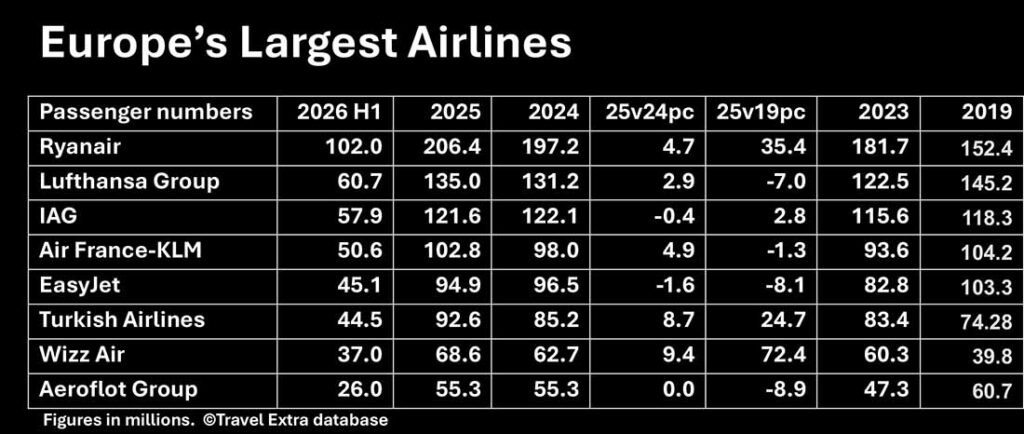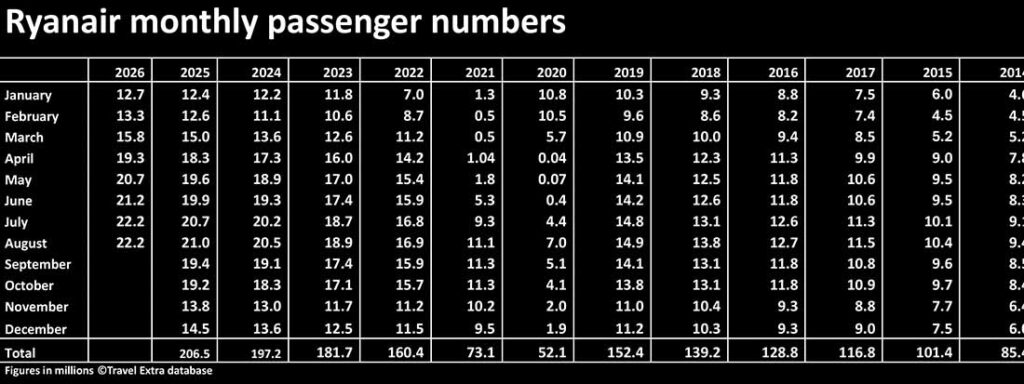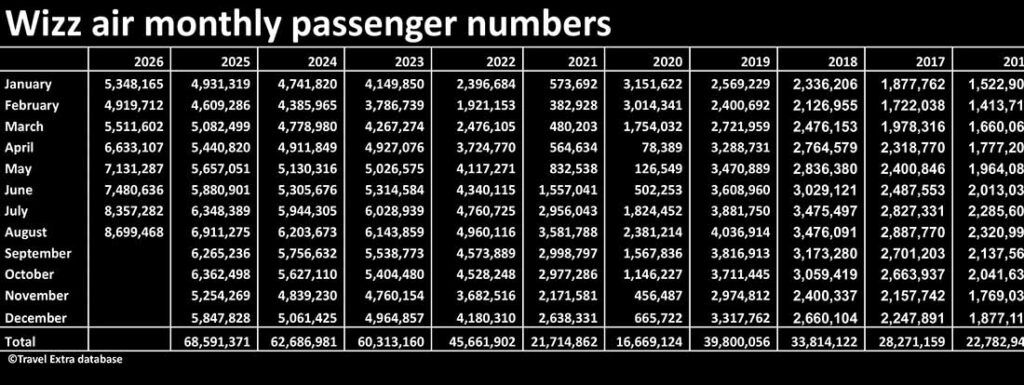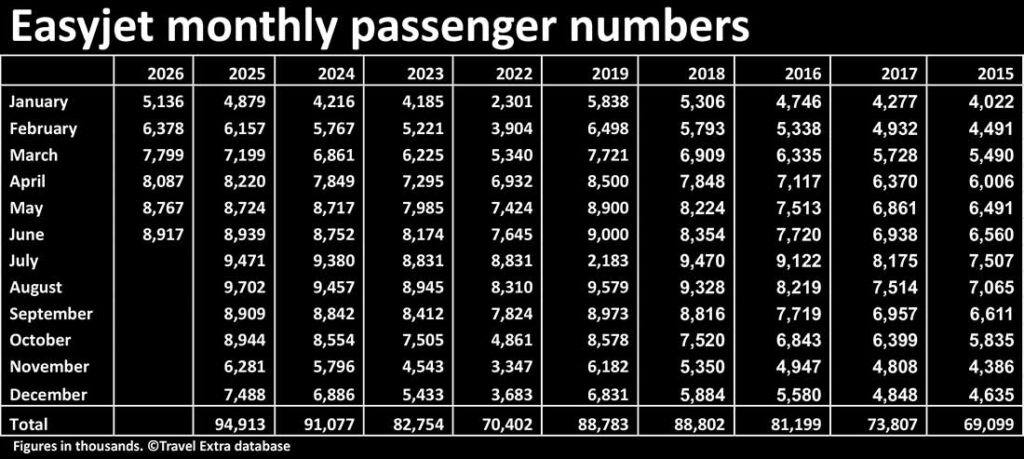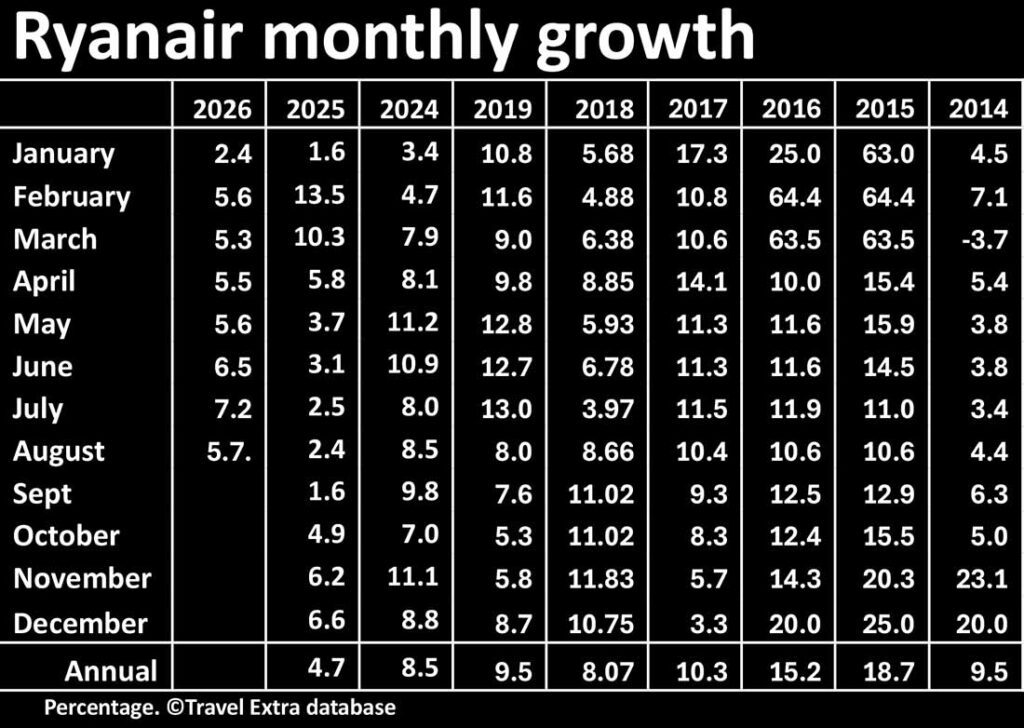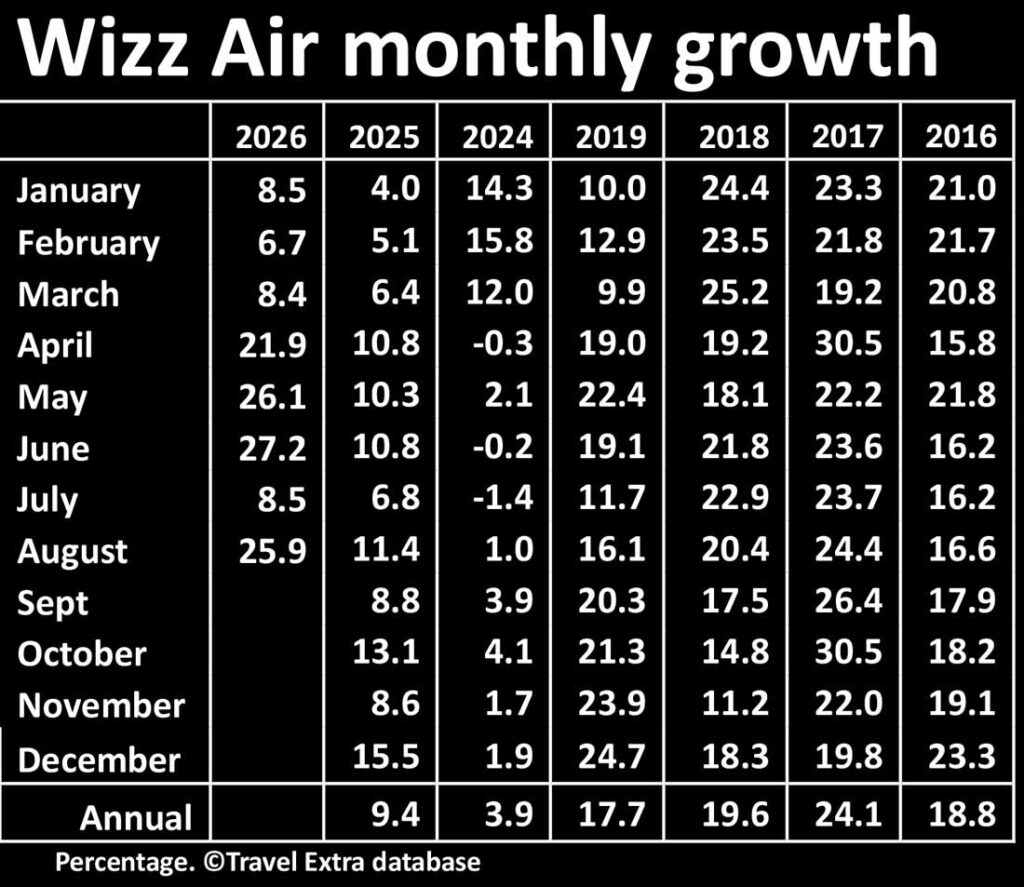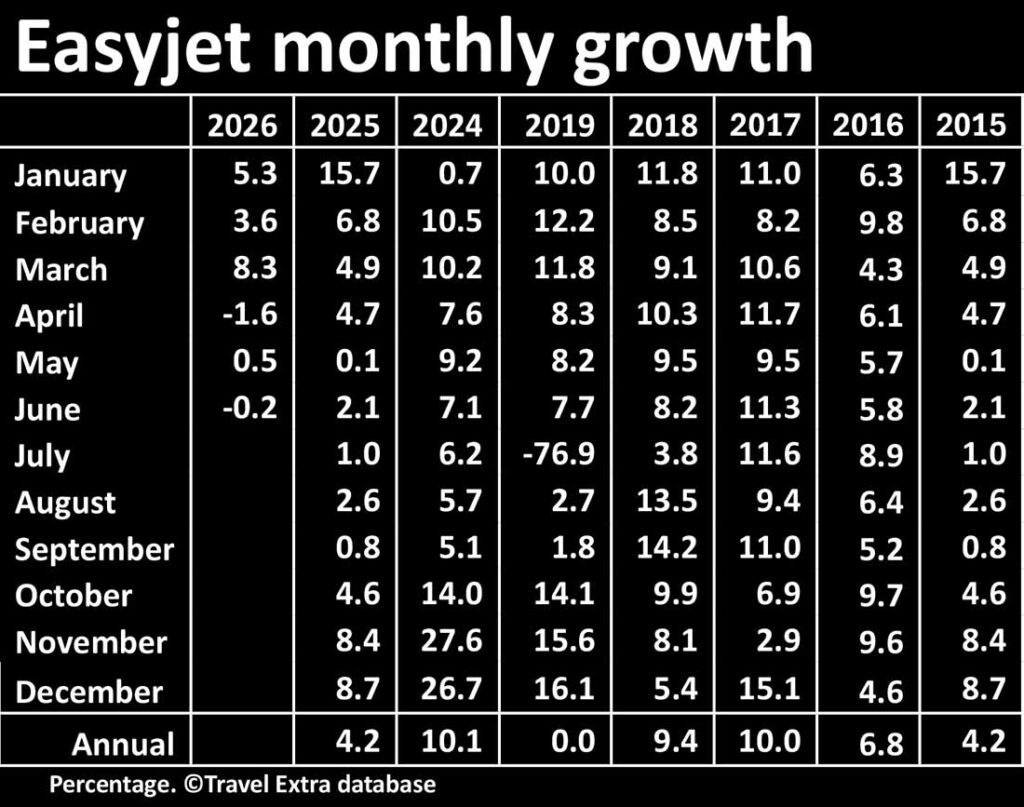
Roll over Ryanair, Wizz are the fastest growing airline in Europe. Their July passengers numbers 8,357,282 are 31.6pc ahead of July 2025 and 115.3pc ahead of pre-pandemic. They are opening more new routes than Ryanair this summer. While Ryanair is more than twice as large, 22.2m in July and over 100m for the first six months of the year, as opposed to around 45m for Wizz, and still growing at 7pc ahead of July 2025 and a substantial 50pc ahead of pre-pandemic levels, it has reasons to keep an eye on its Hungarian rival. The unit cost at Ryanair, usually the lowest in the business, is well below that of legacy flag carrying airlines but not far ahead of Wizz. The airports with which it deals have an alternative carrier with which to do business. Easyjet, subject of a takeover bid, has been stranded in a no-growth quagmire since Brexit and has not regained its pre-pandemic levels.
The contrast in balance sheet strength forms one of the clearest dividing lines between the two carriers. Ryanair operates from a position of exceptional financial resilience. The Irish airline has eliminated long term debt obligations on its core fleet and holds substantial cash reserves that allow it to weather fuel price spikes and geopolitical shocks without external pressure. This fortress balance sheet supports aggressive capacity decisions and underpins its ability to sustain lower fares for longer periods. Wizz Air maintains respectable liquidity with total cash of more than €2.1bn at the end of its last financial year, a clear improvement on the prior period. The Hungarian carrier repaid a maturing €500m bond from internal resources and reduced its leverage ratio from 4.4 times to 3.7 times EBITDA. Liquidity ratios improved to nearly 36pc. Even so the absolute scale of Ryanair’s cash position and the absence of meaningful net debt create a structural advantage that Wizz cannot match in the short term. In periods of rising oil prices or sudden demand weakness the larger carrier retains greater freedom to protect market share while the smaller operator must manage cash more carefully.
Fleet ownership structures reinforce this financial gap. Ryanair has long pursued a policy of owning the bulk of its Boeing 737 fleet. More than 600 aircraft sit on its balance sheet free of lease obligations, giving the group control over residual values, maintenance scheduling and financing costs. Ownership reduces ongoing cash outflows and allows the airline to capture the full benefit of residual asset values over time. Wizz Air follows a different model. The majority of its Airbus A320 family fleet, now standing at 262 aircraft, is held under operating leases or sale and leaseback arrangements. This approach conserves capital for growth and provides flexibility to adjust fleet size, but it generates continuous lease payments that form a fixed cost base. Recent years have seen Wizz complete large numbers of sale and leaseback transactions to support deliveries while managing cash. The strategy works well when growth is strong and residual values remain stable, yet it leaves the carrier more exposed to lessor negotiations and interest rate movements than a pure ownership model. Ryanair’s owned fleet therefore continues to deliver a cost advantage that is difficult for a leasing dependent competitor to close fully.
Base strategy reveals diverging approaches to network development. Ryanair has systematically withdrawn capacity from high tax or high cost markets in recent years. Austria, Belgium, Germany and parts of regional Spain have seen reductions as the airline reallocates scarce aircraft to destinations that offer better returns and lower charges. New bases have opened in Albania, Morocco and Italy where incentives and lower costs support expansion. The policy is deliberate. Ryanair treats airports and governments as partners only when terms remain competitive. Wizz Air, by contrast, continues to open new bases and add aircraft in markets that Ryanair has treated more cautiously. Fresh bases in Madrid and Valencia are scheduled to open in November with domestic Spanish routes attached. A new base in Prishtina, Kosovo, will also begin operations with an A321neo and additional routes. Capacity continues to flow into Central and Eastern European cities as well as selected western European points where yields have improved. The Hungarian carrier’s willingness to expand in Spain and the Balkans while Ryanair trims elsewhere creates direct competition at airports that previously dealt primarily with one dominant low cost operator. Airport managers now possess a genuine alternative when negotiating charges or schedule preferences.
Unit costs remain the ultimate battleground. Ryanair has historically posted the lowest cost per passenger among European airlines through high aircraft utilisation, dense seating, secondary airport use and rigorous control of distribution expenses. Recent figures continue to show cost per booked passenger in the low sixty euro range. Wizz Air operates with unit costs that sit close behind. Its ex fuel CASK has remained competitive even after engine related disruptions and temporary groundings. The younger average fleet age of Wizz aircraft, currently under five years, helps contain maintenance and fuel burn. High density configurations and a focus on high growth, price sensitive markets further support low unit costs. The gap between the two carriers has narrowed sufficiently that many airports and route opportunities can sustain both operators. When Wizz can match or undercut Ryanair’s cost base on a given route the larger carrier loses its traditional ability to price competitors out of the market. The result is more sustained competition on fares and frequencies than Ryanair has faced from any pure low cost rival in more than a decade.
The operational contrast extends to growth rates. Wizz Air’s July passenger total of 8.36m represented a 31.6pc year on year increase, far ahead of Ryanair’s 7pc rise to 22.2m. Capacity at Wizz expanded by more than 30pc while load factor improved to 93.7pc. Ryanair’s load factor held steady at an industry leading 96pc, reflecting mature network density rather than rapid expansion. Over a rolling twelve month period Wizz carried 76m passengers, up 16pc, while Ryanair exceeded 213m. Absolute scale still favours the Irish carrier by a wide margin, yet the differential in growth rates means Wizz is closing the gap in absolute passenger numbers more rapidly than at any previous stage of its development. New route launches this summer further accelerate the process. Where Ryanair has become more selective about additional frequencies, Wizz continues to add services at a pace that challenges established schedules.
Easyjet’s prolonged stagnation provides additional context. The British carrier has failed to regain pre pandemic passenger levels and remains the subject of takeover speculation. Its cost base and network profile leave it less able to compete on pure price in the core low cost segment. Ryanair therefore faces a landscape in which the only credible challenger for the title of Europe’s most aggressive low cost operator is Wizz Air. The Hungarian airline’s expansion into western European markets previously dominated by Ryanair and its ability to open bases in secondary cities create pressure that did not exist when Easyjet was the primary rival two decades ago.
Liquidity differences will influence how each carrier responds to the next downturn. Ryanair’s cash reserves and debt free status allow it to absorb temporary losses on new routes or to maintain capacity during weak demand periods. Wizz must balance growth against the need to protect its €2.1bn cash position and manage lease obligations. Ownership versus leasing shapes residual risk and residual reward. Ryanair captures asset appreciation and residual value; Wizz transfers that risk to lessors in exchange for lower capital intensity. Base decisions reflect different risk appetites. Ryanair exits high cost environments; Wizz enters markets that offer volume growth even if yields are modest. Unit costs remain close enough that neither carrier can ignore the other on overlapping routes.
The competitive dynamic has shifted from one of clear hierarchy to one of mutual observation. Airports that once negotiated primarily with Ryanair now entertain parallel proposals from Wizz. Route opportunities that previously attracted only the larger carrier now face dual interest. Passengers benefit from the presence of two operators with comparable cost structures and aggressive growth ambitions. Regulators and governments gain additional leverage when discussing charges or incentives. For Ryanair the challenge is to defend market share without sacrificing the cost discipline that built its position. For Wizz the task is to convert rapid passenger growth into consistent profitability while managing a largely leased fleet and a more leveraged balance sheet.
Both carriers continue to add capacity for the remainder of the summer and into the winter schedule. Ryanair’s rolling twelve month total exceeds 213m passengers while Wizz approaches 76m. The absolute difference remains large, yet the trajectory of growth rates suggests that the gap will narrow further if current trends persist. Fuel price volatility, engine supply constraints and geopolitical uncertainty will test both models. Ryanair’s ownership structure and liquidity provide a buffer. Wizz’s younger fleet and rapid network expansion offer operational flexibility. The outcome will depend on which carrier better manages the trade off between growth and cost control in the years ahead.
Ryanair’s dominance of European aviation is set to continue, not retreat. But, for the first time since the hey day of Easyjet in the mid 2000s, it looks like getting a serious rival in the low cost market.