
- New estimated cost of Dublin metro rail system brought to Cabinet
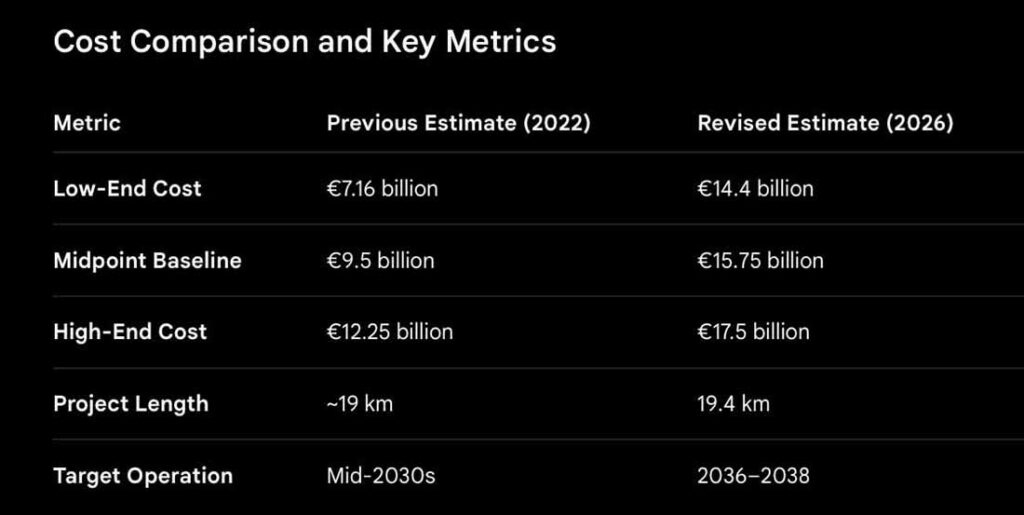
- Previous estimate in 2022 was €9.5 billion
- Route links Swords and Dublin Airport to city centre and Ranelagh
- Work could begin next year with operation in mid to late 2030s
- Project one of nine of critical national importance
Dublin’s MetroLink project is now estimated to cost between €14.4 billion and €17.5 billion, with a central midpoint baseline of €15.75 billion, following Cabinet approval to move the project to the tender phase announced by Transport Minister Darragh O’Brien.
The updated cost estimates more than double the initial minimum projections from four years ago, driven largely by construction inflation and refined design requirements.
The 19.4km fully automated underground and elevated rail line will run from Swords in north Dublin, through Dublin Airport, to Charlemont Street in the south city centre.
Primary factors causing the cost overrun and revised estimates include global and local increases in the price of building materials, labour, and general inflation over recent years have substantially pushed up projected infrastructure costs. Developing a far more detailed and comprehensive technical specification for the 18.8km underground rail line allowed planners to identify and account for previously hidden or under-budgeted costs with greater accuracy.
Additional financial buffers and contingencies have been factored in to protect the project against unforeseen events and “unknown unknown” long-term risks. Decades of planning delays, political changes, and prolonged legal and approval processes have compounded overall expenditure over time.
Trains are designed to operate at three-minute peak intervals, carrying up to 20,000 passengers per hour in each direction. Tte government approval allows Transport Infrastructure Ireland to issue formal tenders to the market to lock in actual delivery costs.
Final construction contracts and precise cost figures are expected to return for government approval in late 2027, with initial advance works and construction aiming to begin next year and passenger services starting between 2036 and 2038.
Related posts:
 Alaska Airlines reveals Seattle routes to Athens and Paris for summer 2027
 ERAA general assembly to bring aviation leaders to Belfast in October
 Wizz Air record growth continues as it plans 10th Romanian base at Brașov
 i6 Group signs partner to deploy eHandshake digital refuelling platform across operations