
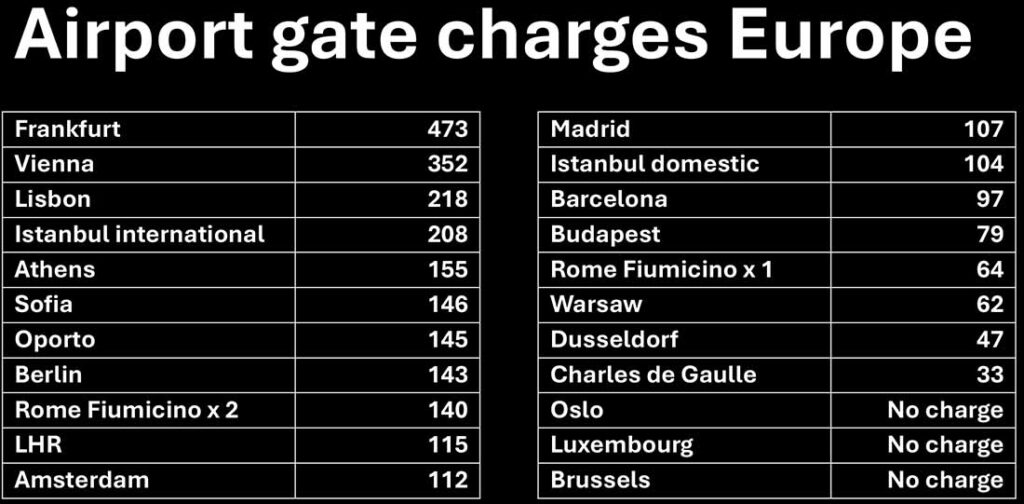
- Boarding bridge charges have ranged from under €40 to well above €400 per hour across European airports.
- Frankfurt has recorded €473, Vienna €352, Lisbon €218 and Istanbul’s international terminal €208.
- Istanbul’s domestic terminal has recorded an exceptionally high figure of €1,104.
- Oslo, Luxembourg and Brussels have imposed no extra charge for boarding bridge use.
- Ownership structure, regulatory frameworks, capacity constraints, competitive dynamics and historical pricing practices have all contributed to the observed range.
Air bridge, jet-bridge, ramp, it all means the same thing. But how much it costs can vary enormously form airport to airport.
The terminology applied to the fixed walkway connecting an aircraft door to a terminal building ranges from jet bridge through passenger boarding bridge to contact stand, and the charges levied for its use display extreme divergence from one European airport to another. The equipment performs an identical function and delivers an experience that appears largely the same to passengers, yet the hourly rate for a sixty-minute period of use can range from under €40 to well above €400 according to the airport in question.
Aviation remains subject to extensive regulation, but pricing for this comparatively standardised piece of infrastructure shows little consistency, even among airports located inside the same national borders.
The factors that produce such divergence invite examination: local market conditions, patterns of airport ownership, the particular regulatory framework in force, constraints on capacity, or simply the persistence of long-established charging conventions. For airlines intent on controlling expenditure, a clear grasp of the economics that underpin these airport charges continues to hold practical value.
Frankfurt tops the chart
The figures assembled for a representative sample of European airports illustrate the scale of the disparity with striking clarity. Frankfurt records a charge of €473, Vienna stands at €352, Lisbon at €218 and Istanbul’s international terminal at €208. Athens follows at €155, Sofia at €146, Porto at €145 and Berlin at €143. Rome’s Fiumicino applies €140 when two boarding bridges are required and €64 when only one is used.
London Heathrow sits at €115, Amsterdam at €112, Madrid at €107 and Istanbul’s domestic terminal at the exceptionally high figure of €1104. Barcelona charges €97, Budapest €79, Warsaw €62, Düsseldorf €47 and Paris Charles de Gaulle a comparatively modest €33. Oslo, Luxembourg and Brussels impose no extra charge at all. These numbers, expressed uniformly in euros, confirm that the cost of an essentially similar service can differ by a factor of more than ten and, in the case of Istanbul’s domestic operation, by a still wider margin.
Such variation cannot be explained by differences in the physical design or operational performance of the bridges themselves. Modern passenger boarding bridges are manufactured by a limited number of specialised suppliers and conform to broadly comparable technical standards. The service they provide, the protection of passengers from weather and the facilitation of rapid embarkation and disembarkation, remains constant. The price differences therefore arise from the commercial and institutional environment in which each airport operates rather than from any intrinsic variation in the asset.
Ownership structure supplies one important line of inquiry. Airports under full or majority public ownership often operate under statutory obligations that limit the freedom to set charges at purely commercial levels. In several cases the airport authority must recover costs according to a transparent and regulated formula that includes depreciation, maintenance and a regulated return on capital. Where private capital holds a controlling interest, the incentive to maximise revenue from every available source, including airside infrastructure, tends to be stronger.
Frankfurt and Vienna, both of which record elevated charges, have undergone partial privatisation in recent decades and now pursue more explicitly commercial strategies. By contrast, airports that remain wholly within the public sector or that operate under tightly constrained concession agreements frequently display lower or even zero incremental charges for bridge use.
Regulatory frameworks exercise a further influence. In some jurisdictions the national aviation authority or an independent economic regulator scrutinises and approves airport charges, requiring that they reflect efficiently incurred costs and that any surplus be justified by investment programmes or service quality improvements.
Elsewhere the regulatory approach is lighter, allowing airports greater latitude to set prices according to demand and competitive position. The absence of a uniform European methodology for the allocation of airside infrastructure costs contributes to the observed inconsistency. While the European Union has established common rules on airport charges in principle, the practical application of those rules leaves considerable discretion to member states and to individual airport operators.
Congested hubs
Capacity constraints and the intensity of competition among airlines also shape pricing decisions. At airports where gate availability is scarce relative to demand, the ability to secure a contact stand becomes a valuable privilege for which carriers are prepared to pay a premium. Congested hubs can therefore sustain higher charges without immediate loss of traffic.
Airports that face stronger competition from neighbouring facilities or that serve markets with more elastic demand for air travel tend to moderate their charges in order to remain attractive to airlines. The zero incremental charges recorded at Oslo, Luxembourg and Brussels may reflect a deliberate policy of simplifying the tariff structure or of absorbing bridge costs within broader landing or passenger fees in order to enhance competitiveness.
Historical pricing practices introduce an additional layer of complexity. Many airports inherited charging schedules that were established decades earlier and that have been adjusted only incrementally. Once a particular structure becomes embedded in airline contracts and in the internal accounting systems of both the airport and its airline customers, radical revision becomes administratively and politically difficult. Incremental indexation or periodic reviews may preserve relative differentials even as absolute levels rise with inflation and investment. The persistence of such historical patterns helps to explain why airports of similar size and traffic mix can still display markedly different bridge charges.
For airlines the financial implications are material. A carrier operating multiple daily rotations at a high-charging airport can incur tens of thousands of euros in additional costs over the course of a year solely for the use of boarding bridges.
These costs feed directly into unit cost calculations and influence decisions about network structure, aircraft utilisation and the choice of operating bases. Low-cost carriers, whose business models depend on rigorous control of every cost element, are particularly sensitive to such differentials and may favour airports that offer lower or zero incremental bridge charges. Full-service network airlines, while less constrained on a unit-cost basis, still monitor these expenses closely as part of broader efforts to protect margins in a competitive market.
No hamronisation
The data also reveal interesting intra-airport variations. Rome’s Fiumicino applies a substantially higher charge when two bridges are required than when only one is used, recognising the greater allocation of scarce gate resources. Istanbul’s domestic terminal stands out with a charge many times higher than its international counterpart, a disparity that may reflect differences in demand elasticity, regulatory treatment or the internal cost-allocation methods employed by the airport operator. Such internal distinctions demonstrate that even within a single airport the pricing of boarding bridges can be calibrated according to specific operational or commercial considerations.
Looking across the sample, no single variable accounts fully for the observed range. High charges appear at both large hub airports and smaller facilities; low or zero charges appear at both major international gateways and regional airports. Ownership, regulation, capacity and history interact in ways that produce outcomes unique to each location.
The lack of pan-European harmonisation in the treatment of airside infrastructure charges means that airlines must continue to negotiate and manage these costs on an airport-by-airport basis.
The broader economic context reinforces the importance of the issue. Fuel prices, labour costs and aircraft ownership expenses remain the dominant components of airline operating costs, yet infrastructure charges represent a controllable element that can be influenced through network planning and contractual negotiation. As carriers refine their cost structures in response to competitive pressures and evolving passenger demand, detailed knowledge of the pricing of even relatively minor services such as passenger boarding bridges retains practical significance.
Fragmented market
In examining the figures, it becomes apparent that the market for airport infrastructure services remains fragmented.
While aircraft themselves, air traffic management procedures and many aspects of passenger processing have converged around common standards, the commercial terms attached to the use of fixed airside assets continue to reflect local circumstances. Whether this diversity ultimately benefits or hinders the efficiency of the European aviation system is a matter for further debate. What is clear from the evidence is that the cost of a standardised service can still vary by an order of magnitude according to the airport at which it is consumed.
Airlines and airport operators alike therefore have reason to maintain close attention to the structure and level of these charges. For the former the objective is cost control and network optimisation; for the latter the objective is the recovery of investment and the generation of returns consistent with ownership expectations and regulatory constraints.
The interaction of these objectives produces the wide spectrum of prices documented across the continent. Understanding the forces that sustain that spectrum remains an essential element of informed decision-making in European aviation.
The pattern revealed by the data also raises questions about transparency. In several cases the precise methodology used to calculate bridge charges is not fully disclosed in publicly available tariff documents. Airlines may therefore find it difficult to anticipate future adjustments or to benchmark one airport against another with complete accuracy. Greater clarity in the presentation of cost-allocation principles and in the justification of specific charges would assist both carriers and regulators in assessing the reasonableness of the prices applied.
Capacity planning
Capacity planning decisions further complicate the picture. Airports that invest heavily in additional contact stands in anticipation of traffic growth may seek to recover those capital costs through higher usage fees. Conversely, airports that elect to expand remote stands and rely more heavily on bus transfers may keep bridge charges low or eliminate them altogether. The strategic choices made by airport management regarding the mix of contact and remote stands therefore feed directly into the pricing of the bridges that are provided.
Labour and maintenance costs associated with the operation of boarding bridges also differ across locations. Wage levels, the intensity of utilisation, climatic conditions that affect wear and the age of the installed equipment all influence the underlying cost base.
Airports in higher-wage economies or those subject to more severe weather may incur greater expenses in keeping bridges serviceable, and these expenses can be reflected in the charges levied on airlines. The data do not isolate these cost elements, yet they form part of the broader explanation for the observed price dispersion.
Competitive dynamics among airports serving overlapping catchment areas introduce still another consideration. Where passengers and airlines can readily choose between alternative departure points, the pressure to maintain competitive total airport charges is stronger.
In such circumstances an airport may elect to absorb the cost of boarding bridges within other fee categories or to set the incremental charge at a deliberately low level. Airports that enjoy a stronger competitive position by virtue of location, connectivity or the absence of nearby rivals face less immediate pressure and may sustain higher specialised charges.
Monopoly pricing
The regulatory principle of cost-relatedness, where it is applied with rigour, should in theory limit the extent of pure monopoly pricing. In practice the determination of efficiently incurred costs, the allocation of common costs across different aeronautical services and the calculation of an appropriate return on capital leave room for judgement.
Different regulators and different airport operators reach different conclusions, and the resulting charges diverge accordingly. The figures for Frankfurt, Vienna and Istanbul’s domestic terminal sit at the upper end of the range, while the zero charges at Oslo, Luxembourg and Brussels occupy the opposite extreme. Between these poles lies a continuum of intermediate prices that reflect the particular balance of commercial ambition, regulatory oversight and historical precedent at each site.
For the travelling public the direct effect of these pricing differences is limited, since the charges form only a small component of the overall airport cost recovered through air fares and passenger service charges. Indirectly, however, the cumulative impact on airline costs can influence route economics, frequency decisions and the choice of aircraft type. Over time such effects can shape the pattern of air services available at different airports and, by extension, the connectivity options open to passengers.
The analysis of boarding-bridge pricing therefore forms part of a wider examination of airport economics. Landing fees, passenger charges, cargo handling rates and the commercial terms for ground-handling services all exhibit their own patterns of variation.
The boarding bridge serves as a particularly clear illustration because the service is discrete, easily measured and functionally identical across locations. The wide range of prices attached to it confirms that even in a mature and regulated industry the commercial treatment of standardised infrastructure can remain highly localised.
Rising prices
As European aviation continues to recover and to adapt to changing patterns of demand, the attention paid by airlines to every element of airport cost is unlikely to diminish. The data presented here supply a concrete basis for that attention. They show that the hourly cost of a passenger boarding bridge can differ by hundreds of euros according to the airport at which the aircraft is parked.
They further show that the reasons for those differences are multiple and interrelated. Ownership form, regulatory design, capacity conditions, competitive pressures and historical charging conventions all contribute to the outcome observed at each location.
Recognition of this complexity is a necessary starting point for any airline seeking to manage its exposure to airport infrastructure charges and for any policymaker concerned with the efficiency and transparency of the charging system as a whole.
Related posts:
 Milan Malpensa airport passenger numbers up 8.6pc in first six months of 2026
 ANALYSIS: How Europe’s hotel developers are turn to conversions rather than new-builds
 AirNav Ireland director discusses record traffic levels and future recruitment
 ANALYSIS: How river cruise companies are responding to low water levels on the Danube and Rhine