Swords into ploughshares, or should that be plough shares? On a normal Tuesday in September, Philip O’Brien, General Manager of the Tullamore Court Hotel would be preparing to seat a couple of dozen guests. This week is different.
“Everyone needs to be fed before 6am this week. They all have their jobs to do, whether it be judging, officiating or directing traffic, so our job is to make sure they’re fed and out the door as soon as possible in the morning. Then in the evenings, you are feeding the masses again. During the ploughing, we’re feeding around 200 a night, when normally it would be a fraction of that.”
The ploughing boom extends beyond breakfast rolls and beyond the immediate hinterland of Tullamore, he says. “Our accommodation will be 100pc full for four days this week, and in the surrounding 30-40 miles it will be the same, It is not just this week either, from eight to ten weeks before the ploughing, demand for accommodation is building with workers getting the site ready. They’re stopping off in local shops, getting their snacks, their lunch, their dinner, it has a huge knock-on effect.”
The National Ploughing Championships generates an estimated €50m in direct economic value for the Irish economy each year. As Europe’s largest outdoor agricultural trade exhibition, the three-day event brings massive financial benefits to both the local host region and the wider national agri-business sector. Local businesses, including hotels, B&Bs, restaurants, pubs, and service stations, experience a dramatic surge in trade. With approximately 300,000 visitors attending the event annually, millions of euro are poured directly into the local host area over just three days.
On the trade floor, machinery stands serve as the main attraction. Millions of euro change hands through commercial farm vehicle and equipment transactions. Past economic studies reveal that trade purchases and personal retail shopping alone generate tens of millions of euro in revenue. The event serves as a launchpad for global trade. Deals brokered via Enterprise Ireland frequently drive millions of euro in international export sales. The event costs 6.5m to host and 1,700 trade stands bring a small army of workers who stay in the region for weeks in advance of the eventitself.
Attended by 3pc of population
The attendance of 243,000, 77,000 ,91,000 75,000 on each the three days, was 18,000 more than last year, 225,500. Using cruise data, the ploughing was attended by just over three per cent of the population or one in every 27 people on the island, although allowance should be made for repeat attendance.
Independent assessments place the overall economic contribution of a single championship at more than €50m with earlier estimates ranging as high as €70m to €80m. These sums flow into accommodation providers retail outlets catering establishments transport operators and agricultural suppliers across Offaly and neighbouring counties.
Local hotels report near total occupancy for the duration of the championships and for several weeks beforehand as contractors and exhibitors arrive to prepare the site. The Tullamore Court Hotel and other properties within a radius of 30 to 40 miles fill every available room.
This surge extends the benefit period well beyond the three main days of competition and exhibition. Public houses restaurants and service stations in Tullamore and surrounding villages record sharp increases in custom. Staff levels rise temporarily to meet demand creating short-term employment opportunities for residents of the hinterland. The injection of visitor spending supports cash flow for businesses that might otherwise experience quieter periods in the autumn calendar.
Trade stand bonanza
Trade stands number more than 2000 and occupy roughly 150 acres of the site. Exhibitors from across Ireland and beyond display machinery livestock products and services. Transactions conducted on the ground generate substantial turnover for participating firms. Historical studies of earlier championships indicated trade purchases exceeding €9.6m in a single year alongside personal shopping of more than €7m and food expenditure of a similar order.
Local suppliers of materials fuel and catering services secure contracts linked to the construction of the temporary infrastructure which includes 31 kilometres of trackway 51 kilometres of electric cable 20.5 kilometres of water pipe and 20 kilometres of broadband cabling.
Fifteen generators supply power equivalent to that required by a town the size of Clonakilty. These requirements create demand for regional contractors and labour.
Midlands explosure
The hinterland gains from the visibility conferred by national media coverage. Every major news bulletin references Screggan and County Offaly during the championship week. Tourism bodies capitalise on this exposure through dedicated pavilions funded by Offaly County Council. More than 20 local businesses occupy stands in the Experience Offaly area where they present products and services to a national audience. Information points staffed by volunteers promote attractions throughout the county. Economic development stands draw attention to strengths in green energy battery storage and related technology projects.
The cumulative effect positions the midlands as a destination for future investment and leisure visits that continue after the temporary structures are dismantled.
Employment effects extend to temporary staff volunteers and stewards whose numbers exceed 2000. Many of these roles are filled by people living in Offaly and adjacent counties.
Ploughing Association accounts
The National Ploughing Association itself operates without government subsidy and incurs annual staging costs of more than €7m. Recent financial statements for the association revealed a post-tax loss of €150926 for the year ended January 2025 after turnover of €5.961m.
The previous year produced a profit. Despite the operating shortfall the association maintains retained earnings of approximately €11.78m providing a buffer that supports continuity.
Ticket prices for 2026 include advance adult rate of €30 and a gate rate of €35 reflecting a €5 increase driven by rising contractor costs linked to minimum wage adjustments and pension requirements. The venue for 2027 has not yet been announced, but the event has been put back a week so as not to coincide with the Ryder Cup at Adare.
Supplier incentives
Agricultural suppliers benefit from direct engagement with farmers who attend in large numbers. Machinery demonstrations and livestock competitions facilitate sales and knowledge transfer. Secondary school students form a substantial portion of the audience with tens of thousands attending in recent years.
Their presence introduces a younger demographic to the sector and supports educational stands. Food and drink outlets on site and in the surrounding towns capture expenditure from both day visitors and those staying overnight.
Historical data from a University College Dublin study of an earlier championship recorded total visitor spending of €36m over three days with a corresponding tax contribution of more than €6.6m to the exchequer. Adjusted for inflation and higher attendance the current contribution is proportionally larger.
Killed the RDS spring show
Infrastructure pressure remains a practical consideration. The sheer volume of machinery to be conveyed in and out of the locality is a challenge, one that saw the demise of the RDS Sporing Show in 1992 after 160 years and a drastic reduction in the agricultural elements of the Dublin Horse Show.
Traffic management by An Garda Síochána has received consistent praise for maintaining orderly movement into and out of the site. Shuttle services from Tullamore and Portarlington railway stations reduce reliance on private cars.
Road improvements and temporary measures absorb the additional volume without permanent disruption to daily life in the hinterland. Once the event concludes the land returns to agricultural use with minimal lasting physical alteration. The economic residual however persists through enhanced business networks and heightened awareness of regional capabilities.
Laois v Offaly
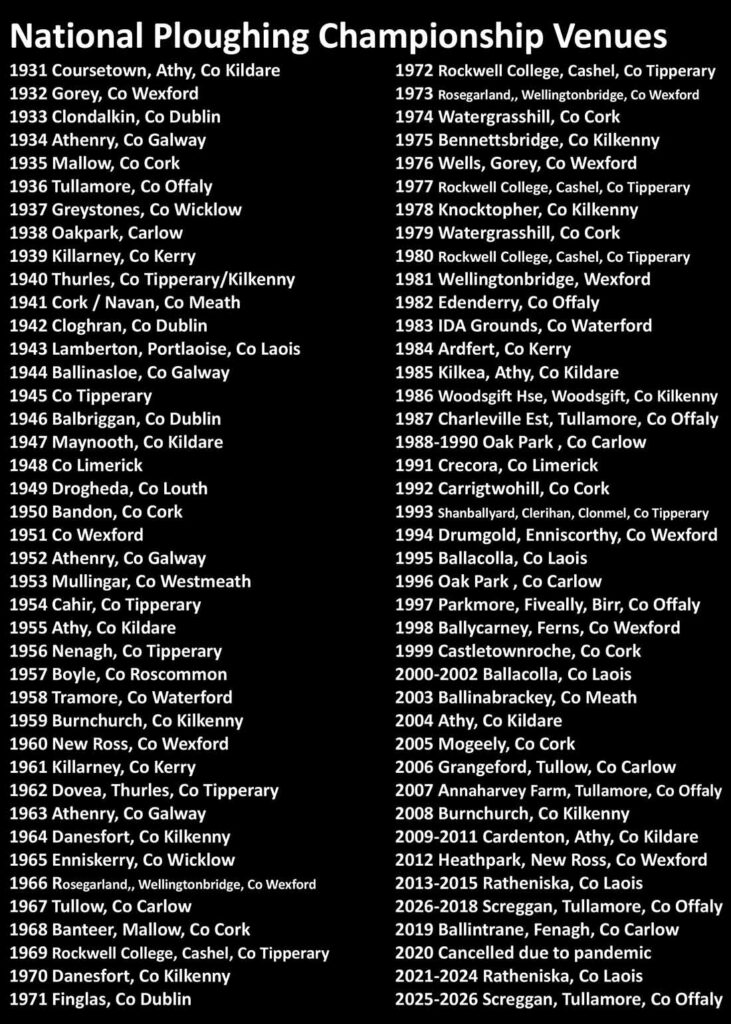
Comparisons with previous host locations illustrate the pattern of benefit. When the championships were held in Ratheniska County Laois attendance reached 244,000. The shift to Screggan produced a modest reduction in 2025 yet local operators still reported strong trading conditions.
The central location of Screggan relative to the national road network facilitates access from multiple provinces and maximises the geographic spread of visitor origin. Eighty per cent of attendees typically travel from outside the immediate locality according to earlier research. This external inflow constitutes pure additionality for the host hinterland rather than a redistribution of existing local spending.
Longer-term effects include the potential for repeat visits. Visitors who first encounter Offaly through the championships may return for other attractions or recommend the area to others. The Experience Offaly pavilion and related tourism stands actively cultivate this outcome.
Agricultural businesses that secure orders at the event often maintain subsequent commercial relationships. The concentration of decision-makers policymakers and industry representatives creates informal networking opportunities that can influence investment decisions months or years later.
A voluntary body
Cost pressures on the National Ploughing Association underline the voluntary nature of the organisation. It operates as a not-for-profit company limited by guarantee and relies on ticket sales exhibitor fees and commercial partnerships. The absence of state funding means that the full economic multiplier generated by the championships accrues to the host region and the wider national economy without offsetting public expenditure.
Rising operational costs have led to the confirmed ticket price adjustment for 2026 yet the association has indicated that reserves remain sufficient to sustain the event for the foreseeable future.
The hinterland of Screggan and Tullamore therefore experiences a concentrated pulse of economic activity that elevates turnover employment and profile for a defined period each year. Accommodation providers record full occupancy. Retail and hospitality outlets register elevated sales.
Local contractors secure infrastructure related work. Tourism and enterprise promotion receive national exposure. The scale of the temporary population on site approaches that of a small town and the associated spending circulates through regional supply chains. While the precise distribution of the €50m-plus impact varies with weather attendance and broader economic conditions the consistent pattern of benefit is clear from successive host communities.