
Air Transit were here in 2014, Air Canada were her in the compulsory stopover days and again in 2017-18,. The route even attracted Flyglobespan, which collapsed so spectacularly even before the global financial recession had struck.Is Shannon’s route to Toronto a stayer this time round?
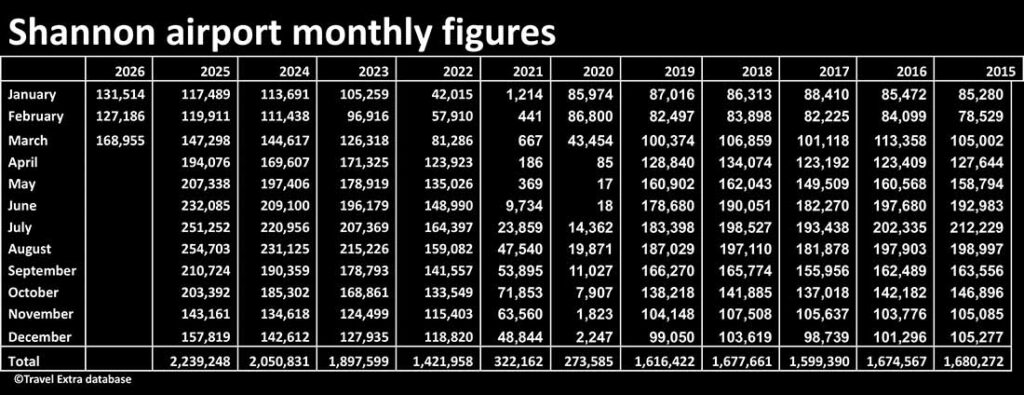
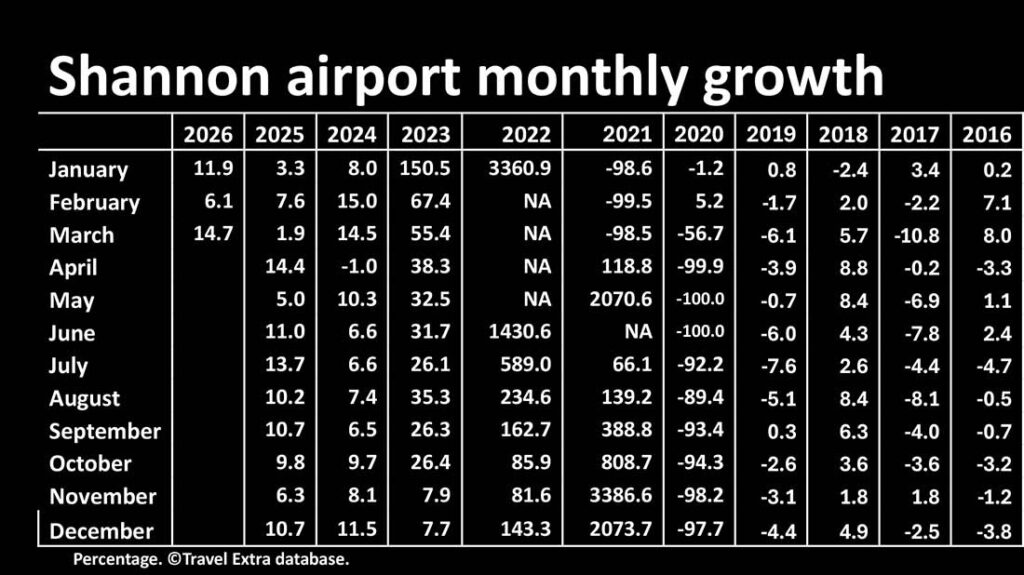
The question of a sustainable air link between Shannon Airport and Toronto Pearson has occupied route planners, airport managers and regional politicians for more than a decade. Previous services, operated mainly by Air Canada on a seasonal basis with Boeing 737 MAX aircraft between 2017 and 2019, and earlier experiments with other equipment, all ultimately proved short-lived. Load factors fluctuated, yields remained under pressure and the economics of operating a relatively large aircraft on a thin long-haul route repeatedly failed to deliver consistent returns.
The arrival of the Airbus A321XLR into airline fleets across Europe and North America has reopened the discussion with fresh technical and commercial parameters that earlier generations of aircraft simply could not offer. Shannon Airport’s strategic position on the western seaboard of Ireland has always made it an attractive technical stop and a potential origin for transatlantic traffic from the west and south of the country. The large Irish diaspora concentrated in the Greater Toronto Area provides a ready-made visiting friends and relatives market, while Canadian tourists seeking access to the Wild Atlantic Way and the west of Ireland form a complementary leisure flow. Business traffic, though smaller, exists through corporate links in technology, pharmaceuticals and agrifood.
Absolute volume of point-to-point demand has historically fallen short of the threshold required to fill a wide-body aircraft year-round or even for a full summer season without aggressive pricing that eroded margins. Limerick and Galway’s combined population is too small to support a viable outbound trans Atlantic operation. Most airlines operate 80-20 or 70-30 outbound inbound balances. It means higher fares =, and works when one side of the conomy is stronger to sustain it.
The B737 solution
Air Canada’s 2017-18 seasonal operation used the 737 MAX under ETOPS regulation, an efficient narrow-body by the standards of the late 2010s, but one still constrained by range and payload when fully loaded on a sector of approximately 5,000 kilometres against prevailing westerly winds.
Payload restrictions in summer heat or with strong headwinds forced the airline to leave seats empty or limit cargo, undermining the unit cost advantage the aircraft was supposed to deliver. When the global grounding of the MAX fleet arrived and was followed by the collapse in travel demand during the pandemic, the route disappeared from schedules and has not returned on a scheduled non-stop basis.
Aer Lingus has concentrated its Canadian flying on the thicker Dublin-Toronto market, deploying a mix of A330 and more recently A321LR and A321XLR aircraft on that denser city pair, leaving Shannon without a direct Canadian link.
A321XLR a game changer
The A321XLR changes the arithmetic. With a design range of up to 4,700 nautical miles in a typical two-class configuration of around 180 to 200 seats, the aircraft is capable of operating Shannon-Toronto with meaningful payload even under adverse wind conditions. Fuel burn per seat is substantially lower than that of the previous generation of wide-bodies that once served thinner North Atlantic routes. The single-aisle layout also allows airlines to right-size capacity to actual demand rather than forcing traffic into a 250 or 300-seat aircraft that must be filled through heavy discounting. For an airport such as Shannon, where catchment is strong in the west but smaller overall than Dublin’s, this capacity match is critical. Operational flexibility is another advantage.
The A321XLR can be rostered across a mixed network of medium-haul European and longer transatlantic sectors, improving aircraft utilisation. Airlines that have ordered the type, including Aer Lingus and Air Canada, can therefore deploy it where yields are highest on any given day rather than locking a large twin-aisle into a marginal route for an entire season. As fuel prices rise, the A321XLR is a good place to be.
Canadian tourism to Ireland on the rise
Canadian outbound tourism to Ireland remains seasonal, peaking in the summer months and around major cultural events, while the visiting friends and relatives market shows more year-round stability but still exhibits clear peaks. A 180-seat aircraft can be scheduled three or four times weekly in the shoulder seasons and daily in high summer without creating the large blocks of empty seats that previously destroyed profitability.
Cargo capacity, though limited compared with a wide-body, is still useful for high-value perishables and express freight from the west of Ireland, adding a secondary revenue stream that earlier pure passenger operations sometimes lacked. Airport economics at Shannon support the case. Landing charges, handling fees and ground costs remain competitive relative to the larger Dublin operation.
The airport’s runway and terminal infrastructure can accommodate the A321XLR without modification, and existing US pre-clearance facilities, while primarily oriented toward American traffic, enhance the overall product for any transatlantic passenger. Regional stakeholders have long argued that a direct Canadian service would reduce leakage of west-of-Ireland traffic through Dublin and strengthen Shannon’s role as a genuine alternative gateway.
Challenges remain.
Competition from one-stop options via Dublin, London or other European hubs continues to siphon price-sensitive traffic.
The absolute size of the local market means that any new service will still depend on a high proportion of connecting passengers at the Toronto end if frequencies are to be sustained through the quieter winter months.
Fuel price volatility and the cost of sustainable aviation fuel mandates will test the cost advantage of even the most efficient new aircraft.
Labour and training requirements for a new type, though moderated by fleet commonality, still represent an upfront investment for any carrier that has not already integrated the XLR into its operation. Regulatory and bilateral considerations are relatively straightforward. Ireland and Canada maintain liberal air service arrangements, and both Shannon and Toronto Pearson possess the necessary traffic rights and infrastructure.
Slot availability
The principal barrier has always been commercial rather than legal. Slot availability at Toronto is manageable for a modest frequency, and Shannon’s capacity is not constrained. From the perspective of the west of Ireland economy the potential gains are clear. Improved connectivity supports tourism businesses that rely on long-haul visitors, facilitates business travel for exporters, and strengthens the case for further inward investment.
Previous route attempts demonstrated that when the service operated, hotel occupancy and car-hire demand in the Shannon catchment rose measurably during the operating season. A more sustainable aircraft type raises the probability that those benefits can be locked in for longer periods rather than remaining confined to short summer windows.
Airline network strategy will ultimately decide the outcome. Aer Lingus, with its growing fleet of A321LRs and XLRs and its established presence in Toronto from Dublin, is the most obvious candidate to extend the type to Shannon.
Air Canada, having previously served the route and now introducing its own XLRs, retains the commercial knowledge and the Canadian market presence. Either carrier, or a partnership between them, could make the numbers work if capacity is matched carefully to demand and if the aircraft’s range and efficiency are fully exploited. The history of Shannon-Toronto is one of repeated optimism followed by withdrawal when the equipment available proved too large or too thirsty for the available traffic.
Design parameters
The A321XLR is the first aircraft type whose design parameters align closely with the characteristics of this particular city pair. It does not guarantee success, because success still depends on pricing discipline, schedule reliability, marketing investment and the broader health of travel demand between Ireland and Canada. It does, however, remove the structural mismatch between aircraft size and market size that doomed earlier efforts.
Regional authorities and the airport itself have a role to play through targeted route development support, joint marketing with Canadian tourism boards, and the continued maintenance of competitive operating costs. Airlines will look for evidence that the catchment can deliver consistent forward bookings and that yields will support the cost of a long thin sector. The technical solution is now available.
Whether commercial will follows remains the open question that the next twelve to eighteen months of fleet deployment decisions will begin to answer. The A321XLR does not rewrite the underlying geography or demography of the route. It does alter the unit economics sufficiently to give the service a realistic chance of lasting beyond a single experimental season.
After multiple unsuccessful attempts with less suitable aircraft, that shift in the fundamental arithmetic is the most promising development the route has seen in years. The market will determine whether promise translates into a durable schedule.


Related posts:
 ANALYSIS: How Europe’s hotel developers are turn to conversions rather than new-builds
 ANALYSIS: How river cruise companies are responding to low water levels on the Danube and Rhine
 Cork, Shannon and Dublin Airports EACH shortlisted for Routes World Awards
 ANALYSIS: TCS and Rolls-Royce breakthrough in hydrogen-powered aviation, is this the moment the carbon besieged planet is waiting for?