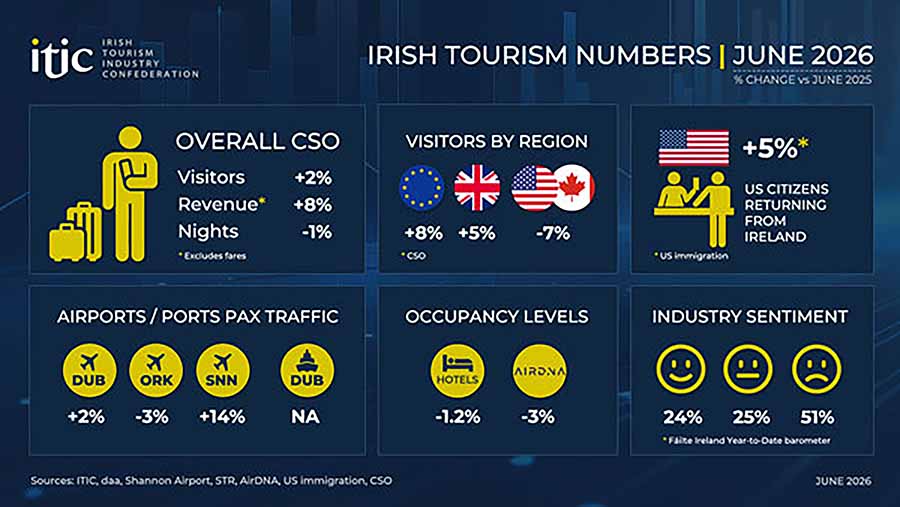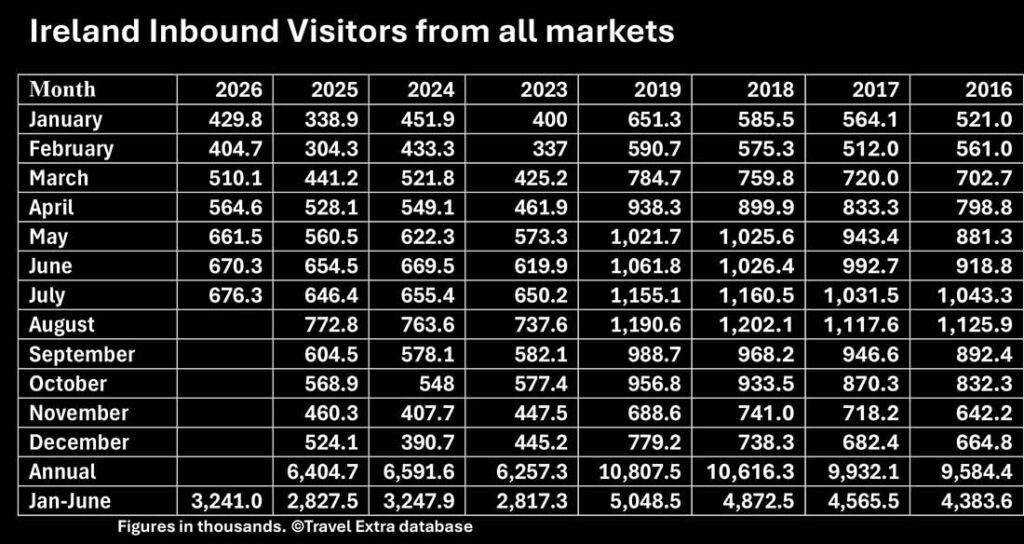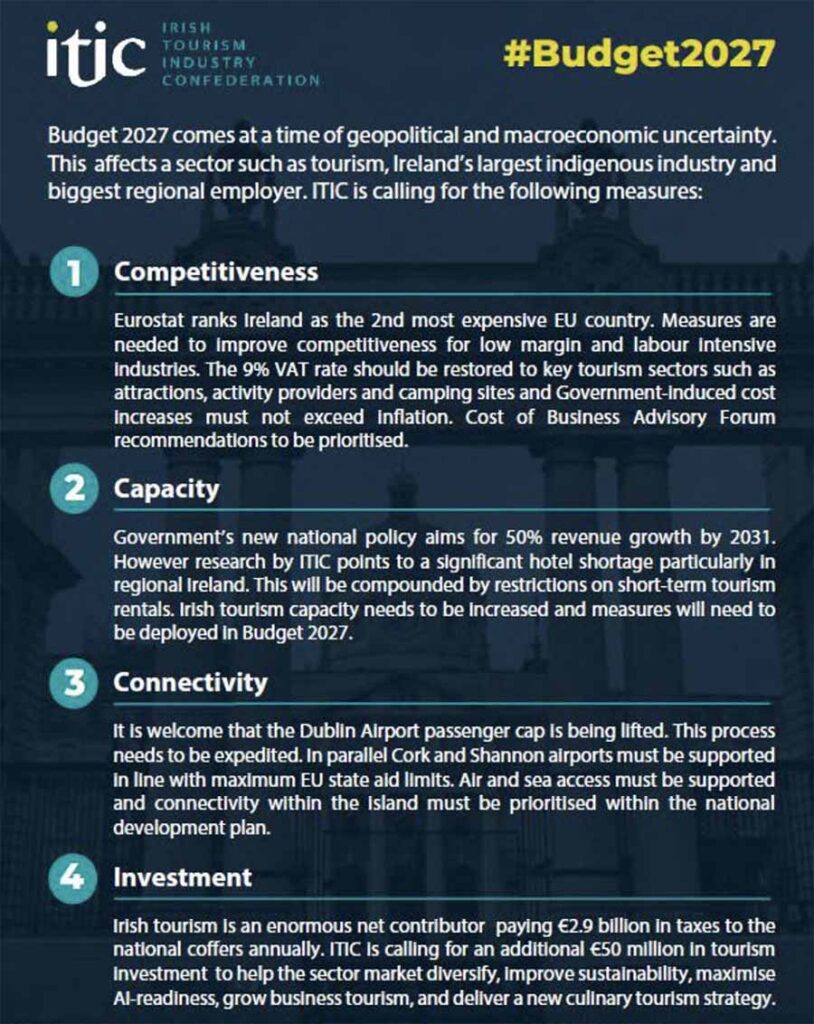
The Irish Tourism Industry Confederation’s annual budget submission gives as good an overview of the hospitality sector as one can find. ITIC members are often accused of being self-serving in their demands. Their credentials in terms of tax take are often deprecated by politicians and, one suspects, more forcefully by their public service advisors. But revenue figures they claim are sometimes disputed. But the fundamentals of tourism are not about tax take or revenue, but in the sheer volume of employment they provide, especially outside of the large urban centres and among those without formal qualifications, or those who seek to work while pursuing those formal qualifications. A shortage of hotel beds, threat to the self catering sector, a high cost of business, and uncertain prospects as international and domestic hospitality spend face separate ill-defined pressure are all among the key message contained in this year’s document, released earlier in the week.
Structural limits curtail ambitoin
The submission makes plain that Ireland’s tourism sector stands at a crossroads where ambition collides with structural limits. Government policy targets growth in tourism revenue from €9.6bn in 2024 to €14.8bn by 2031. Meeting that trajectory depends on physical capacity that does not currently exist in sufficient quantity or in the right places. A report prepared for ITIC in conjunction with the Irish Tour Operators Association by Crowe identifies a shortfall of between 10,000 and 15,000 hotel bedrooms nationwide. Tourism activity reached 85.9m bednights in 2024 and is projected to rise by almost 20pc by 2031. Occupancy levels already run high. Dublin hotels operate at approximately 84pc annual occupancy and frequently exceed 90pc in peak periods. Headroom for additional demand is limited. Accommodation remains concentrated in Dublin and along the Wild Atlantic Way while Ireland’s Hidden Heartlands and other regions lag behind. Demand is seasonal and increasingly dispersed, creating acute shortages precisely where and when growth is most needed.
The Crowe analysis attributes the shortfall to a failure of supply delivery rather than any shortage of demand. High construction and financing costs, planning complexity and weaker viability in regional markets have produced a systemic market failure. Private sector investment alone has proved insufficient to deliver the scale or regional distribution of rooms required. Without targeted intervention to accelerate delivery, particularly outside the main urban centres, the growth targets set out in national policy risk becoming unattainable. Measures proposed include capital grants, reduced development levies, time-limited tax incentives and state-backed financing for hotel projects. A review of options for employer-led staff accommodation is also recommended so that hotels can house the workers needed to operate expanded capacity.
The regional airport dilemma
Regional airports form another pillar of capacity. Shannon Airport and Cork Airport are essential to the geographic spread of tourism and to the development of the Wild Atlantic Way, Ireland’s Hidden Heartlands and Ireland’s Ancient East. They enable sustainable patterns of visitation and support local economies. Budget 2027 should provide for direct capital funding for state-owned regional airports and include Shannon and Cork within the Regional Airports Programme for 2026 to 2030. Such support would allow upgrades to infrastructure, green initiatives and passenger services that attract longer stays and repeat visits. Aviation’s contribution to global greenhouse gas emissions stands at 2 to 3pc. Irish airports and airlines are already advancing decarbonisation. Dublin, Cork and Shannon are implementing substantial measures on the ground while carriers lead in the purchase of Sustainable Aviation Fuels. There is an opportunity to position Ireland as a research and development hub for SAF if political commitment follows.
Funding levels for the sector remain modest relative to its contribution. The Department of Enterprise, Tourism and Employment allocates €233m annually to tourism. ITIC recommends an additional €50m to future-proof the industry and enable sustainable growth. Indecon Economic Consultants research for Fáilte Ireland shows that 29 cent of every euro spent by a visitor returns to the exchequer in tourism-related taxes. On that basis the industry contributed €2.
9bn last year. An over-dependence on the United States market makes diversification urgent. Increased overseas marketing funds, cooperative market access funds, regional visitation supports, sustainability initiatives, industry supports, business tourism investment, AI readiness, a food tourism strategy and event funding, including for the St Patrick’s Festival, would all help. The National Training Fund has accumulated a surplus approaching €2bn from employer contributions of 1pc of payroll. Further releases from this fund should be directed toward labour-intensive sectors such as tourism and hospitality to support skills development and industry engagement with education.
Taxes second highest in Europe
Cost competitiveness features prominently throughout the submission. Ireland maintains the second highest alcohol taxes in Europe. A reduction in alcohol excise would ease pressure on hospitality businesses while reform of the cost of Special Exemption Orders would lower the administrative burden of late-night trading. The boat rental sector’s switch to Hydrotreated Vegetable Oil, now in its third season, faces jeopardy from the product’s high price. HVO costs between 8 cent and 14 cent more per litre than road diesel and currently sells at approximately €1.83 per litre against €1.69 for road diesel. It attracts the same Mineral Oil Tax of 37 cent per litre and Carbon Tax of 15 cent per litre as fossil diesel even though it is a vegetable oil that reduces the carbon footprint by more than 90pc. Customers increasingly question why they cannot use cheaper road diesel. If sustainable tourism measures are to be encouraged, the tax treatment of HVO requires adjustment to provide financial encouragement rather than equivalent taxation.
Insurance costs continue to rise despite reforms in recent years. Savings generated by those reforms have not been passed on fully by insurers. Liability premiums remain unaffordable for many operators. An enhanced role for the Personal Injuries Assessment Board, together with implementation of recommendations from the Cost of Business Advisory Forum, is required with urgency so that organisations with limited or no access to cover can obtain it at reasonable rates. Aviation competitiveness depends on airport charges and taxation remaining at levels that sustain and grow long-haul services. The VAT71 scheme needs modernisation to address vehicle design constraints, introduce faster repayment timeframes and align treatment with the six counties. Fare equity across Public Service Obligation routes would be improved by extending concessionary schemes to commercial operators and providing appropriate funding support from the National Transport Authority.
Labour policy changes should pass an SME stress test before implementation to avoid disproportionate burdens on smaller operators. A no-tax policy on customer tips and gratuities would simplify administration and improve take-home pay for staff. Reform of Employment Permit rules would ease recruitment in occupations experiencing shortages. Micro registered self-catering businesses would benefit from a tax-free allowance and extended investment tax relief. The wider VAT treatment of conference-related costs also requires review. Business events deliver substantial economic value. International organisers assess total hosting costs when choosing destinations. If Ireland’s VAT structure renders conferences more expensive, more difficult to administer or less recoverable than in competing locations, bidding strength will decline.
Industry pitch for grant aid
Investment recommendations extend across several practical areas. Grants for tourism providers to improve sustainable practices, including retrofitting and green energy, would accelerate the sector’s environmental transition. Support for recruitment pipelines through paid training programmes and simplified visa processes for shortage occupations would help address staffing constraints. Tax-free shopping enhancements, including drop-off and checkpoint facilities at ferry ports, would increase uptake among sea passengers from Britain and further afield. Larger-scale capital grants for product development and experience upgrades, together with support for digital systems including artificial intelligence and data tools, would improve efficiency and the visitor offering. Dublin requires resources for transport infrastructure, product development, public realm improvements, cleanliness and perceptions of safety alongside the regional focus.
Business tourism receives particular attention. A dedicated Association Conference Competitiveness Fund would help offset cost gaps when Ireland competes with comparable international cities for events that deliver economic, social and environmental value. Increased resources for bid support, site inspections, destination subvention and international association sales activity are needed to realise the ambitions of Business Events 2030. Structured engagement with conference ambassadors in universities in Dublin, Cork, Galway and Limerick would convert more academic, medical, scientific and professional connections into confirmed international congresses. Such investment constitutes economic development. Conferences generate delegate spend, supplier revenue, tax return, knowledge exchange, professional development, sectoral reputation and repeat visitation.
Need for certainty from planning process
Further capacity measures include prioritising investment and planning certainty at Dublin Airport to accommodate growth in passengers and wide-body operations. Infrastructure investment in tourism amenities should match current consumer requirements and be accompanied by workforce education. Electric vehicle charging infrastructure outside large urban centres would support dispersed travel patterns. Support for festivals and other initiatives in smaller centres would help extend the season for SMEs. A capital and feasibility support programme for regional conference infrastructure capable of hosting 400 or more delegates, with exhibition space, breakout capacity, poster areas, catering circulation and nearby accommodation, would strengthen the regions’ ability to attract business events. The private coach and bus sector requires research funding, enhanced passenger incentives and equitable access to decarbonisation supports to complete its sustainable transition.
The continued recovery of Irish tourism remains of immense importance to the national economy. This has been a difficult year on several fronts and Budget 2027 arrives at a decisive moment. Tourism is Ireland’s largest indigenous industry and its biggest regional employer. It has demonstrated resilience over successive challenges and retains critical national importance. The industry supports the Government’s five-year national tourism policy and shares ambition for the sector’s future. Realising that growth requires concrete measures in Budget 2027 around competitiveness, capacity, connectivity and investment. Sustainable expansion depends on pro-tourism and pro-enterprise policies that address the structural constraints identified in the Crowe report and the cost pressures detailed by members.
Budget 2027 can establish a clear pathway for success in the years ahead. Such an outcome would benefit the visitor, the tourism industry, local communities and the national exchequer through sustained employment, regional development and the substantial tax contribution already demonstrated by the sector.