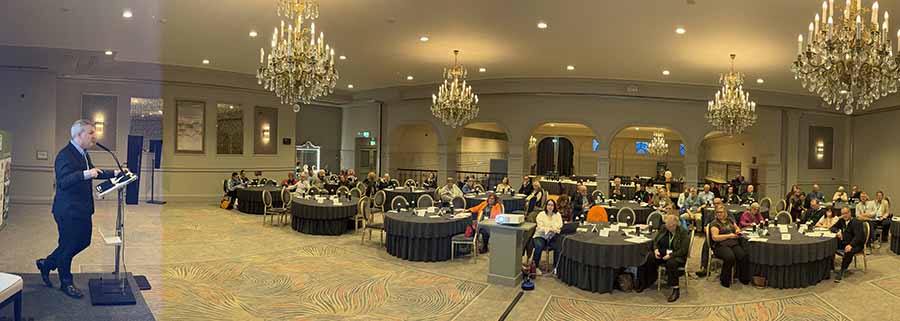
Twelve Key Takeaways from the Irish Self-Catering Federation Conferenceat Killashee Hotel, Naas in November 2026 as the industry faces a potential meltdown caused by the new short-term letting register due to open around 1 December 2026 and accompanying planning regulations.
Operators receive a two-month window to register each unit for €25. After the window platforms must display valid registration numbers and remove non-compliant listings. In the 25 largest towns and cities operators must hold planning permission to register while a two-year grace period applies outside those areas until 23 October 2028.
Short-term and self-catering properties supply around 40pc of tourism bed spaces in Ireland. Platforms including Airbnb and Expedia will enforce registration numbers from February 2027.
- The short-term rental register opens almost immediately: The national short-term letting register is due to open on or around 1 December 2026, once the legislation completes its final stages and is signed by the President. Operators will have a two-month window to register each unit (€25 per unit). After that window, platforms will be required to display valid registration numbers and remove non-compliant listings. Registration itself is designed to be quick (under five minutes per unit) and does not involve quality inspections.
- Planning permission is now tightly linked to registration: In the 25 largest towns and cities (generally those over 20,000 population), operators must already be planning-compliant, or become so very quickly, in order to tick the “authorised” box on the register. Outside those areas a two-year grace period runs until 23 October 2028. This linkage of registration to planning authorisation is stricter and faster than in most other EU countries and was the single biggest source of tension at the conference.
- A simplified change-of-use form has been introduced – but capacity remains a concern: The Department of Housing has created a simplified retention application form that removes the need for professionally drawn plans and maps for pure change-of-use cases. However, operators repeatedly raised fears that local authority planning departments are already overburdened and that “further information” requests will effectively turn simplified applications back into full planning applications, causing major delays.
- Seven years of continuous operation creates a pathway: Properties that have been used continuously for short-term letting for at least seven years without enforcement action now benefit from a presumption in favour of retention permission. This is a once-off regularisation opportunity rather than an ongoing right and applies only to established operators.
- Short-term rentals already supply around 40% of tourism bed spaces: Industry and platform data presented at the conference estimate that short-term and self-catering properties account for up to 40% of all tourism bed spaces in Ireland – second only to hotels. For every euro spent on accommodation, approximately €2.70 flows into local cafés, restaurants, pubs and attractions, underlining the sector’s role in the wider tourism ecosystem.
- Demand is softening and guest behaviour is changing: Key Data showed a strong first half of 2025 followed by a clear softening in the second half. Guests are staying fewer nights (average length of stay down to 6.2), booking closer to arrival, and shifting toward one- and two-night stays. Direct bookings remain significant in Ireland but are losing share. Operators were urged to adjust pricing, minimum-stay rules and marketing to protect revenue.
- Most short-term rental activity happens outside Dublin: Three-quarters of short-term rental guest nights occur outside the capital. The west and south-west alone generate more guest nights than Dublin. Speakers repeatedly stressed that rural and regional self-catering is fundamentally different from multi-unit urban investment properties and should not be treated the same in policy.
- Women form a large part of the sector’s workforce: Data shared from Scotland and wider European sources showed that women make up around 56% of those employed in short-term rentals, many working part-time. Speakers warned that poorly designed regulation risks significant social and mental-health impacts on these small, often lifestyle, businesses.
- Platforms must enforce registration numbers or face fines: Airbnb, Expedia and other platforms confirmed they will require registration numbers once the scheme becomes mandatory (from February 2027). They must remove listings that lack valid numbers when ordered to do so by Fáilte Ireland. They cannot give planning or legal advice, but will cascade official guidance and are preparing systems and host communications.
- Quality assurance still has value alongside online reviews: While peer reviews dominate, speakers argued that independent quality schemes (Welcome Standard / ISCF / Fáilte Ireland) provide consistency and confidence that pure online reviews cannot. In an AI-driven search environment, verified standards help small operators stand out and give guests reassurance.
- Technology and AI are now essential survival tools: Multiple technology providers demonstrated how property-management systems, channel managers and AI agents can automate routine guest communication, pricing, upselling, review responses and gap-filling. Operators were strongly encouraged to tidy listing data, protect direct bookings, and use AI for factual tasks while retaining human control over refunds and sensitive issues.
- The Federation will continue the fight at national and EU level: ISCF leaders made clear that while the legislation is proceeding, the organisation will keep lobbying TDs, engage with the European Commission (DG GROW), and explore evidence-based challenges. Member stories highlighted real local economic losses already occurring and a determination not to accept rural self-catering as collateral damage in the housing debate.