Dublin, the capital of Ireland wears its heritage in its sleeve, through bits waterways, its statues, its many watering holes, its architecture and its main street.
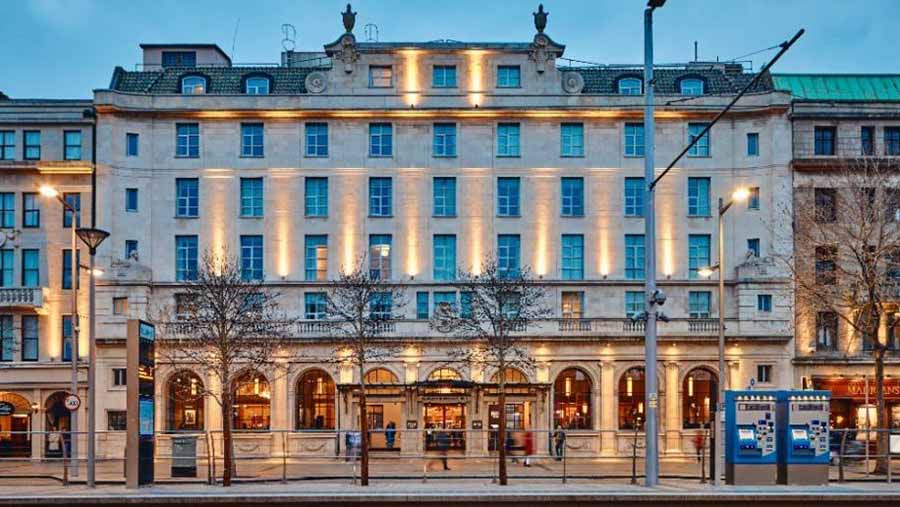
O’Connell Street. That is where you will find the Riu Plaza The Gresham Dublin. Behind that gleaming façade, itself a hundred years old, you will find much of the history of the city carved into the walls and hinging from the chandeliers.
Unlike three other hotels on the street, the Gresham survived the 1916 rebellion only to perish during the Battle of Dublin in the Irish Civil War. The building became a stronghold for anti-Treaty forces. On 6 July 1922 fire had taken hold, and within days the structure lay in ruins together with several neighbouring hotels. Only the Gresham among them was destined for complete reconstruction.
Gresham reborn
Out of the rooms came the ferro-concrete façade that was to become famous today. The new Irish Free State awarded the owners compensation of £93,550. On 29 October 1926 a contract was signed with the builders McLaughlin and Harvey for a replacement hotel of approximately 250 rooms.
English architects Robert Atkinson and Alexander Frederick Berenbruck Anderson designed the new building in a fusion of Art Deco and neo-classical styles. Construction employed ferro-concrete for its fire-resistant qualities and speed of erection. The rebuilt Gresham Hotel opened on 16 April 1927. Many original features from that reconstruction, including Waterford crystal chandeliers, remain in place. The reopening was one of the great public celebrations of recovery after years of conflict.
Atkinson’s blend of contemporary Art Deco detailing with classical proportions produced a façade that continues to dominate its stretch of O’Connell Street.
In the mid-twentieth century the hotel continued to adapt under energetic management. In Dublin lore, the legendary hotelier Timothy ‘Toddy’ O’Sullivan became as famous as the Hollywood stars he hosted. To this day Toddy’s bar is named in his honour.
When he became manager in 1940, he appointed Karl Uhlemann as head chef and set about transforming the dining experience, utilizing the access to Ireland’s native food supply at a time when rationing was widespread. An English newspaper when so far as to reproduce the the Gresham menu on its front page, inadvertently prompting a steady stream of off-duty American officers who descend on the hotel and carried its reputation home with them.
O’Sullivan, appointed a director in 1945, continued after the war with a programme of modernisation to attract high-spending American visitors. By the early 1950s the hotel possessed eighty additional bedrooms and became the first in Ireland to provide en-suite facilities in every room.
The influencers of the era, society newspaper diarists like Frank Hall and Terry O’Sulivan held court there, confident that the news would come to them. If it was happening anywhere in Dublin, it was at the Gresham.
In 1959 the Garden Room restaurant opened. On New Year’s Eve 1961 Teilifís Éireann launched the Irish national television service from the premises. O’Sullivan secured further publicity by hosting former United States President Dwight D. Eisenhower and later accommodating members of President John F. Kennedy’s entourage.
By 1964 the hotel was hosting 80,000 guests annually and employed nearly 400 staff. Film stars of the era, among them Ingrid Bergman, Grace Kelly, Bing Crosby and Bob Hope, regularly stayed there.
Ownership changed hands again in 1978 when the Ryan Hotel Group acquired the property. In 2001 the group adopted the name Gresham Hotel Group. Four years later Precinct Investments, controlled by builder Bryan Cullen, took the then stock-market-listed company private in a transaction valued at €117 million.
RIU to the rescue
After the National Asset Management Agency later assumed control of associated loans, the hotel was purchased in September 2016 for €92 million by Spain’s RIU Hotels and Resorts, founded in 1953 on the island of Mallorca and 49pc owned by the travel group TUI, operates 100 hotels and resorts across nineteen countries. . The property thereafter traded as Hotel Riu Plaza The Gresham Dublin. The building remains the oldest within the entire RIU portfolio.
RIU, Chief executive Luis Riu confirmed that Dublin represented an attractive market because of rising tourist numbers, infrastructure investment and demand for quality accommodation.
The acquisition formed part of RIU’s expansion of its Plaza brand into European city centres. At the time of purchase the hotel contained 323 rooms and suites together with twenty function rooms, a restaurant and a bar.
A prior renovation in 2013 had already modernised aspects of the interior, so only limited further adjustments were required to align the property with RIU standards.
After the disruption of the pandemic, revenues recovered strongly. Room sales more than tripled and staff numbers rose correspondingly. In 2024 the hotel completed a comprehensive refurbishment that expanded capacity by sixteen rooms to a total of 404.
The Gresham has gazed on more than two centuries of Irish urban and economic history. Each owner has left their trace in architecture, service standards and guest profile. Each has made their own contribution, to rebuild, modernise and reposition in response to changing circumstances.
Dublin will change, but O’Connell Street will always be O’Connell street, with the Gresham as its corner tone.
Dublin’s own palace, indeed.