
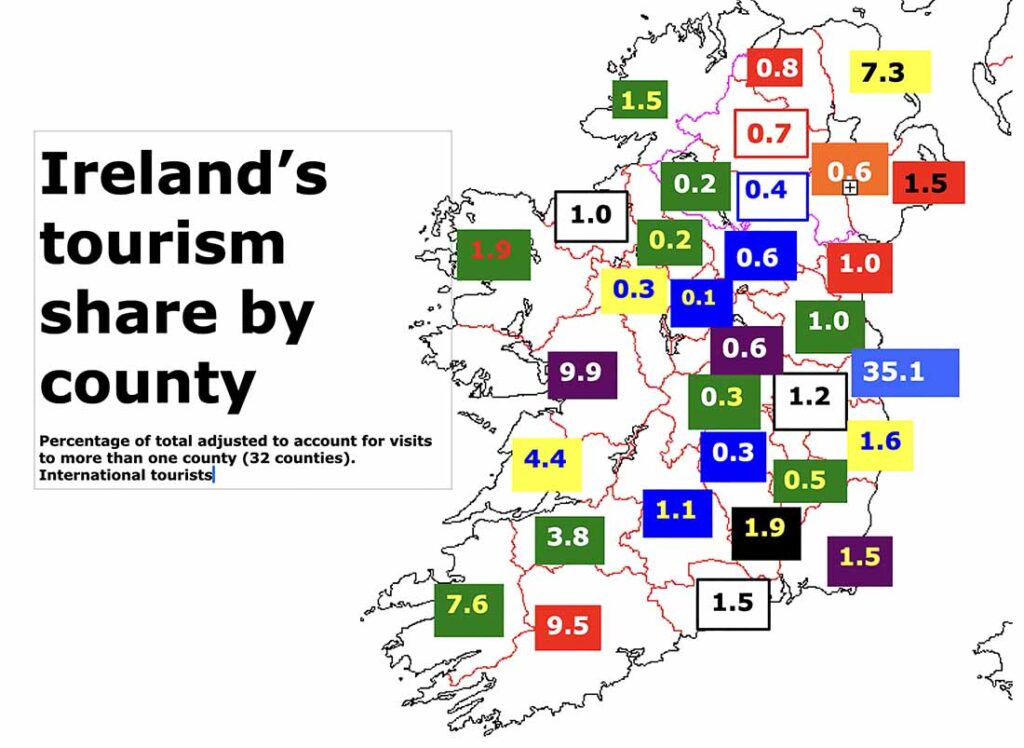
Just FIVE counties, Dublin, Galway, Cork, Kerry and Antrim, attract 70pc of all the international tourists that come to ireland.
There is nothing new about that. This pattern has persisted for years and continues to shape the economic geography of the island in ways that reward a narrow set of locations while leaving large parts of the country with limited exposure to the spending power of visitors from abroad.
The figure of 70pc translates directly into hotel occupancy rates, restaurant revenues, transport utilisation and local employment that cluster heavily around these counties and leave others dependent on domestic demand or alternative industries.
Dublin stands as the primary gateway. Most long haul flights arrive at Dublin Airport and many short haul services follow the same route. Visitors often treat the capital as both entry point and principal destination, drawn by the density of hotels, museums, theatres and organised tours. The result is a self reinforcing cycle in which infrastructure investment follows visitor numbers and visitor numbers follow infrastructure.
Galway benefits from a strong cultural identity that has been marketed effectively for decades, with its festivals and west coast setting acting as magnets. Cork combines city amenities with proximity to coastal scenery, while Kerry has long been associated with the Ring of Kerry itinerary that appears in countless brochures and online itineraries.
Antrim, on the northern side of the border, draws substantial numbers through the Giant’s Causeway and the coastal road, both of which feature prominently in promotional material aimed at overseas markets.
Together these five named counties account for the great majority of bed nights and day visits recorded by international travellers.
Counties count the benefits
The economic consequences of this concentration are measurable. Tourism receipts flow disproportionately into the local economies of these counties, supporting jobs in hospitality, retail and transport that are less abundant elsewhere. In Dublin the sector contributes a substantial share of service employment. In Kerry and Galway rural communities near popular routes gain seasonal income that would otherwise be absent.
Antrim similarly records higher visitor expenditure than many other northern counties. When international arrivals expand, these areas capture the growth first. When arrivals contract, as occurred during periods of global travel restriction, the same areas experience the sharpest falls. The pattern creates both opportunity and vulnerability. Opportunity arises because established destinations can scale capacity more readily. Vulnerability appears when external shocks hit and the absence of a broader geographic base leaves the national tourism account exposed.
Regional disparities follow directly from the 70pc figure. Counties outside the favoured group receive far smaller shares of international spending. Transport connections are thinner, marketing budgets are lower and the volume of repeat international traffic is limited. Local authorities in those areas face the task of maintaining attractions and accommodation with thinner revenue streams. The imbalance also influences labour markets. Young people in less visited counties often migrate toward the high tourism zones or leave the island altogether in search of more reliable employment. Over time this movement reduces the human capital available for any future expansion of tourism outside the core counties.
Road and rail
Infrastructure decisions have reinforced the existing distribution. Major road and rail upgrades have historically prioritised corridors that serve Dublin and the principal regional cities. There are no railways in Donegal.
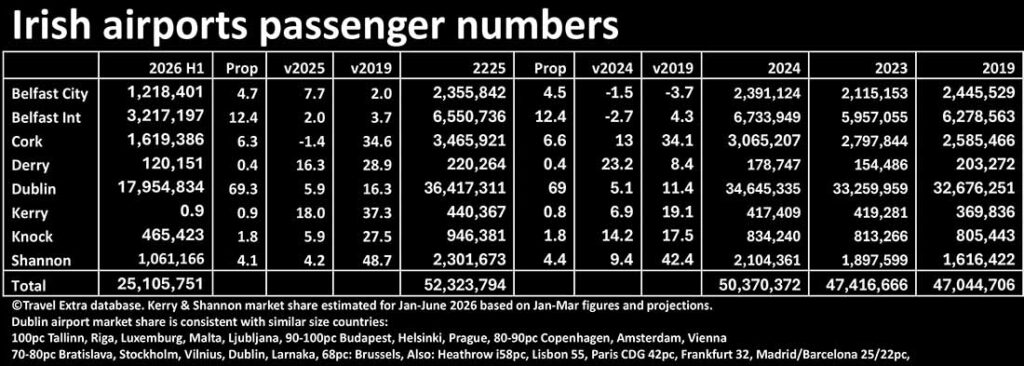
Airport capacity expansions have concentrated on Dublin, with secondary airports handling smaller volumes. Dublin gets 70pc of the air traffic to and from the island, the two Belfast airports another 18pc, with just 5pc going through Cork and 4pc through Shannon.
Public funding for visitor centres and heritage sites has tended to follow proven demand rather than attempt to create new demand in quieter locations. Private investment behaves in the same way. Hotel groups and tour operators locate capacity where occupancy can be predicted with greater certainty. The cumulative effect is that the 70pc share becomes more entrenched with each investment cycle.
Marketing strategies have played a parallel role. National tourism bodies and regional organisations have understandably promoted the destinations that already attract large numbers, because those campaigns generate measurable returns in the short term. Imagery of the Cliffs of Moher, the streets of Galway and the landscapes of Kerry circulates widely. Antrim’s coastal features receive similar attention.
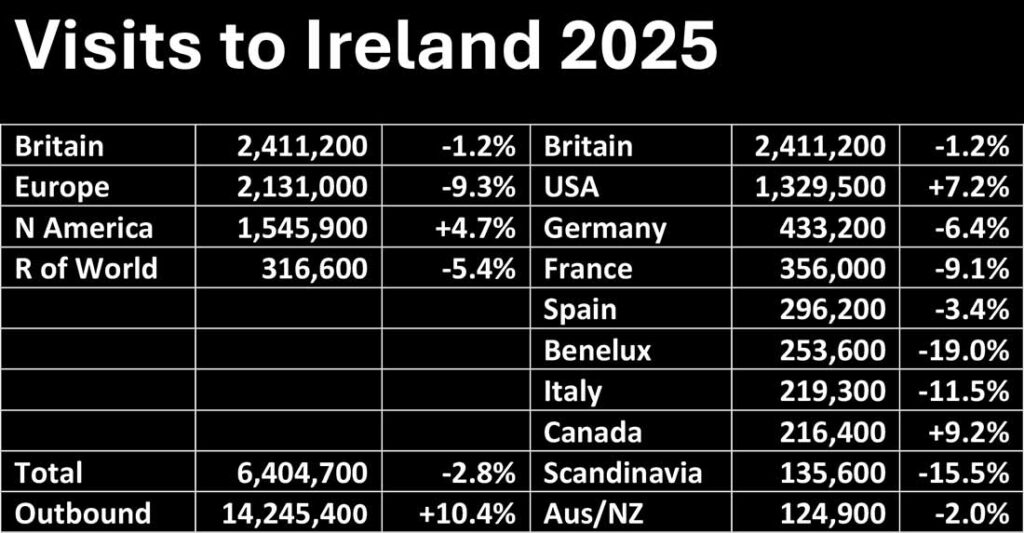
The volume of digital content and print material devoted to these places far exceeds that devoted to many other counties. Search engine results and social media algorithms amplify the same hierarchy, directing potential visitors toward the familiar rather than the less photographed. The outcome is that first time travellers from the United States, Britain, Germany and France arrive with itineraries that rarely extend beyond the established circuit.
More seasoning, please
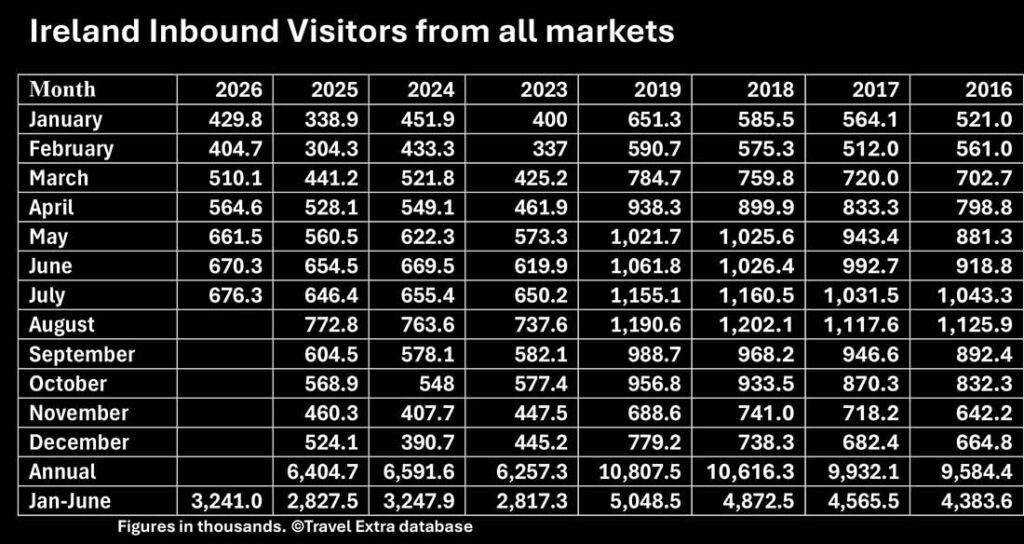
Seasonal patterns intensify the concentration. Summer months bring the highest volumes, and the core counties absorb the peak loads. In autumn the numbers decline but the same locations continue to dominate the remaining traffic. Shoulder season marketing has attempted to spread demand across more months, yet the geographic distribution remains largely unchanged. Winter tourism is thinner still and again clusters around Dublin and a handful of other centres that maintain year round facilities. The result is that pressure on roads, parking and popular sites in the high volume counties rises sharply in peak periods while capacity elsewhere sits under used.
Environmental and social pressures accompany the visitor numbers. Popular trails and coastal paths in Kerry and Antrim experience erosion and litter accumulation that require continuous management.
In Dublin and Galway residential neighbourhoods near tourist zones report higher rents and occasional friction over noise and congestion. Local residents in these areas sometimes express concern that the character of their towns and villages is being reshaped by the scale of visitation. At the same time communities in low volume counties observe that they receive few of the economic benefits while sharing the national costs of tourism promotion and infrastructure. The imbalance therefore generates both localised strain and broader perceptions of uneven development.
No place like home
What to do? Start with domestic. Fáilte Ireland’s Corporate Strategy 2026–2029 and the national policy framework “A New Era for Irish Tourism,” his department is actively reallocating resources to ensure that visitor spending and employment benefits extend beyond traditional hubs like Dublin into all regional counties year-round.
It is the latest in a series of strategies published by tourism authorities have recognised the need for wider geographic spread and have funded pilot projects in less visited counties.
Product development grants have supported new walking routes, heritage interpretations and small scale accommodation outside the core. Collaborative marketing campaigns have attempted to link lesser known areas to the established itineraries so that visitors extend their stays. Progress has been real but limited in scale. The 70pc share has not shifted dramatically, which suggests that the underlying drivers of accessibility, brand recognition and investment remain powerful.
A more decisive approach would require coordinated action across transport, planning and promotion. Improved regional air links and better inter city rail frequencies could lower the transaction costs of visiting secondary destinations. Planning frameworks that encourage accommodation development in under represented counties, accompanied by matching public investment in public realm and visitor facilities, could alter the supply side. Marketing that allocates a larger share of resources to new narratives and lesser known landscapes could begin to reshape demand. Data systems that track visitor movements in finer geographic detail would allow policy makers to measure the effects of these interventions with greater precision.
The international picture
It is a shared problem. Overconcentration of tourists in a small number of hotspots in a short season is a familiar problem and has come back to haunt authoirites in Spain, Italy and Croatia. Other European destinations that once faced similar concentration have pursued deliberate dispersal policies with mixed but instructive results. Some have succeeded in raising the share of secondary regions through sustained investment and product differentiation.
Others have found that the primary gateways retain their dominance because of irreversible advantages in connectivity. Ireland’s situation combines elements of both. Dublin’s airport capacity and urban amenities give it structural strength that is difficult to replicate.
At the same time the island’s compact size and the quality of landscapes outside the core counties create genuine potential for broader distribution if the necessary supporting conditions are put in place.
Private to the rescue
The private sector will follow the money and also follow the inventives. Tour operators design packages around reliable transport and proven demand. If secondary counties can demonstrate consistent product quality and easier access, operators will incorporate them.
Independent travellers, who form a large share of the market, rely on online information and peer recommendations. Improving the digital visibility of less visited places and ensuring that booking platforms present them prominently can influence those choices. Local destination management organisations have a role in coordinating the many small providers whose collective offer determines the attractiveness of a county.
Employment quality also deserves attention. In the high volume counties tourism jobs are more numerous but can be seasonal and relatively low paid. In lower volume counties the same jobs, when they exist, may offer greater stability relative to local alternatives but remain scarce. Raising skill levels and career pathways across the sector would improve outcomes in both settings. Training programmes linked to regional strengths, such as outdoor guiding in western counties or urban hospitality in the cities, can help retain workers and raise service standards.
Digital dilemma
Digital platforms will keep evolving and with them the ways in which destinations are discovered. Against that background the existing concentration remains a central fact of Irish tourism. The 70pc share held by the listed counties is both a measure of past success in building attractive products and a signal that future growth could be more evenly shared if policy and investment adjust accordingly.
The analytical task is therefore to treat the concentration not as an inevitable outcome but as a pattern that can be influenced. Detailed monitoring of visitor flows, transparent evaluation of dispersal initiatives and willingness to redirect resources toward under represented counties form the practical basis for change. Without such steps the economic benefits of international tourism will continue to accrue mainly to the same limited set of places, reinforcing the geographic imbalance that the 70pc figure so clearly reveals.
The big five serve as a starting point for sustained examination rather than a final verdict on the structure of the industry.
Related posts:
 ANALYSIS: How Europe’s hotel developers are turn to conversions rather than new-builds
 AirNav Ireland director discusses record traffic levels and future recruitment
 ANALYSIS: How river cruise companies are responding to low water levels on the Danube and Rhine
 ANALYSIS: TCS and Rolls-Royce breakthrough in hydrogen-powered aviation, is this the moment the carbon besieged planet is waiting for?