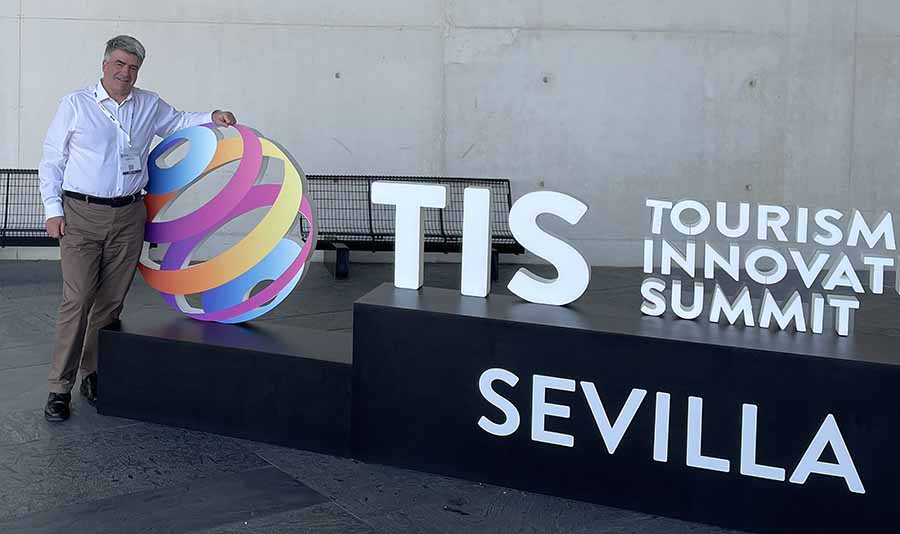
- The Tourism Innovation Summit 2026 takes place from 6 to 8 October 2026 at FIBES in Seville
- The 7th edition operates under the slogan Time to Reimagine
- AI is moving into core operational infrastructure with focus on predictive personalisation
- Discussions centre on measurable sustainability and regenerative tourism models
- Argentina features as the official guest country alongside over 400 international speakers
The Tourism Innovation Summit (TIS) 2026 in Seville is structured around major themes shifting from operational AI infrastructure to destination management. While Day 1 established the overarching vision under the slogan “Time to Reimagine,” Day Two (Wednesday, 7 October 2026) shifts heavily toward specific institutional collaborations, regional connectivity, and cross-border strategic distribution.
A primary focus of Day 2 was the Innovative Tourism Regions Forum (Foro de Regiones Turísticas Innovadoras).
Key takeaways from Day Two
- Data-driven saturation solutions: Regional leaders and tourism executives—including representatives from Castilla y León and Andalusia—addressed the pressing issues of tourist capacity management, balancing local community resources, and diversifying geographical offerings away from hyper-congested hot spots.
- Shift from volume to value: Discussions focused on leveraging data analytics systems to transition destination marketing organizations (DMOs) from judging success purely by overall visitor counts to prioritizing higher spend-per-capita metrics and measurable regional legacy.
- Retail and Travel Distribution Realities (Vision 2030): Conducted In panels tracking the evolution of distribution channels, experts mapped out the upcoming milestones for tech-driven sales ecosystems.
- From inventory to smart descriptions: The core message for travel agencies and distribution platforms is the transition from simple inventory listing to intelligent sales descriptions optimized for AI-driven assistants.
- AI Agent integration: With travelers shifting their research to social platforms and utilizing Agentic AI for highly specific, custom-built travel schedules, the industry’s focus is on how regional providers can sync their backend distribution pipelines directly into global AI search frameworks.
- The airline role in regional development: Speakers evaluated how regional airline networks can serve as core development tools for smaller, emerging territories. Mitigating macroeconomic pain points: Panels tackled the immediate structural pressures squeezing airline operators and local travel providers, specifically managing rising fuel/energy costs, persistent global inflation, and ongoing hospitality talent shortages.
- Continuous Tech & Management Innovation Showcases. Parallel sessions continued throughout the day highlightin case studies on maximising the efficiency of the digital guest journey Providers demonstrated the deployment of next-generation tools spanning ticketing architectures, specialized hotel property management systems (PMS), and decentralized blockchain payment tools.
Key Takeaways from Day One
- AI Shift from Differentiation to Infrastructure: Artificial Intelligence has officially moved past the trial and testing phases. Speakers emphasized that by 2026, AI is no longer a luxury feature but core infrastructure. The industry’s current challenge is scaling AI profitably across operations, focusing heavily on Agentic AI capable of planning entire custom itineraries autonomously and real-time operational decision-making.
- Predictive Personalization Over Marketing: Standard marketing is being replaced by predictive hyper-personalisation driven by data intelligence. The “2026 traveler” relies heavily on social media for initial inspiration and deploys AI assistants to design the exact granular details of their travel experiences.
- Regenerative and Inclusive Tourism Models: Sustainability has shifted from a mere declarative goal to a measurable expectation. Major industry partners—such as ILUNION Hotels (focusing on accessible and inclusive hospitality) and Grupo Piñero (focusing on regenerative frameworks)—stressed that tourism must leave a net-positive impact on local communities and ecosystems.
- Data-Driven Destination Management: The deployment of advanced data analytics tools, like the Seville Tourism Intelligence System, was showcased as critical for modern destination management organisations (DMOs). These systems allow destinations to manage capacity pressures, predict visitor flows, and mitigate the strains of overtourism in real time.
Balancing Tech Automation with the Human Touch: In panels led by tech providers like Kiwi.com, experts debated how to balance deep customer support automation with human intervention. The consensus is that while AI handles immediate logistics, human-led customer care remains the primary builder of trust and competitive advantage. - Operational Pressures: Beyond the tech, day one addressed immediate global challenges squeezed by macroeconomics, including air connectivity limitations, high inflation, rising energy costs, and persistent hospitality talent shortages.
The summit hosts over 400 international speakers from global brands including Google, Skyscanner, Iberostar and Vueling. Argentina features as the official guest country.