Ireland’s love affair with Cuba started with a one paragraph news report. Harry Snyder of Budget Travel spotted it in a daily newspaper, one of those little briefs on the right hand column, confirming that Aeroflot were going to use Shannon airport as a stop over for direct flights from communist era Moscow to Havana.
Harry’s tour operator instinct kicked in. He knew that Cuba was beautiful. He knew that Aeroflot would have seats to sell on that flight, at bargain basement rates. Why not get Irish holiday makers to take the direct flight to Cuba?
We continued to travel in large numbers since, even though Budget Travel has long transitioned away from Harry and Gillian’s hands, even when the direct flights were halted by other events. About 4,000 Irish a year would travel in a good year. Gordon Penney’s Cuba Travel specialised in trips to the island.
But now is a time of great sadness for everyone who loves Cuba. Donald Trump’s war games in the Caribbean have ensnared the economy of the “island who dared” as the great Irish travel writer Dervla Murphy described it.
Canadian airlines have cancelled flights. Others have managed to keep services going with refuel stops in Punta Cana. Jetfuel supplies are running low. Cuba’s tourism industry is grinding to a halt, and with it the life blood of an economy long strangled by decades of American belligerence and economic sanctions.
The crisis has five main facets that reveal the depth of the damage.
Jetfuel shortage
First, airlines have reacted with swift and severe cutbacks to the jetfuel shortage that Cuban authorities confirmed on 9 February 2026, when they revealed that stocks at all nine international airports had run dry. Air Canada suspended all flights to the island indefinitely, citing the inability to refuel on arrival and the risks to operations.
WestJet followed suit, halting services from Canadian hubs and planning special repatriation charters for stranded passengers. Air Transat extended its suspension through 30 April 2026, after initial attempts to maintain limited routes failed due to the fuel constraints.
European carriers like TUI Airways rerouted flights via Mexico or Cancun, adding hours to journeys and pushing up costs for those few still willing to go. Russian airline Aeroflot, once a lifeline for direct links, confirmed it would pause all Cuba operations after completing evacuation runs, leaving Moscow-Havana routes dormant for the foreseeable future.
These moves have slashed arrivals by over 70pc in the past week alone, turning Havana’s Jose Marti airport into a ghost terminal where echoes replace the hum of jet engines.
Hotels close
The second point lies in the desperate responses from hotel groups, which have begun shuttering properties to conserve scant resources.
Meliá Hotels International, the Spanish chain with deep roots in Cuba through two dozen resorts, revealed on 9 February 2026 that it would reduce availability across three key sites, including the Meliá Cohíba in Havana and outposts in Varadero and Cayo Coco.
Staff rotations have shifted to week-on, week-off schedules, with workers bunking in on-site rooms because fuel shortages prevent commutes from home. Iberostar, another major player, confirmed similar closures at its flagship properties, relocating guests to facilities with backup generators powered by whatever diesel can be scraped together.
The Cuban tourism ministry has ordered these transfers en masse, moving thousands from low-occupancy beachfronts to urban boltholes better positioned for rationed power grids. In Varadero, once a ribbon of sun-soaked all-inclusives drawing 1.5m visitors yearly, entire blocks now stand empty, their pools still and bars unstocked.
This consolidation aims to prioritise essential services, but it strips away the very allure that drew sun-seekers: the promise of uninterrupted escape. Hoteliers whisper of layoffs looming, as occupancy dips below 20pc, forcing a reckoning with an industry that once pumped €2.76bn into the national coffers annually.
Repatriation
Third, measures to repatriate citizens and visitors underscore the human toll of this squeeze. Russia led the charge, with Aeroflot chartering one-way flights from Havana to Moscow starting 12 February 2026, ferrying out over 2,000 nationals in the first wave. The Kremlin’s economic ministry urged its people to shun Cuba trips altogether, framing the operation as a mercy mission amid the “worst fuel crunch in years”.
Canada mobilised Air Transat for similar lifts, prioritising families split by the cancellations, while WestJet pledged €500 vouchers to those rerouted home via Toronto. Cuban authorities have scrambled buses and ferries for internal moves, but outbound options dwindle daily, leaving expats and dual nationals in limbo.
Stories filter out of haliday makers bunkered in a Trinidad guesthouse with dwindling euros and no flight manifest. These evacuations, patchwork at best, expose the fragility of a system where one blockade chokes the arteries of movement.
Travel advisories
The fourth facet emerges from the stark warnings issued by foreign offices across Europe and beyond.
Ireland moved Cuba from “normal precautions” up two notches to “avoid all but essential travel,” urging registration on its portal and cash reserves for the long haul home.
England, too, updated its guidance, advising against all but essential travel to Cuba due to “severe disruptions” from the fuel dearth.
Australia’s Smartraveller escalated to a level three alert the same day, counselling citizens to reconsider any need to visit, as shortages ripple through transport and supplies. Canada echoed this with a blanket call to avoid non-essential journeys, while Germany and France layered on cautions about blackouts and empty shelves. These advisories, once mild nudges, now border on prohibitions, deterring the casual explorer who once filled Budget Travel’s rosters.
Such counsel not only protects lives but accelerates the isolation Trump seeks, turning allies into bystanders.
Tourism plummets
Finally, the economic impact cascades like a domino fall, threatening to bury Cuba under layers of deprivation. Tourism, the sector’s beating heart, accounted for 10pc of GDP before this latest assault, but arrivals have plummeted 80pc year on year, gutting revenues from €2.76bn to projections of under €500m for 2026.
The broader economy, already battered by Trump’s January executive order slapping tariffs on oil suppliers to the island, faces hyperinflation and ration queues that stretch for blocks. Factories idle without diesel for trucks, hospitals ration generators, and black market fuel fetches €10 a litre in back alleys. This is no mere dip; it is strangulation, amplified by sanctions that block even humanitarian aid.
For Ireland, with our shared history of blockade and resilience, the sight stings. We who danced in Havana’s salsa halls, who bartered cigars in Viñales, must now ask: how long before the island of dare becomes the island of despair? The answer lies not in Washington’s games, but in Havana’s grit and our collective will to push back. Lift the siege, or watch a jewel dim forever.
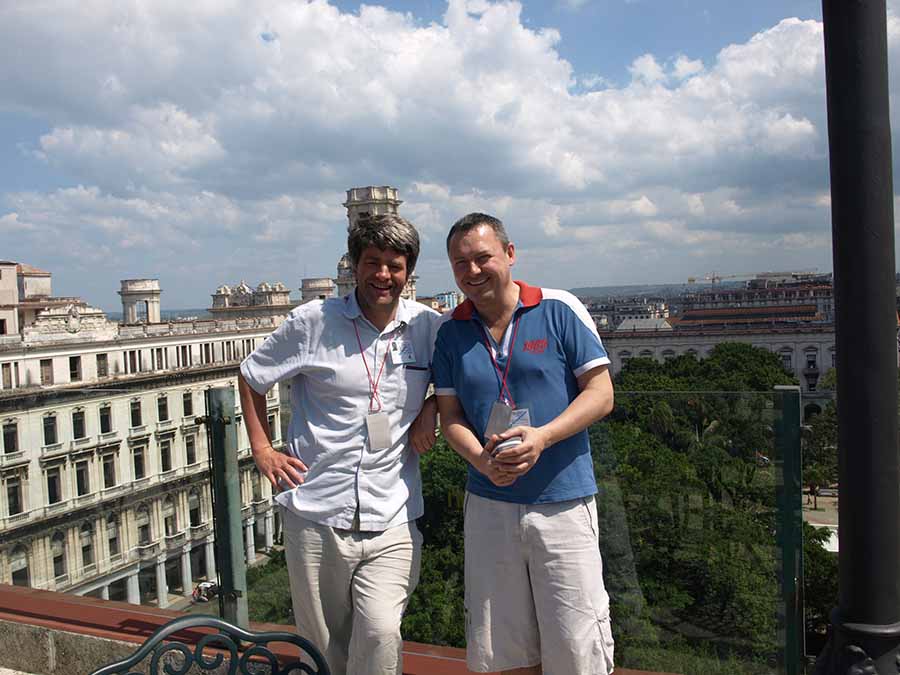
Eoghan Corry and Ed Finn in havana 2009