On 27 May 1936, following a religious service and blessing by the Irish Air Corps Chaplain, a small De Havilland Dragon aircraft named Iolar (Eagle) took off from the grass runway at Baldonnel Military Aerodrome near Dublin, bound for Bristol. This marked the inaugural flight of Aer Lingus, which had been established just one month earlier with an authorised capital of £100,000, a staff of twelve, a single aircraft, and a biscuit tin full of spare parts.
The airline’s administrative office was at 39 Upper O’Connell Street but it also instituted a night booking office, telephone Dublin 43533, at the LSE Motor Company’s premises in Parnell Street. Its ‘terminal’ at Baldonnel, telephone Clondalkin 39, was erected by the Office of Public Works and consisted of a wireless hut and a passengers’ hut containing a waiting room as well as pilots’, control officers’ and managers’ rooms.
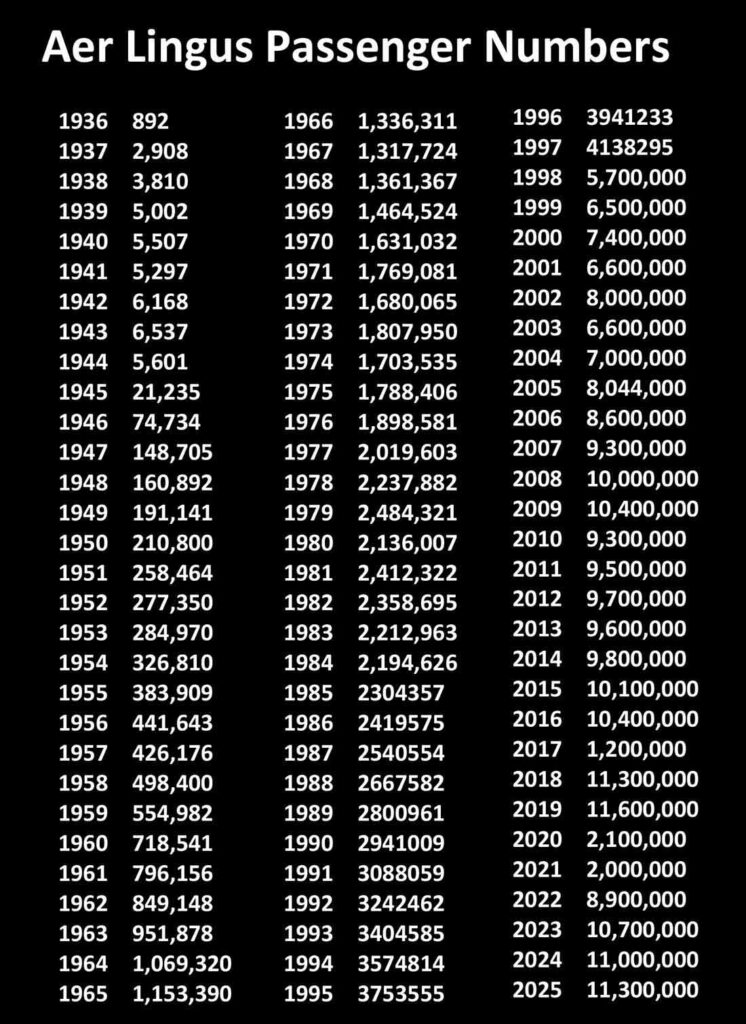
In its first year, the fledgling airline carried 892 passengers, generated £4,697 in revenue, and recorded an operating loss of £5,147.
The outbreak of World War II severely limited operations, but not the determination of its founders. Services were reduced to a single route to Britain. During this challenging period, Aer Lingus acquired its first Douglas DC-3, grew traffic by 50%, and relocated its base to the new Dublin Airport at Collinstown.
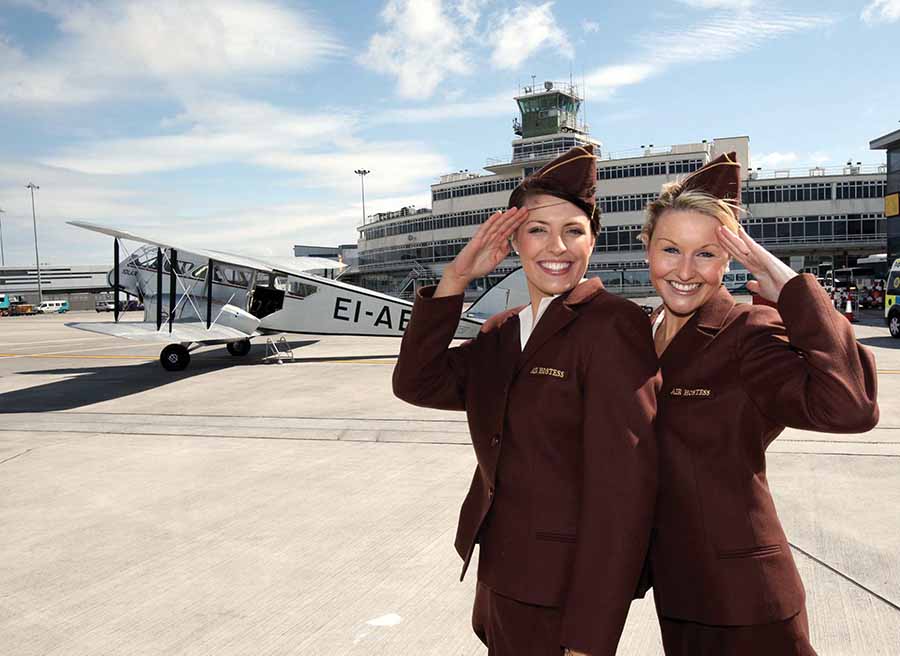
Normal operations resumed in 1945. In November of that year, the Dublin–London route reopened, and the airline welcomed its first three air hostesses.
A pivotal moment came in 1946 with the Anglo-Irish Air Agreement. The two governments tasked Aer Lingus with developing all air services between Ireland and Britain. The agreement also allowed British European Airways (BEA) and British Overseas Airways Corporation (BOAC) to take a combined 40% shareholding in the Irish carrier.
Over the following decade, Aer Lingus focused primarily on expanding its British network. However, it also looked further afield: just two months after the agreement, it launched its first continental service from Dublin to Paris. A year later, Aerlinte Éireann was formed to operate transatlantic flights.
In May 1954, Aer Lingus became the world’s first airline to operate scheduled services to Lourdes, France — a route it continues to serve as a major operator today. In recognition of its contribution, the airline’s then General Manager, Dr J.F. Dempsey, was awarded the Freedom of Lourdes.
The Anglo-Irish Air Agreement was revised in 1956, opening the Irish market to more competitors. Foreign shareholdings in Aer Lingus were reduced, and Aer Rianta eventually acquired and transferred the shares to the Irish Minister for Finance.
Rather than contract in the face of new competition, Aer Lingus chose bold expansion. Over the next three years, it added Düsseldorf, Frankfurt, Zurich, Rome, and Copenhagen to its European network.
Until 1958, Dublin had been awkwardly positioned on the eastern edge of the airline’s route map. That year, the long-awaited transatlantic service finally balanced the network westward.
In subsequent years, Aer Lingus opened offices in many cities not served directly by its routes and undertook some memorable charter flights. In 1963, one of its Boeing 720s flew to Australia to repatriate passengers from a stranded liner. In 1966, it operated its first flights to the Soviet Union, carrying the Glasgow Celtic football team to Moscow and Tbilisi.
Another notable development was the creation of Aer Lingus Commuter, which operated short-haul cross-channel services using Shorts 360 aircraft built in Belfast.
By the early 1970s, facing the uncertain economics of the airline industry, Aer Lingus launched a successful diversification programme. Over the following decade, these non-airline businesses contributed approximately £120 million in profits.
Today, Aer Lingus is far more than just an airline. It provides aircraft maintenance and overhaul services to a fleet four times the size of its own. Its customers span Africa, the Caribbean, the Middle East, and China. The airline offers specialised training for pilots and technicians from countries including Bahrain, Malaysia, Libya, Namibia, Nigeria, Sudan, Kuwait, Iraq, Guinea, and the People’s Republic of China. It also has investments in hotels, leisure complexes, aircraft leasing, computer services, helicopter operations, personnel recruitment, hospital management, robotics, catering, and more.
The global airline industry is undergoing rapid change. American-style deregulation has reached Europe, and an almost “Open Skies” regime now exists between Ireland and Britain. Under new arrangements, Aer Lingus has secured rights to operate via Manchester to Zurich, Milan, Hamburg, and Copenhagen, and via Birmingham to Brussels (with a limit of 30% local UK pick-up traffic for onward journeys). The airline has moved quickly to launch these new services and hopes the remaining restrictions will eventually be lifted.
In addition to new continental services, it has launched routes from Dublin to London Stansted, Newcastle, and domestic services to Galway and Sligo.
Two new Boeing 737-300s entered service, with two more 737-400s scheduled for delivery in 1989 and four 737-500s in 1990. The total cost of this initial European fleet renewal programme is around $215 million, which Aer Lingus plans to fund entirely from its own resources without seeking additional equity from the government.
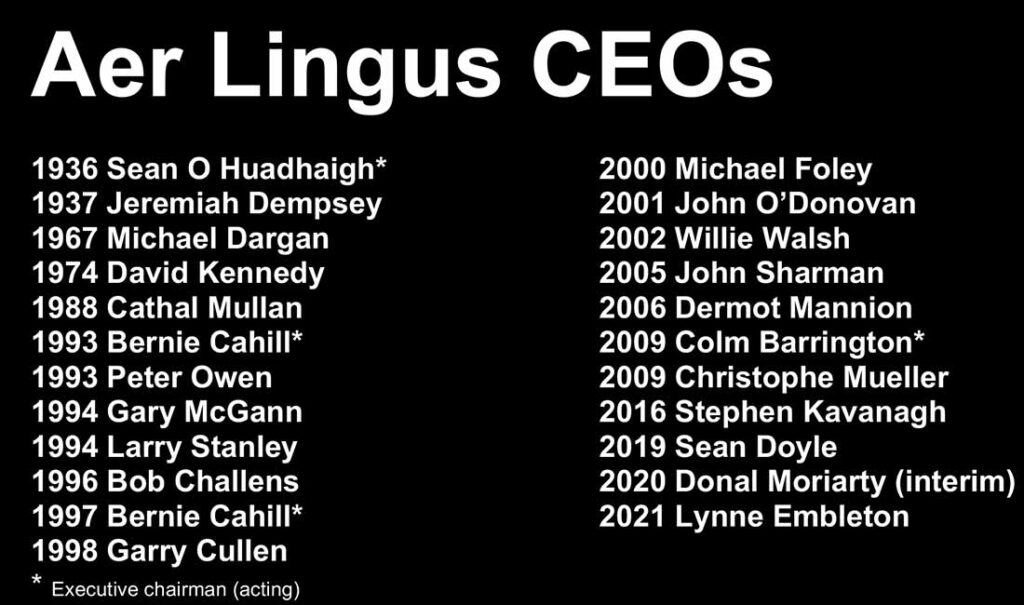
Operating from a small domestic market, Aer Lingus was a strong advocate for greater liberalisation of European air routes. When it came, it almost sank the airline. It was a newly founded rival, Ryanair, that benefitted most from rderegulation.
From the late 1980s, Aer Lingus faced growing competition on short-haul routes as Ryanair emerged as a formidable low-cost rival following Irish aviation deregulation. Ryanair’s aggressive expansion on the Dublin–London corridor and other UK and European routes forced Aer Lingus to adapt, with lower fares and operational efficiencies becoming essential for survival. This rivalry intensified throughout the 1990s and 2000s, shaping Aer Lingus’s shift towards a more commercial, hybrid business model.
A key innovative step came in 1994 when Aer Lingus introduced the Airbus A330 on transatlantic services, becoming the first airline to operate the type under ETOPS rules over the North Atlantic. The B747, of which Aer LINgus had two, was too expensive and it looked for a while that Aer Lingus would have to exit the trans-Atlantic completely, leaving the routes to Delta. The management, Bernie Cahill, looked at the Airbus A340 but it was too large. With the assistance of Paddy Judge, head of IALPA last the time, the airline negotiated with Airbus salesman Chris Buckley for the much more suitable A330, which did not have ETOPS clearance at the time. Aer Lingus identified the specs as suitable for trans-Atlantic and clearance followed. This allowed more efficient and direct flights from Dublin to the United States, facilitating the gradual retirement of the Boeing 747 fleet by 1995 and modernising long-haul operations.
The early 2000s brought a severe double whammy. The foot-and-mouth disease outbreak in 2001 devastated Ireland’s tourism and agricultural sectors, while the 11 September terrorist attacks in the United States caused a sharp collapse in transatlantic travel. These events, combined with high costs and intense Ryanair competition, pushed Aer Lingus to the brink of failure. The airline implemented a painful survival plan involving job cuts, route reductions, and the adoption of elements of a low-fares model.
In the mid-2000s, Aer Lingus completed its transition to an all-Airbus fleet. The last Boeing 737-500s were retired in October 2005, with Airbus A320 family aircraft dominating short- and medium-haul services and A330s handling long-haul routes. This standardisation brought efficiency gains and supported further network development.
Ryanair made repeated attempts to acquire Aer Lingus, including major bids in 2006 and 2008 that ultimately failed due to regulatory and board opposition. These moves highlighted the intense rivalry but also kept Aer Lingus under pressure to improve competitiveness. Partial privatisation occurred in 2006, with the Irish government and Ryanair holding significant stakes.
The eventual takeover by International Airlines Group (IAG) in September 2015 provided stability and capital for growth. Under IAG ownership, Aer Lingus strengthened Dublin as a major transatlantic hub, expanding services to North America. In the 2020s, the airline has deployed Airbus A321LR and A321XLR aircraft on thinner long-haul routes, enabling profitable direct flights to secondary U.S. cities and supporting record transatlantic capacity while maintaining its distinct Irish identity
Retired staff member Margaret Brown shared: “Wearing the uniform and representing Aer Lingus abroad were particularly proud memories for me. It’s probably the closest I’ll get to the feeling of donning an Irish jersey in the World Cup. “
The 1930s: small beginnings
Aer Lingus was inaugurated in April 1936 with an authorised capital of £100,000, a staff of just twelve, one De Havilland Dragon aircraft, and, a famous legend has it, a biscuit tin of spare parts. On 27 May 1936, following a religious service and blessing by the Irish Air Corps Chaplain, the tiny aircraft named Iolar (Eagle) took off from the grass runway at Baldonnel Military Aerodrome near Dublin on its inaugural flight to Bristol.
Despite modest beginnings, the airline grew steadily in its early years. Using a seven seater aircraft, passenger numbers were tiny by modern standards:
- 1936: 892 passengers
- 1937: 2,980 passengers
- 1938: 3,810 passengers
- 1939: 5,002 passengers
In its first full year of operation, Aer Lingus carried 892 passengers and earned £4,697 in revenue, recording an operating loss of £5,147. The airline initially focused on services to Britain, operating from Baldonnel before later moving to the new Dublin Airport at Collinstown.
The outbreak of the Second World War in 1939 brought major restrictions, but the foundations laid in the 1930s enabled Aer Lingus to survive and later expand. These early years demonstrated the resilience and ambition of Ireland’s fledgling national airline.
The 1940s: a decade of survival
The 1940s were a decade of survival and recovery for Aer Lingus. The outbreak of the Second World War severely restricted operations, limiting services to a single route between Ireland and Britain. Despite these challenges, the airline acquired its first Douglas DC-3, increased traffic by 50%, and relocated its operating base to the new Dublin Airport at Collinstown.
Passenger numbers reflected the difficult wartime conditions before surging in peacetime:
- 1940: 5,507 passengers
- 1941: 5,297 passengers
- 1942: 6,168 passengers
- 1943: 6,537 passengers
- 1944: 5,601 passengers
- 1945: 21,235 passengers
- 1946: 74,734 passengers
- 1947: 148,705 passengers
- 1948: 160,892 passengers
- 1949: 191,141 passengers
In November 1945, the Dublin–London service reopened and the first three air hostesses began duty. The pivotal Anglo-Irish Air Agreement of 1946 tasked Aer Lingus with developing all air services between the two countries and allowed BEA and BOAC a 40% shareholding in the airline.
By the end of the decade, Aer Lingus had laid strong foundations for post-war expansion, transforming from a small wartime carrier into a growing national airline.
The 1950s: English investment and first trans-Atlantic
The 1950s marked a period of significant expansion for Aer Lingus. Following the 1946 Anglo-Irish Air Agreement, the airline focused on building its network. In 1954, it became the first airline in the world to operate scheduled services to Lourdes, France, a route it continues to serve today.
New continental routes were rapidly added, with services launched to Paris (1946, but expanded in the 1950s), followed by Düsseldorf, Frankfurt, Zurich, Rome, and Copenhagen within three years after the 1956 revision of the Anglo-Irish Air Agreement. Foreign shareholdings were reduced as the airline strengthened its Irish ownership.
The most important development came in 1958 with the long-awaited launch of transatlantic services, which helped rebalance the network westward from its previous easterly focus.
Passenger numbers grew strongly throughout the decade:
- 1950: 210,800
- 1951: 258,464
- 1952: 277,350
- 1953: 284,970
- 1954: 326,810
- 1955: 383,909
- 1956: 441,643
- 1957: 426,176
- 1958: 498,400
- 1959: 554,982
By the end of the decade, Aer Lingus had evolved into a modern European airline with a growing international presence.
The 1960s:; Aggressive modernisation in the jet age
The 1960s marked a transformative period for Aer Lingus, Ireland’s flag carrier. The airline shifted from propeller-driven aircraft to the jet age, expanded its international network (especially transatlantic routes), and experimented with novel services like car ferries while passenger numbers grew significantly.
Passenger numbers roughly doubled over the decade (+104% total growth). Strong gains aligned with jet introductions and route expansions; the only dip was in 1967 (possibly due to economic factors or operational adjustments).
Aer Lingus aggressively modernsed its fleet: Early 1960s Propeller Era: Continued use of Fokker F27 Friendships (delivered late 1950s) for short-haul UK routes, gradually replaced by second-hand Vickers Viscount 800s in 1966.
The airline entered the jet era on 14 December 1960 with three Boeing 720s for transatlantic services (Dublin/Shannon to New York and Boston). These were successful and boosted capacity and speed.
- 1964: Added larger Boeing 707s to supplement the 720s on long-haul routes.
- 1965: Introduced BAC One-Eleven jets for Continental European routes.
- 1969: Brought in Boeing 737-200s to handle high demand, particularly on the busy Dublin–London route. These became a workhorse for European services.
- In 1967, Aer Lingus ordered its first Boeing 747s (delivered in 1970–71), positioning it for further long-haul growth in the next decade.
One of the most distinctive (and ultimately short-lived) initiatives was the Aviation Traders ATL-98 Carvair operation. In the early 1960s, Aer Lingus sought to tap into the growing car tourism market between Ireland and the UK/Europe.
It acquired Carvairs (converted Douglas DC-4s with a distinctive raised cockpit and nose-loading door) starting around 1963. These could carry up to 5 cars + 22–34 passengers (or configured for more passengers/freight). Routes included Ireland to Liverpool, Bristol (UK), and Cherbourg (France). They also supported nighttime cargo flights.
The aircraft were versatile (e.g., transporting vehicles, passengers, and even horses), but the service proved uneconomical. Competition from improving sea ferries (cheaper and more convenient) led to the end of car-ferry operations in October 1966. The planes were then repurposed for freight before being disposed of.
New transatlantic destinations like Montreal and Chicago (1966). Focus on Europe and North America. The airline adopted the iconic shamrock livery elements and operated as “Aer Lingus, Irish International Airlines.” Strong growth was driven by post-war tourism, emigration patterns, and Ireland’s improving economy. The airline benefited from government ownership and strategic route rights.
The 1970s:: Jumbo jets and growing losses
The 1970s was a decade of growth and modernisation for Aer Lingus. In March 1971, the airline took delivery of its first Boeing 747-100, becoming one of the early European operators of the jumbo jet. A second 747 followed shortly afterwards, with a third acquired later in the decade. The 747s were primarily used to expand and enhance transatlantic services to North America, significantly increasing capacity on long-haul routes.
The airline continued to modernise its fleet with additional Boeing 737s for short-haul operations. In the early 1970s, facing industry challenges, Aer Lingus launched a successful diversification programme into areas such as aircraft maintenance, training, leasing, and other aviation-related services, which helped bolster its financial position.
Passenger numbers showed steady overall growth despite economic fluctuations:
- 1970: 1,631,032
- 1971: 1,769,081
- 1972: 1,680,065
- 1973: 1,807,950
- 1974: 1,703,535
- 1975: 1,788,406
- 1976: 1,898,581
- 1977: 2,019,603
- 1978: 2,237,882
- 1979: 2,484,321
By the end of the decade, Aer Lingus had strengthened its position as Ireland’s national carrier with a modern wide-body capability and a growing network.
The 1980s: Losses, Launch of Aer Lingus Commuter and Recovery
The 1980s proved a challenging decade for Aer Lingus, Ireland’s national airline. It faced economic pressures, rising competition from deregulation, and the need to modernise its fleet and operations while remaining state-owned. The airline responded with route adjustments, subsidiary launches, diversification efforts, and fleet renewal.
Aer Lingus entered the decade in a difficult financial position. It recorded a significant loss of IR£11.2 million in 1981, driven by high fuel costs, global economic conditions, and the effects of U.S. airline deregulation, which increased competitive pressures on transatlantic routes. In response, the airline closed several money-losing long-haul services, including routes to Montreal and Chicago around 1979–1980.
The older Boeing 707 aircraft, which had been a mainstay for transatlantic services, were gradually phased out in the early 1980s. The last Boeing 707 in the fleet, named Saint Canice, made its final flight in 1986 on a special enthusiast trip from Dublin to Knock and back. By this point, the airline relied more heavily on its Boeing 747s for North Atlantic operations.
In 1980, Aer Lingus acquired a 54% stake in the small all-cargo carrier Aer Turas, which operated DC-8 freighters. This move strengthened its cargo capabilities. One of these aircraft later achieved a notable milestone by becoming the first Irish plane to circumnavigate the globe in 1984.
The airline also pursued diversification beyond core passenger operations. In 1983, its subsidiary Dunfey Hotels acquired Omni International Hotels, expanding into the international hotel sector (this investment was later sold in 1988 for $135 million).
A key development came in 1984 with the establishment of Aer Lingus Commuter, a fully owned subsidiary. This allowed the airline to serve smaller cities in Ireland and Britain more economically using turboprop aircraft, such as the Short 360, rather than jets. The move helped sustain regional connectivity that might otherwise have become unviable.
The airline faced a notable security incident in 1981 when one of its flights from Dublin to London was hijacked. The event ended without injury after negotiations in France.
Deregulation in the British-Irish market gathered pace during the decade. In 1986, Ireland became one of the first European countries to liberalise its main route (Dublin–London), allowing new competition, including from Ryanair, which began operations in the mid-1980s. This led to lower fares and significant growth in passenger numbers on the route.
Aer Lingus invested in fleet renewal to improve efficiency. Between 1987 and 1989, it introduced new Boeing 737s to replace older models and added Fokker 50 turboprops to the Commuter fleet. In 1989, the first of five Boeing 737-400s entered service, offering greater capacity for European routes.
By the mid-to-late 1980s, traffic began to recover. North Atlantic passenger numbers grew strongly in 1985, and overall operations showed improvement, with the airline returning to profitability in some years. However, challenges persisted, including the need to address high costs and prepare for further liberalisation in European aviation.
Aer Lingus celebrated its 50th anniversary in 1986, marking half a century since its founding in 1936.
Throughout the 1980s, Aer Lingus balanced its role as a flag carrier—maintaining essential links to North America and Europe—with commercial realities. It operated a mix of transatlantic jets (primarily Boeing 747s), short-haul Boeing 737s, and commuter turboprops. The decade laid groundwork for the more intense competition and restructuring that would follow in the 1990s, as the European aviation market continued to open up.
The airline carried millions of passengers annually by the end of the decade, supported ancillary businesses such as maintenance and hotels, and adapted to a more competitive environment while retaining its core identity as Ireland’s national carrier.
1990s: Crisis and Restructuring
The 1990s were a turbulent but ultimately transformative decade for Aer Lingus. The airline faced severe financial difficulties early on due to the Gulf War, economic recession, intense competition from low-cost carriers like Ryanair, and the effects of European aviation liberalisation. It underwent major restructuring, fleet modernisation, and a shift towards greater commercial efficiency, setting the stage for recovery as Ireland’s “Celtic Tiger” economy boomed later in the decade.
Aer Lingus entered the decade still operating a mixed fleet that included Boeing 737s, older types on short-haul routes, and Boeing 747s on transatlantic services. In 1990, following further deregulation in Ireland, the airline retired its BAC One-Eleven aircraft and replaced them with new Boeing 737s. The commuter division introduced Saab 340B turboprops in 1991 to replace Short 360s.
The early 1990s brought deep losses. The Gulf War, high fuel prices, and aggressive competition contributed to heavy deficits, with the airline reportedly losing around IR£116 million in 1993 and accumulating substantial debt. In response, the Irish government provided a state aid injection (reported as IR£175 million), and the Cahill Plan was launched in 1993–1994. This restructuring programme involved significant cost-cutting, workforce reductions, and operational changes. Maintenance operations had already been separated into TEAM Aer Lingus in 1990.
A major milestone came in 1994 when Aer Lingus introduced the Airbus A330 on transatlantic routes, becoming the first airline to operate the A330-300 under ETOPS rules over the North Atlantic. This allowed more direct services, including from Dublin to the United States. The airline phased out its Boeing 747s, with the last flight taking place on 2 October 1995 after 25 years of service, during which over eight million passengers had flown on the type.
Aer Lingus Commuter expanded its capabilities, adding BAe 146 regional jets in 1995 to replace some turboprops on UK routes. This helped improve competitiveness on thinner routes. By the mid-1990s, the mainline fleet increasingly featured newer Boeing 737 variants, making Aer Lingus one of the first carriers to operate all three versions of the second-generation 737.
The restructuring bore fruit as traffic grew and costs fell. By the mid-1990s, Aer Lingus returned to profitability. It added new destinations, such as Newark, to its North American network. In February 1996, the airline unveiled a new corporate identity, the first major change in twenty years, reflecting a more modern and commercial outlook.
The Airbus A321 entered service in 1998, initially deployed on the busy Dublin–London Heathrow route to replace some 737-400s. In 1999, long-range Airbus A330-200 aircraft enabled the launch of a new service to Los Angeles. The airline also returned to Belfast with services to New York later in the decade.
Competition with Ryanair intensified throughout the decade, particularly on the Dublin–London corridor and other UK routes. Aer Lingus used its Commuter subsidiary to compete more effectively on lower-yield routes while maintaining a full-service offering on core sectors.
By the late 1990s, Aer Lingus benefited from Ireland’s strong economic growth. Pre-tax profits reached IR£55 million in 1998, with passenger numbers rising steadily. The airline operated a modernising fleet focused on Boeing 737s for short-haul and Airbus A330s for long-haul, supported by regional aircraft in the Commuter division. It sold TEAM Aer Lingus during this period as part of efforts to streamline operations.
The 1990s transformed Aer Lingus from a struggling state carrier into a more efficient operator better equipped for the fully liberalised European market of the new millennium. Challenges from low-cost competition persisted, but the decade ended on a more positive note with renewed profitability and a refreshed brand.
2000s: Post-9/11 Crisis, Survival and Privatisation
The 2000s marked another period of significant change for Aer Lingus. The airline navigated the aftermath of the 11 September 2001 attacks, intensified low-cost competition, fleet transition to an all-Airbus operation, partial privatisation, and strategic shifts towards a hybrid business model combining competitive fares with full-service elements.
Aer Lingus entered the decade with a mixed fleet that still included Boeing 737s on short-haul routes and Airbus A330s on long-haul services. The first Airbus A320 entered service in June 2000 on busier continental European routes.
The terrorist attacks of 11 September 2001 had a severe impact on transatlantic and overall operations. In response, the airline implemented a survival plan that included staff reductions, route cuts, and fleet shrinkage. It also adopted elements of a low-fares model to better compete with carriers such as Ryanair. On 1 February 2001, Aer Lingus Commuter was fully merged back into the mainline operation.
These measures, combined with cost reductions and the introduction of more modern aircraft, enabled the airline to return to profitability despite the challenging global aviation environment.
A major milestone occurred in October 2005 when the last Boeing 737-500s were withdrawn, making Aer Lingus an all-Airbus airline for the first time. Deliveries of additional Airbus A320 family aircraft (including A320s and A321s) accelerated from 2004 onwards, supporting both European and higher-density routes.
In 2006, Aer Lingus launched its first scheduled long-haul service outside North America, to Dubai. The route operated until March 2008. It was unsuccessful, largely because of the absence of an interline agreement with Emirates, for whom CEO Dermot Mannion had previously worked.
Long-haul operations continued to rely on Airbus A330 aircraft. In June 2007, the airline placed an order for six Airbus A350-900s and six additional A330-300s to support future growth and fleet replacement. Deliveries of the new A330-300s began in 2009.
On 2 October 2006, Aer Lingus was partially privatised through a flotation on the Dublin and London stock exchanges. The Irish government retained a significant stake (initially around 28%), while Ryanair acquired a minority shareholding of over 25% at one point. Ryanair made takeover bids in 2006 and again in 2008, both of which were rejected by Aer Lingus and faced regulatory scrutiny.
The airline left the Oneworld alliance on 31 March 2007 as part of its evolving commercial strategy. It opened a base at Belfast International Airport in August 2007. A route to San Francisco was inaugurated, although it was suspended during the global financial recession before being revived.
The global financial crisis towards the end of the decade brought renewed pressure. In 2009, Aer Lingus announced a restructuring plan aimed at cutting operating costs substantially by 2011 through efficiency measures and network adjustments.
Despite these challenges, the airline upgraded its long-haul product from late 2008 and continued to develop its network, particularly transatlantic services, while maintaining competitiveness on short-haul routes. It benefited from Ireland’s economic links and the growing importance of Dublin as a transatlantic gateway.
The pressure of competing with Ryanair were beginning to tell. When he was appointed in 2009, the first CEO of Aer Lingus to come rom outside of Ireland, Christophe Mueller said that the airline had become a “me too” airline and needed another strategy. He also signaled that the A350 was the wrong aircraft for the airline, something that was to prove correct as the airline converted orders over the next few years to more suitable aircraft such as longer range A320s and A321s, culminated in the A321XLR.
By the end of the 2000s, Aer Lingus had transformed into a more agile, lower-cost operator with a modern all-Airbus fleet focused on Airbus A320 family aircraft for short- and medium-haul services and A330s for long-haul. It balanced its flag-carrier heritage with commercial realities in a fully liberalised European market. The decade prepared the airline for eventual full integration into a larger group in the following years, while competition with Ryanair remained a defining feature of its operating environment. Passenger numbers and profitability recovered in stronger years, supported by route development to mainland Europe and North America.
The 2010s: Network Growth and Takeover
The 2010s represented a decade of recovery, strategic repositioning as a value hybrid carrier, network expansion, and ultimately a major change in ownership for Aer Lingus. The airline continued to balance its flag-carrier role with competitive pressures while benefiting from Ireland’s economic recovery.
Aer Lingus entered the decade recovering from the global financial crisis. In 2010, it reported a return to profitability with a positive operating result, supported by cost controls and network adjustments. That year, the airline celebrated 70 years of operations at Dublin Airport.
In 2011, Aer Lingus took delivery of a new Airbus A320 in a special retro 1960s “Irish International” livery to mark its 75th anniversary. It also restored its historic Iolar aircraft (a De Havilland Dragon) to airworthy condition.
A significant partnership developed with Aer Arann. In 2010–2012, this evolved into a franchise agreement under the Aer Lingus Regional brand. Aer Arann (later Stobart Air) operated shorter regional routes to England, France, and the Isle of Man, allowing Aer Lingus to maintain connectivity on thinner routes using turboprop aircraft while focusing its mainline fleet on busier sectors.
The airline expanded its Gatwick operations cautiously and adjusted transatlantic services from Shannon in response to seasonal demand.
Aer Lingus strengthened its long-haul network. In April 2014, it launched direct services to San Francisco and Toronto, enhancing its North American presence. It also embraced social media innovations, becoming one of the first airlines active on platforms such as Snapchat.
The most transformative event of the decade occurred in 2014–2015. International Airlines Group (IAG), owner of British Airways, Iberia, and Vueling, launched a takeover bid. After initial rejections, IAG’s improved offer of €2.55 per share (totalling around €1.4 billion) was recommended by the Aer Lingus board in January 2015. The Irish government agreed to sell its 25% stake in May 2015, and Ryanair sold its near-30% holding in July 2015. Regulators approved the deal with conditions, including the release of slots at London Gatwick.
IAG assumed control on 2 September 2015, and Aer Lingus shares were delisted shortly afterwards. The airline continued to operate as a separate entity with its own brand, management, and headquarters in Dublin, while gaining access to greater capital and network synergies within the IAG group.
Under IAG ownership, Aer Lingus focused on developing Dublin as a transatlantic gateway. It expanded routes to North America and refined its hybrid model — offering competitive fares alongside a full-service product on long-haul flights. The airline benefited from Ireland’s strong economy and growing tourism and business links.
Fleet modernisation continued with Airbus A320 family aircraft on short- and medium-haul routes and Airbus A330s on long-haul services. Plans were laid for future widebody and narrowbody additions to support further growth.
By the end of the 2010s, Aer Lingus had stabilised as a profitable, modern operator within the IAG portfolio. It maintained a strong presence on UK, European, and North American routes while using regional partners for thinner markets. The acquisition by IAG provided financial strength and strategic opportunities that shaped its development into the following decade. Passenger numbers grew steadily, and Dublin Airport solidified its role as a key hub connecting Europe with North America.
The 2010s thus marked Aer Lingus’s transition from an independent listed company to an integrated but distinct member of one of Europe’s largest airline groups.
2020s: COVID-19 Crisis and Initial Recovery
The 2020s have been a period of profound disruption followed by strong recovery and ambitious growth for Aer Lingus. As a wholly owned subsidiary of International Airlines Group (IAG) since 2015, the airline faced the severe impact of the COVID-19 pandemic early in the decade before capitalising on Ireland’s economic strength, transatlantic demand, and fleet modernisation to expand its network significantly.
The decade began with major challenges. In early 2020, Aer Lingus unveiled a new uniform designed by Irish fashion designer Louise Kennedy, reflecting a modern brand refresh. However, the global COVID-19 pandemic soon dominated operations.
Travel restrictions led to a dramatic 95% reduction in the network during spring 2020. The airline cut employee hours and salaries by 50% as a temporary measure and sought around 900 job cuts. It also operated vital cargo flights, including repatriation and personal protective equipment (PPE) deliveries from China.
Like much of the aviation industry, Aer Lingus incurred heavy losses in 2020 and 2021. Recovery began in 2022 as restrictions eased, with a gradual resumption of services. The airline benefited from strong pent-up demand on transatlantic routes, leveraging Dublin’s position as a key gateway between Europe and North America.
Aer Lingus accelerated its transition to more efficient narrowbody aircraft for long-haul operations. It took delivery of Airbus A321LR aircraft, which enabled profitable services on thinner transatlantic routes. Deliveries of the longer-range Airbus A321XLR followed, with the first examples arriving in late 2024 (after some delays). These aircraft opened new possibilities for direct flights to secondary U.S. cities.
The airline expanded its North American footprint aggressively. New or increased services included routes to cities such as Denver, Las Vegas, Nashville, Indianapolis, Minneapolis, Cleveland, and others. In 2025 and 2026, further growth saw increased frequencies to Boston and New York JFK (third daily flights) and a new route to Raleigh-Durham in 2026. By mid-decade, Aer Lingus operated one of its largest-ever transatlantic schedules.
Short- and medium-haul operations continued with the Airbus A320 family, while widebody Airbus A330s supported core long-haul services. In 2025, IAG placed orders that included Airbus A330-900neo aircraft expected to support future widebody needs for Aer Lingus.
Sustainability efforts advanced, with targets for increased use of sustainable aviation fuel (SAF). In 2026, Aer Lingus became the second IAG airline to introduce Starlink in-flight Wi-Fi.
Aer Lingus maintained its hybrid model — competitive fares on short-haul with a full-service long-haul product. It continued to use partners for some regional routes while focusing mainline operations on higher-yield sectors. Dublin Airport’s role as a transatlantic hub strengthened considerably.
The airline faced typical industry pressures, including labour relations, fuel costs, and competition, but overall traffic and financial performance improved markedly as the decade progressed, supported by Ireland’s robust economy and tourism sector.
By 2026, Aer Lingus had emerged from the pandemic as a leaner, more efficient operator with a modern fleet centred on Airbus types. It successfully expanded its transatlantic network to record levels while maintaining strong European connectivity. The decade reinforced its position within IAG, allowing access to group resources for growth while preserving its distinct Irish brand and flag-carrier identity.
Aer Lingus continues to evolve as a key connector for Ireland, balancing heritage with commercial ambition in a highly competitive global aviation market. Routes to Raleigh Durham and Pittsburgh, launched in 2026, brought the total number of direct connections to North America to 24. At the same time, free fast wifi was introduced to the first aircraft of the fleet, EI-EIN, Saint Dalamán, with the rest of the long haul fleet to follow in 2026 and the short haul fleet in 2027.