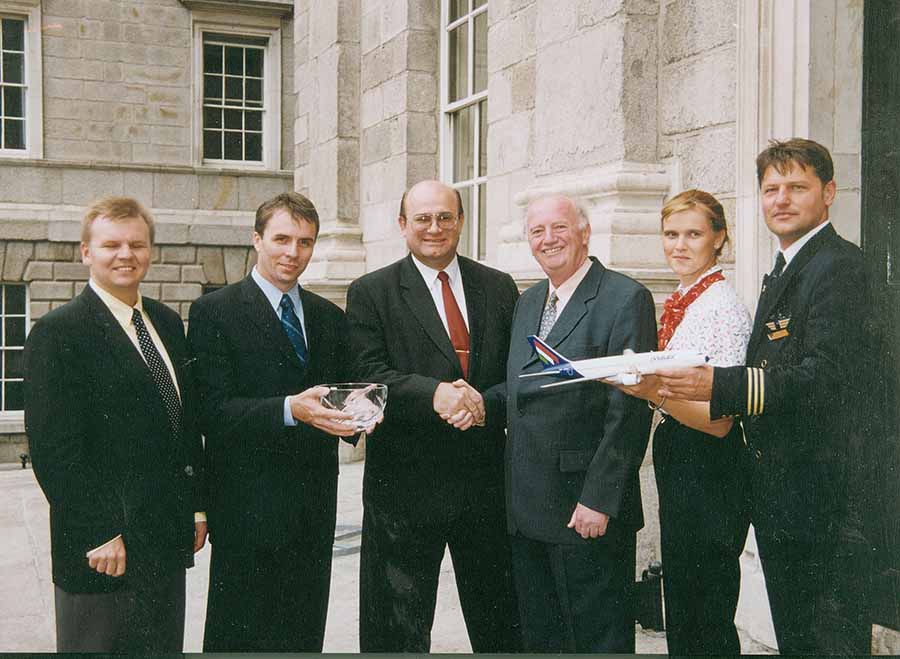
From the moment Josezf Varadi walked into that hotel room in Dublín, you could tell he was a man that was going places, which is a reasonable enough supposes iron as he was one of Europe’s youngest and highest achieving aviation chief executive officers.
Malev’s country head in ireland, Geraldine Aherne, was our host on the evening, gregarious and glamorous as always. There were speeches by the ambassador and other dignitaries, but it was Josezf who set the room on fire. He spoke about networks, load factors, and turnaround times in a way that was unusual for his colleagues in a state secure airline, many of whom were leftovers from the iron rice bowl of the communist era.
Malev, the old flag carrier for Hungary, was expanding into Cork having opened a Dublín service and served as a pioneer in Eastern Europe for other airlines. Malev came with a considerable amount of baggage, (well over the standard 22K allowance), and eventually ended up in the great aircraft scrapyard in the sky. The spotters of Shannon still remember the night, September 9, 2005, that leased Malev aircraft queued to land on the runway, as dramatic as it gets as airline failures go.
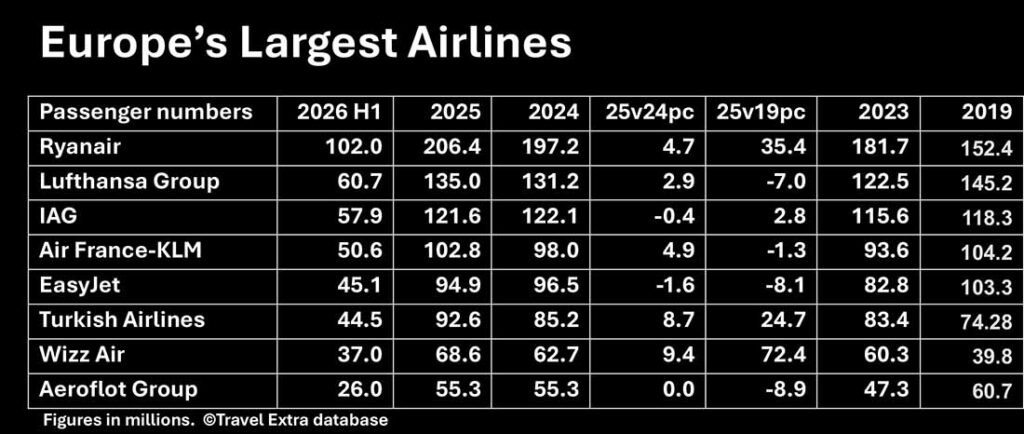
But Josezf Varadi was not built for failure. The airline he found it after my life has brushed everyone aside, including long-standing rivals Ryanair, and taken its place as the fastest growing airline in Europe.
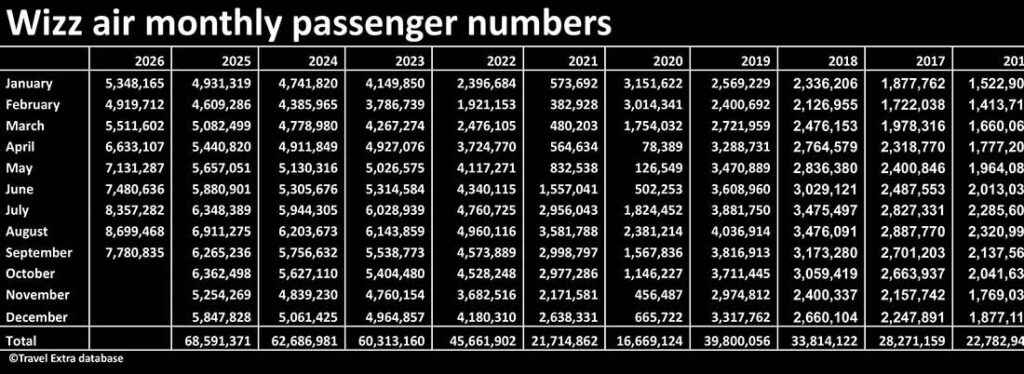
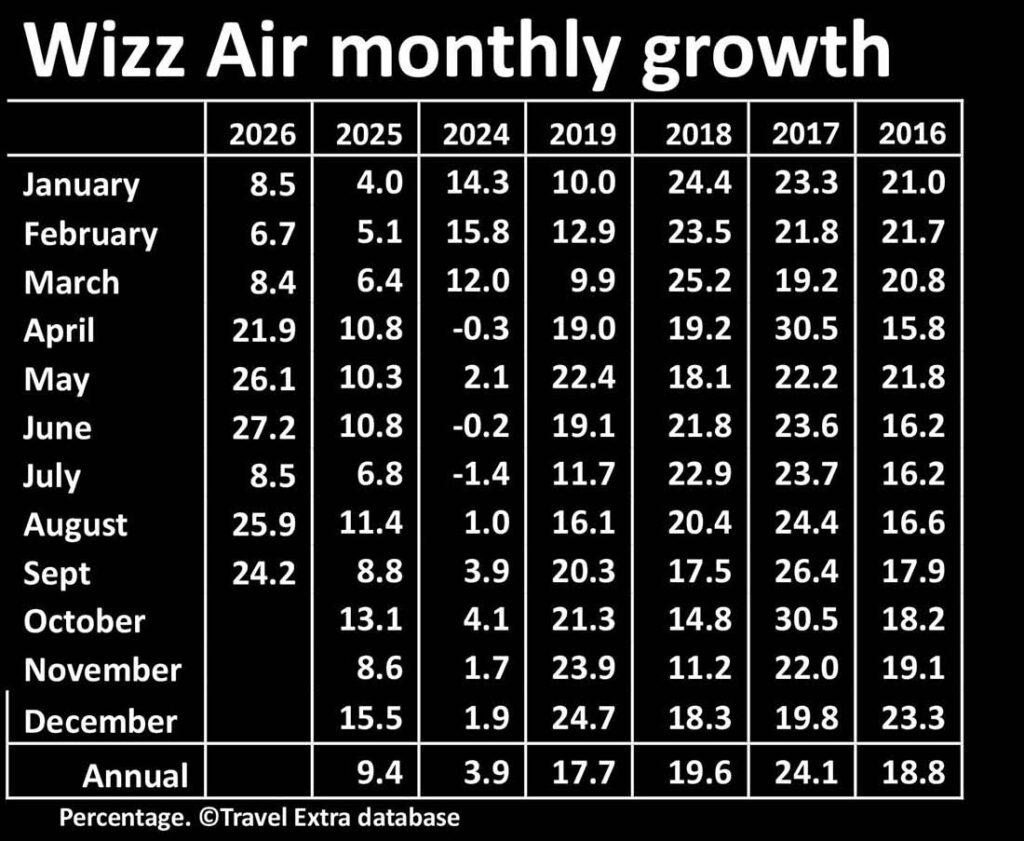
Wizz Air have just announced passenger numbers of 8,699,468 million for Augusts, marking a 25.9pc increase compared to the same month in the previous year and 115.5pc ahead of pre-pandemic. Rolling annual was 77,811,090, up 17.6pc on the twelve months to July 2025. It is an astonishing achievement. Load factor was at Ryanair levels, 95.6pc, where the industry average is 82pc.
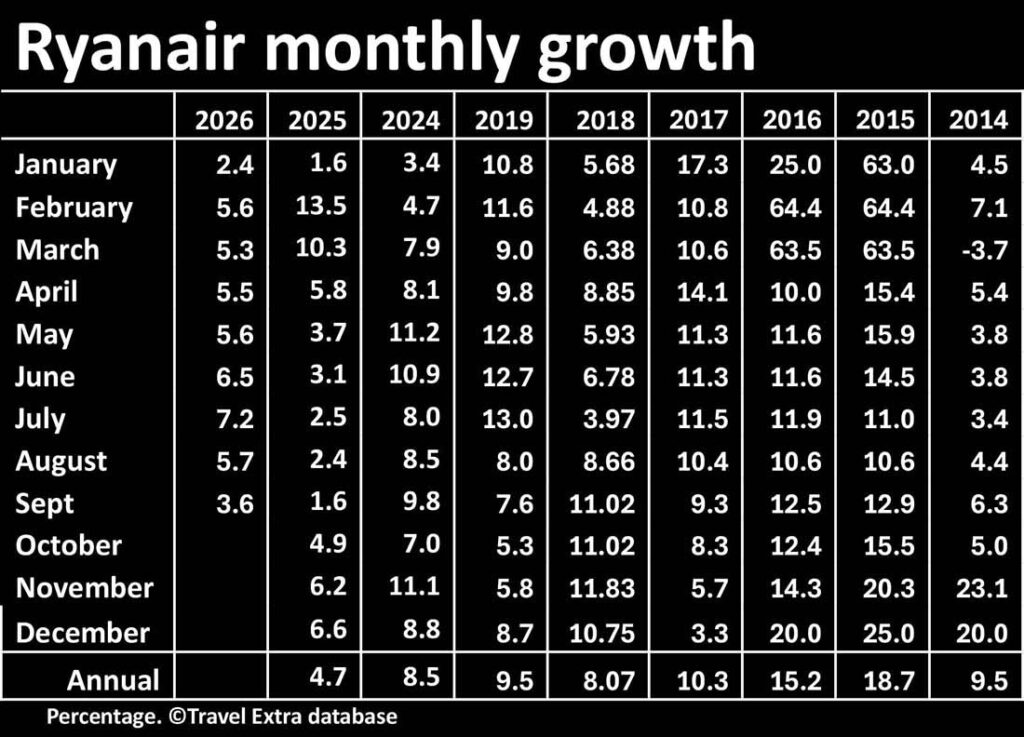
Summer time growth of 26pc is unprecedented din European aviation, and, while Ryanair achieved higher growth rates in the winter months 2014-15 and 2015-16, it has not seen summer r growth of that level since the early noughties.
The trajectory of Wizz Air under Josezf Varadi is a lesson in the inexact science of low cost aviation. After leaving the state carrier he co founded Wizz Air in 2003 with partners and investment from Indigo Partners. He has remained chief executive throughout the airline’s existence, Europe’s second longest currently serving after (you have guessed it),Michael O’Leary. The sequence of roles supplied commercial discipline and an appreciation of cost structures that informed the design of the new carrier.
The fleet consists solely of Airbus A320 and A321 family aircraft simplifying crew training maintenance procedures and spare holdings. High density single class configurations maximise seats per departure. Rapid turnarounds at secondary airports increase daily utilisation. These design choices produce the unit cost structure that enables the low fare offer and the passenger growth shown in the tables. From annual totals below 20m in 2015 to figures approaching 70m and monthly peaks now above eight million, the recorded trajectory constitutes one of the clearest instances of continuous expansion among European carriers.
Network densification
Cometh the hour, cometh the man. Josezf Varadi was born in Debrecen in 1965 and graduated in economics from the Budapest University of Economic Sciences in 1989. He subsequently obtained a Master of Laws from the University of London.
Between 1991 and 2001 he worked at Procter and Gamble rising to sales director for global customers across eleven European Union countries. In 2001 he joined Malév Hungarian Airlines as chief commercial officer and later served as chief executive until 2003.
Wizz’s first base was established, not in Hungary, but at Katowice Airport. On 19 May 2004 the airline operated its inaugural commercial flight from Katowice to London Luton and based its initial aircraft there.
A second base opened in Budapest the following month. Early operations relied on a small fleet of Airbus A320 aircraft serving a limited set of western European destinations. Subsequent development of further bases proceeded systematically across Central and Eastern Europe.
Additional locations were opened in Poland including Warsaw Gdańsk Poznań and Wrocław as well as in Romania Bulgaria the Baltic states and the western Balkans. Later phases extended the base network into Italy with aircraft placed at Milan Malpensa Rome Fiumicino Naples Catania and Turin and into the United Kingdom at London Luton.
By 2026 the largest bases by aircraft numbers were Budapest Bucharest and London Luton. The progressive addition of bases has raised the total number of operational points and supported denser schedules within the core region while enabling selective western European growth.
The expansion programme was concentrated on densification inside Central and Eastern Europe while extending selected capacity into Italy, England and other western European points. Additional aircraft have been based at Milan Malpensa, Naples, Catania, Turin, Warsaw Chopin and Rome Fiumicino. Fleet size increased from 231 aircraft at the end of the previous financial year to 262 by the close of March 2026 with further A321neo deliveries scheduled.
The programme has favoured shorter stage lengths that raise daily aircraft utilisation and support higher load factors. New routes have been timed to capture both peak summer traffic and shoulder season flows including autumn schedules. Market share within the Central and Eastern European region has been maintained at leading levels by seat capacity. The approach has produced measurable passenger gains in Italy where annual volumes have risen into the low twenties of millions and in Poland where double digit growth has been recorded in recent years.
The programme has also involved the opening of secondary airport bases that offer lower charges and faster turnarounds, agam plan familiar to anyone who has watched the growth of low cost aviation in the USA, Europe and Asia since the 1980s.
Pratt and Whitney setback
The Pratt and Whitney engine setback imposed a temporary limit on available capacity. Service bulletins issued in November 2023 required inspections of PW1100G geared turbofan engines on the A320neo family.
Problems linked to powder metal components necessitated engine removals for examination. Limited maintenance capacity and spare engine stocks resulted in the grounding of approximately forty aircraft for extended periods. Average grounded numbers stayed in the low to mid forties through much of 2025 before a measured reduction.
Compensation packages were confirmed with the manufacturer to cover direct costs and supply operational assistance. A further support agreement extending through 2026 was later revealed. Forty geared turbofan (GTF) powered aircraft were held out of service for required inspections and shop visits. After two years of negotiaoitn, Wizz Air finally reached a multi-year commercial support and compensation agreement with engine manufacturer Pratt & Whitney through December 31, 2026. The arrangement covers direct costs and provides operational backing for roughly 40 Airbus A320neo family aircraft grounded due to microscopic crack inspections linked to contaminated powder-metal parts.
The agreement extends through the end of calendar year 2026 and “includes both operational support and a compensation package covering the Company’s direct costs associated with the aircraft that have been grounded or are expected to be grounded.”
The airline nevertheless retained Pratt and Whitney for a large share of future engine requirements. Management anticipates continued improvement in aircraft availability through 2026 and 2027.
Despite the disruption the airline selected Pratt and Whitney engines for a substantial portion of its remaining Airbus order book securing further assistance as part of the agreement. Management expects the number of affected aircraft to continue reducing through 2026 and 2027 as maintenance throughput increases.
Expanding too fast?
Wizz Air is increasing capacity by roughly 25pc to 30pc year-on-year and filling aircraft at high load factors above 95%. However, this rapid growth has coincided with deepening operating losses, squeezed profit margins, and lower fare yields as the airline cuts prices to absorb high fuel costs and geopolitical disruptions. One commentator wanted: “It reported an operating loss of €183.3 million ($211.7 million) for April-June, its first quarter, as it was unable to pass on rising fuel costs stemming from the Iran war to its core customers who demand cheap seats.”
Concerns have been expressed that the pace of expansion may prove excessive. Rapid addition of seats and routes has required intensive yield management to fill the extra capacity. In some periods revenue per available seat kilometre has softened as new flying is absorbed.
The volume of routes less than one year old has risen sharply creating a digestion challenge. Analysts and rating agencies have noted the operational strain associated with simultaneous fleet growth engine related groundings and network adjustments.
The decision to moderate future delivery rates through renegotiation with Airbus reflects an acknowledgement of the need to balance growth with reliability and profitability.
When Michael O;Leary says fuel costs linked to the conflict in the Middle East are putting pressure on the industry and that some airlines could struggle to survive this winter if oil prices remain high, there is no doubt to whom he is referring.
The debt dilemma
Debt ratio considerations form a parallel area of attention. Wjhile Ryanair is debt free with wholly owner aircraft, Wizz’s lease liabilities under accounting standards constitute the greater part of reported borrowings. Wizz Air operates a total fleet of 262 aircraft, the vast majority of which, nearly 100pc, are held through operating leases, financial leases, and sale-and-leaseback (SLB) arrangements rather than outright ownership. Most of these are leased out of Dublin. AerCap famously leased Wizz Air’s very first operational A320-200 back in 2004
Lessors contracted with Wizz include Aviation Capital Group (2), Aergo Capital (1), Arena Aviation Capital (1), Avic Leasing (6), Avolon (1), Bbam (1), Bleriot Aviation Funding (1), Boc (3), Bocomm Leasing (3), Carlyle Aviation Partners (3), Ccb Financial Leasing (1), Cdb Aviation (8), CDB leasing (1), Chishima Real Estate (1), Cmb Financial Leasing (2), Deucalion Aviation (1), Dynam Aviation (2), Fpg Group (2), Goshawk Aviation (1), Huoguo Limited (1), Icbc (2), Jp Lease (2), Maverick Aviation (3), Maverick Aviation Ventures (2), Orix Aviation (2), Pembroke (3), Sierra Echo (1), Smbc (6) and Wings Capital Partners (1).
The leverage ratio calculated as net debt to earnings before interest tax depreciation and amortisation stood at 3.7 at the end of the financial year to March 2026 a reduction from 4.4 in the prior year. Net debt hovered near €4.9 billion.
Liquidity ratios improved over the same interval. Rating agencies have observed elevated leverage linked to the engine inspections higher fuel costs and the costs of absorbing capacity. One agency lowered its rating while another affirmed an existing assessment with a stable outlook.
Management has prioritised cash generation sale and leaseback activity and controlled capital expenditure to support gradual deleveraging. The structure of aircraft financing through leases rather than outright ownership keeps reported leverage higher than pure owned fleet models but preserves balance sheet flexibility. Aggressive seat expansion is outpacing unit revenues, forcing the carrier into a margin problem even as passenger volume surges
The commodity business
Like Michael O’Leary, Josezf Varadi knows he is in the commodities business, a Lidl or Aldi of the skies. Experience in consumer goods instilled rigorous attention to unit costs and customer price sensitivity. The period at Malév demonstrated the constraints of a full service model under public ownership. Continuous leadership of Wizz Air has permitted consistent application of the ultra low cost formula through successive market conditions. External board roles and recognition within Hungary have accompanied the operational record. By early 2026 cumulative passengers since the first flight exceeded five hundred million.
Seasonal patterns within the traffic statistics remain consistent. June July and August produce the highest monthly volumes. In 2025 August reached 6,911,275 passengers and July 6,348,389. The 2026 equivalents of 8,699,468 and 8,357,282 record the absolute rise. Intermediate months display intermediate levels that further base development and frequency increases seek to elevate. Winter months remain lower but have expanded in absolute terms as year round demand in principal cities has strengthened.
Network adjustments during the engine inspection period have redeployed available aircraft onto high utilisation routes. Frequency increases on established corridors and the selective opening of additional bases in lower cost locations have offset temporary fleet reductions. Monthly passenger totals for the first eight months of 2026 already exceed the matching months of earlier years. Ancillary revenue streams from baggage seats and priority services continue to support yields while the core fare structure maintains the price advantage.
Working together
Keepigg a coordinated system with the engine manufacturer and lessors is central to Wizz’s future. Shop visit times have exceeded original estimates extending the period of reduced availability. Statements from management have confirmed the priority of returning aircraft to service. Financial support packages have limited the cash impact. Retention of the engine supplier for future aircraft indicates an assessment that reliability will improve and that the efficiency profile of the geared turbofan remains attractive.
The strategy has remained oriented toward European organic growth. The fleet is composed exclusively of Airbus A320 and A321 family aircraft simplifying training maintenance and spares. High density cabins maximise seats. Rapid turnarounds at secondary airports raise daily cycles. These features generate the unit cost base that supports low fares and the passenger growth recorded in the statistics. From annual totals below twenty million in 2015 to figures approaching seventy million with monthly peaks now above eight million the trajectory stands as a clear instance of continuous expansion.
He has seen it all. For that optimistic and surprising choice of first base at Katowice and the subsequent development of a wide base network the expansion programme the traffic statistics the engine setback and the attention to leverage and growth pace all form part of the analytical record under Josezf Varadi’s leadership.