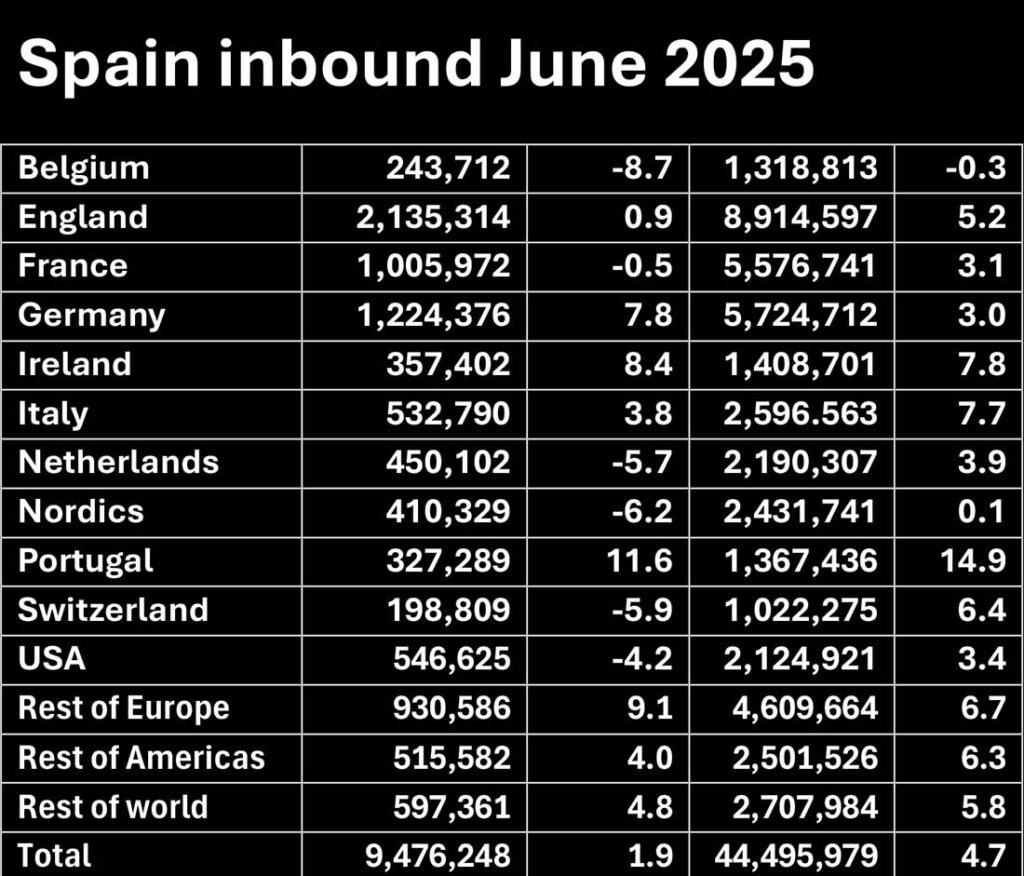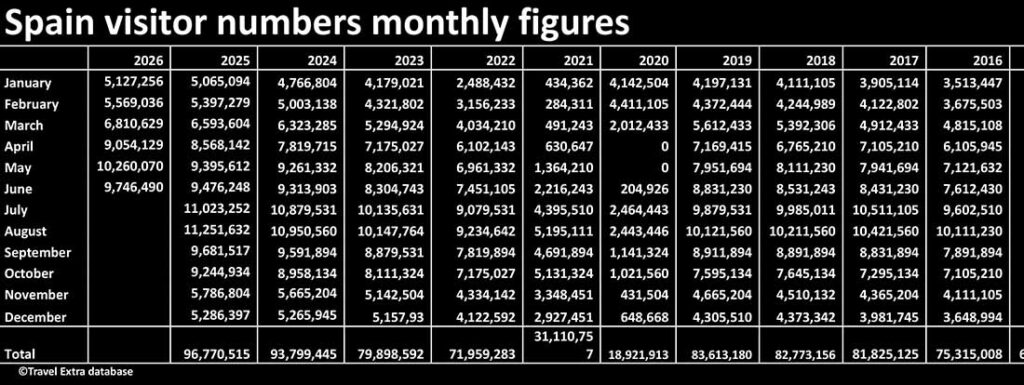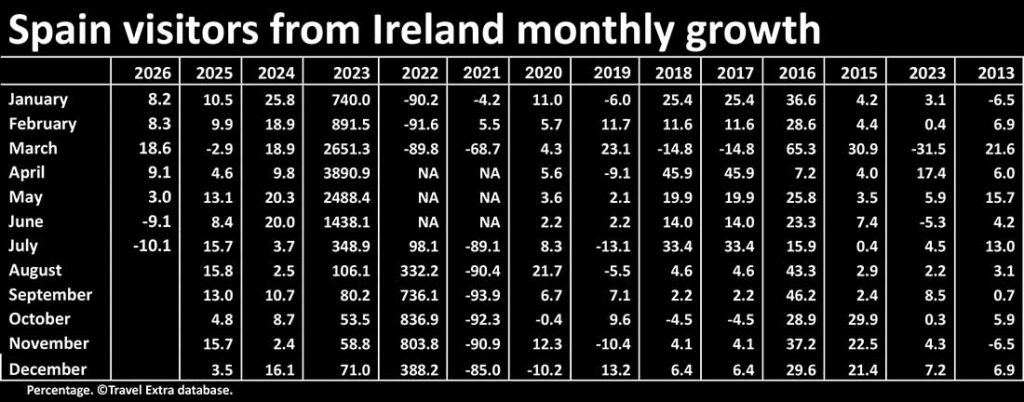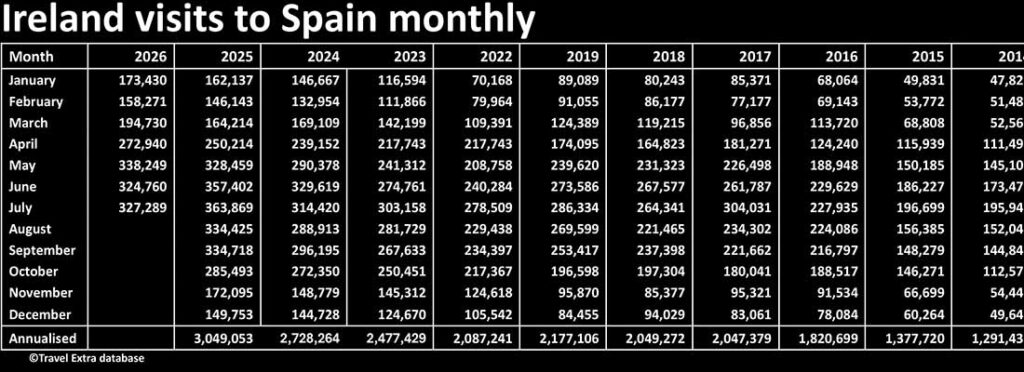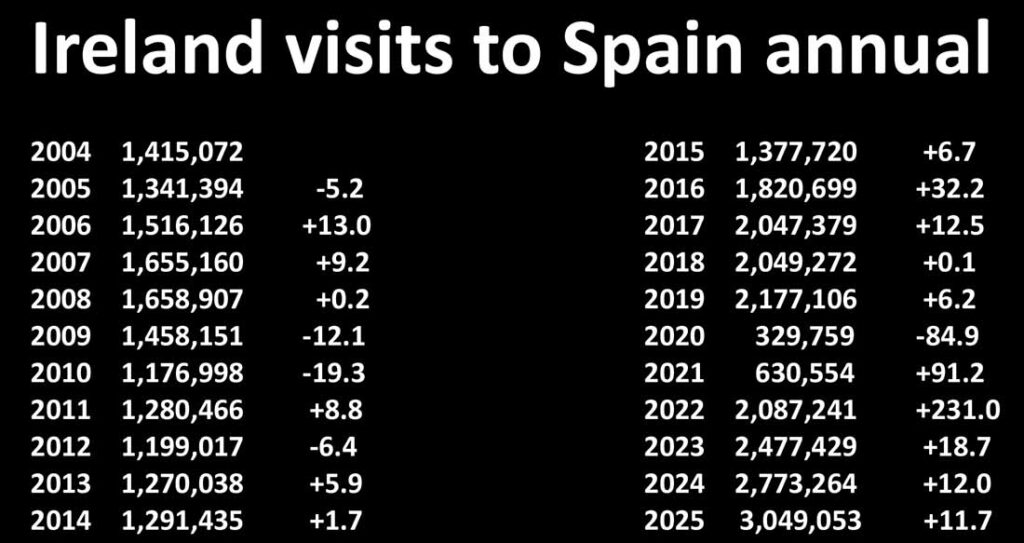
European travel habits are changing, driven by economic pressures, rising costs, and the earlier heat waves of 2022 and this year. The latest statistics from the Spanish tourist board show drops in the French and German inbound market and also from Ireland 28 successive months of growth.
The figures from Spain provide a clear window into wider patterns across the continent. French and German holiday makers, long the backbone of Mediterranean summer traffic, have reduced their visits this year. Higher accommodation rates, elevated flight prices and successive heatwaves have combined to alter decisions that once seemed automatic. Families who previously booked two-week stays in the Costa del Sol or the Balearics now weigh shorter breaks or alternative destinations closer to home. The Spanish tourist board has confirmed that the decline in these two source markets coincides with broader European inflation that continues to squeeze discretionary budgets even as overall recovery from earlier disruptions remains incomplete.
Ireland presents a contrasting picture. Outbound travel expanded for 28 consecutive months according to the same Spanish data sets. In June Ireland’s visitor numbers to Spain fell by 9pc and Spanish visitor numbers to Ireland rose by 6pc. One statistical swallow does not a summer make, but the figures have caused some scratching of heads.
Overall tourism visits to Spain in June were up considerably, it is jut some of the key markets to the north that have seen a decline. The distribution of the tourisminlfux is also significant: Balearics 23.3pc, Catalonia 20.8pc, Andalucia 15.7pc, Valenciana 12pc, Canarias 10.6pc and Madrid 9.1pc, leasving vast areas of the country empty of both otuorists, the local populaiotn and the problems about over-tourism that have been highlighted in international media.
Cost of living concerns
Economic pressures sit at the centre of the shift. Energy costs, food prices and housing expenses have risen faster than wages in several large economies. Households in France and Germany confront monthly outgoings that leave less room for overseas travel. When airfares climb in parallel with hotel rates, the calculation changes. A family of four that once accepted a €2,000 package now hesitates or opts for domestic alternatives.
Spain has confirmed occupancy levels that remain high in absolute terms and the composition of guests is evolving. Operators report more short-stay visitors from nearby markets and fewer long-haul or multi-week bookings from traditional northern European sources. The hospitality sector adapts by adjusting pricing strategies and promoting shoulder-season packages, though the underlying cost structure limits flexibility.
Weather factors compound the economic ones. Repeated heatwaves across southern Europe have altered perceptions of summer comfort. Temperatures that regularly exceed 35 degrees Celsius make outdoor dining and beach days less attractive for older holiday makers or those with young children. Destinations that once marketed uninterrupted sunshine now face questions about livability during peak weeks.
Spanish resorts have revealed investments in shade structures, air-conditioned public spaces and later evening entertainment to mitigate the effects. Holiday makers respond by shifting bookings toward autumn months when temperatures moderate and prices often soften. The traditional July and August concentration weakens as more guests seek milder conditions. This seasonal redistribution affects aviation scheduling, staffing patterns in hotels and the viability of seasonal businesses that depend on concentrated summer revenue.
Aviation networks reflect these preferences. Low-cost carriers that built their models on high-frequency summer services between northern Europe and the Mediterranean adjust capacity in response to booking patterns. Routes from German and French secondary airports show softer loads while Irish gateways maintain stronger demand. Fuel costs and airport charges remain elevated, keeping fares higher than pre-pandemic norms.
Passengers who once tolerated long connections now favour direct flights even at a premium. The result is a more fragmented network in which popular city pairs retain density while thinner routes face reduction or cancellation. Spanish airports are continuing to handle record daily movements during peak periods, yet the origin of those aircraft has shifted toward markets that still demonstrate resilience.
The trade versus self-bookers
Hospitality operators confront the practical consequences. Properties that relied heavily on French and German tour operators are talking for the first time about the need to diversify marketing spend. All-inclusive packages that once guaranteed volume face greater scrutiny as holiday makers seek greater control over daily expenditure. Independent hotels experiment with flexible cancellation terms and value-added experiences that justify higher rates. Labour shortages persist in many coastal areas, raising wage costs and limiting the ability to expand service levels.
The Spanish government has confirmed ongoing discussions with regional authorities about infrastructure investment that can spread visitor pressure beyond the most congested zones. Regional airports and secondary resorts gain attention as potential relief valves for oversubscribed destinations.
The Irish growth streak of 28 months stands out against the broader European backdrop. Strong employment figures and a cultural emphasis on foreign holidays have insulated outbound demand from some of the pressures felt elsewhere. Irish holiday makers show willingness to book earlier and to accept modest price increases when the destination delivers reliable weather and familiar amenities.
Spanish resorts that cultivate relationships with Irish tour operators and direct online channels benefit from this consistency. Aviation links from Ireland to Spain have expanded in both frequency and destination choice, creating a virtuous circle of supply and demand. The contrast with French and German patterns illustrates how national economic conditions and demographic profiles produce divergent travel behaviours even within a single destination market.
Changing weather patterns
Longer-term implications extend beyond the current season. Adapting to changing weather patterns will require capital expenditure that smaller operators may struggle to fund. Rising insurance costs linked to extreme weather events add another layer of expense. Economic uncertainty in larger source markets could prolong the period of softer demand from France and Germany.
At the same time, emerging markets within Europe and beyond offer potential compensation if connectivity and marketing investment follow. Spain has revealed targets for overall visitor numbers that remain ambitious, predicated on successful diversification of origin markets and more even seasonal distribution. Whether those targets prove realistic depends on the interplay of cost, heat and consumer confidence in the months ahead.
The redistribution of European travel demand is neither temporary nor uniform. Cost-of-living pressures and earlier heat waves are reshaping decisions that once followed predictable seasonal rhythms. Spanish data on French and German declines alongside sustained Irish growth provide concrete evidence of the change. Aviation and hospitality sectors must adjust capacity, pricing and product to match the new patterns.
Destinations that succeed will be those able to offer value, comfort and flexibility in an environment where both money and weather are less forgiving than in previous decades. The statistics already available make clear that the old assumptions about who travels where and when no longer hold with the same reliability.
They are called sun holidays for a reason. European holiday makers continue to seek warmth, culture and rest, yet the means and timing of those pursuits have altered. The Spanish experience of simultaneous contraction in some markets and expansion in others captures the complexity of the present moment. Operators, carriers and destination managers who read the data carefully and adapt their offerings accordingly will be better placed to navigate the years ahead. The 28-month Irish growth sequence and the concurrent French and German reductions are not isolated anomalies. They form part of a larger realignment driven by forces that show little sign of rapid reversal.