Italy has put al of its cities under the highest heat alert as temperatures soar. Italy’s Health Ministry placed all 27 cities monitored under its national heat surveillance system on red alert Thursday, the first time this year the entire network has been under the highest warning level simultaneously.
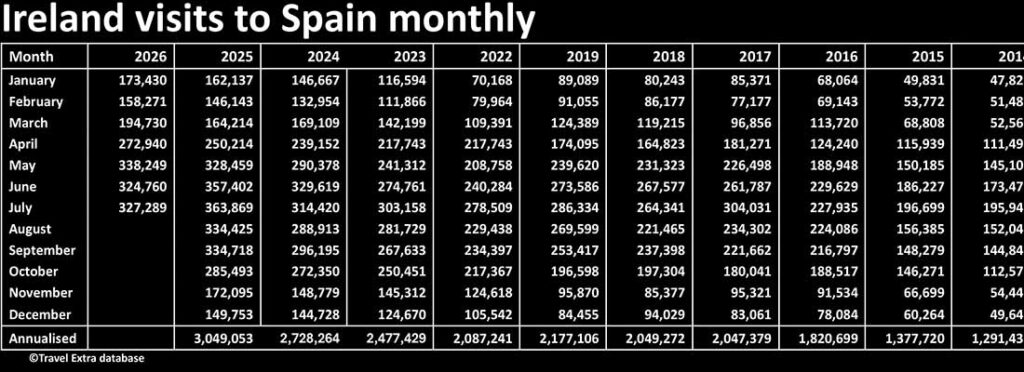
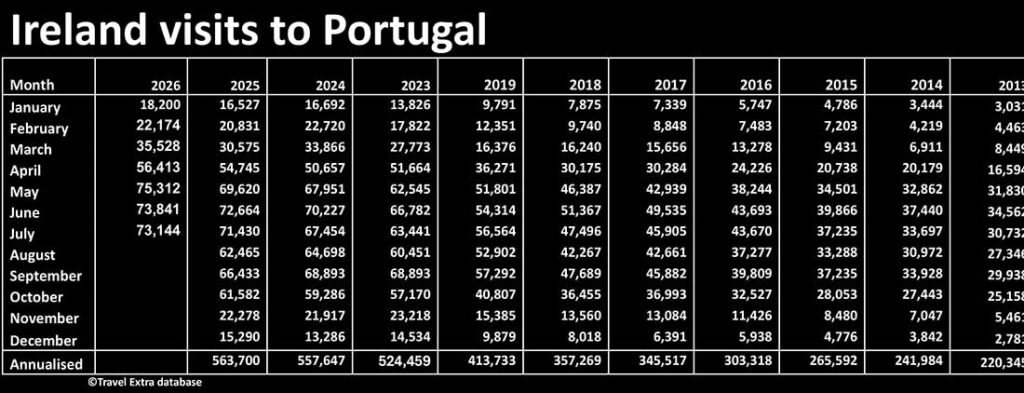
Tuesday’s data form Spain and Portugal showed the first dip in irish tourism to both countries in over two years when the June figures were finalised. It is too early to say whether there is no major market shift in holiday patterns by Irish people. June may be too hot for some people as the heat waves of 2022 and 2026 show earlier peaks. It is likely a symptom of another trend flagged earlier this month by the Centra Statistics Office in their own figures for June, that Ireland’s relentless appetite for travel may be slowing down, but are there other factors at play?
Italy has not yet release any corresponding data, but Thursday’s alerts stretch from Trieste in the northeast to Palermo in Sicily and signal a health risk for the entire population, not only vulnerable groups such as older adults and people with chronic illnesses. Authorities urged residents and tourists to avoid direct sunlight during the hottest hours of the day, remain indoors where possible and drink plenty of water as temperatures in some areas approached 40 C. The heat has also forced adjustments at major tourist attractions. The ministries of tourism and culture extended evening opening hours at landmarks including Rome’s Colosseum and Pantheon. Cooling mist fans have been installed at the Colosseum’s entrances and additional medical stations have been made available.
This coordinated response across the Italian peninsula reflects a broader pattern of extreme heat that has settled over much of southern and central Europe, compelling governments to recalibrate public health strategies and cultural site management in real time. The simultaneous elevation of every monitored urban centre to red status marks a departure from previous seasonal patterns in which alerts tended to arrive in staggered waves according to regional microclimates. Instead the current episode has produced a near-uniform thermal load that leaves little geographic refuge within the national boundaries. Medical authorities have therefore shifted from targeted advisories aimed at the elderly or those with preexisting conditions toward universal guidance, recognising that prolonged exposure at these intensities can overwhelm even healthy physiological systems. The decision to keep major monuments open later into the evening constitutes a pragmatic attempt to preserve both visitor numbers and visitor safety, allowing the dispersal of crowds across cooler hours while still generating the revenue on which many sites depend. Mist systems and temporary clinics represent modest infrastructural adaptations, yet they illustrate how heritage management is being forced into closer alignment with emergency medicine.
Beyond Italy the same atmospheric configuration has produced record readings and cascading operational difficulties. In Austria the mercury reached 41.2 C on Wednesday in the village of Bad Deutsch-Altenburg near the Slovak border, according to GeoSphere Austria, the highest temperature ever recorded in the country. Austria is also facing severe drought. Rainfall from 1 January through 30 June was 27 percent below the long-term average nationwide, while some eastern regions received only half their normal precipitation.
Climatologist Alexander Orlik said some parts of the country had not experienced such dry conditions since 1885. These figures place the present drought in a historical frame that extends well beyond living memory and therefore beyond the adaptive capacity of current agricultural and water-management regimes. The extreme maximum temperature itself is not an isolated meteorological curiosity; it arrives against a backdrop of sustained moisture deficit that has already stressed vegetation, soil moisture reserves and river systems.
Hungary has confronted parallel constraints. Prolonged drought and record-low water levels on the Danube River have severely affected the country’s only nuclear power plant, which relies on river water to cool its reactor, as well as river cruise boats that ply the river. On Wednesday night Budapest recorded its warmest overnight low temperature on record, with temperatures falling only to 28 degrees Celsius. The persistence of elevated overnight minima prevents the physiological recovery that cooler nights normally afford and simultaneously reduces the thermal gradient that helps rivers replenish through overnight condensation and reduced evaporation. Power-generation authorities must therefore balance electricity demand, which itself rises with air-conditioning loads, against the physical limits of cooling-water availability. River-cruise operators face grounded vessels and cancelled itineraries, converting what had been a reliable summer revenue stream into a source of financial pressure.
Germany has registered growing concerns over the impact of drought on transportation and industry as water levels on the Rhine and other rivers continued to fall. Transport Minister Steffen Bilger met affected organisations Thursday and warned that low water levels posed major challenges for inland waterway shipping, industry and the broader logistics chain. The Rhine functions as a critical artery for bulk commodities, chemical feedstocks and intermediate goods; reduced draught forces barges to lighten loads or suspend operations, with consequent cost increases that propagate through manufacturing supply chains. Industrial facilities that draw process water or rely on river transport for just-in-time deliveries confront the same hydrological bottleneck. The ministerial meeting itself signals official recognition that the problem has moved beyond seasonal inconvenience into the domain of systemic risk for the national economy.
In southeastern France firefighters maintained a large presence in the Var region after authorities said a major wildfire there was no longer spreading but remained capable of reigniting. The blaze, which began 20 July, has burned more than 60 sq. km, making it the largest recorded in the region in recent decades. Authorities warned that strong winds and extremely dry conditions left southeastern France at very high risk for additional wildfires. The containment of active flame fronts does not equate to the elimination of residual heat within the fuel bed; ember-driven restarts remain probable under continued desiccation and gusty conditions. The scale of the burned area already exceeds recent historical benchmarks, implying that recovery of forest cover and soil stability will occupy years rather than months.
Across the Balkans the heat wave reached its peak on Thursday as temperatures neared 40 C and authorities battled drought and wildfires. In Serbia firefighters struggled to contain several blazes after days of dry weather. One major fire burned through pine forests west of Belgrade, while another spread near the central town of Kraljevo, where difficult terrain complicated firefighting efforts. In neighbouring Croatia tourists in Dubrovnik sought refuge in shade and avoided beaches during the hottest hours of the day as temperatures soared along the Adriatic coast. The combination of forest fire and coastal heat places dual demands on emergency services while simultaneously altering the behaviour of visitors who form the economic backbone of many Adriatic communities.
The same thermal regime has begun to reshape tourism and travel patterns in Spain, France, Greece and northern Europe. In Spain the combination of elevated daytime maxima and limited overnight relief has prompted hotel operators in Andalusia and the Balearic Islands to adjust outdoor dining schedules and to expand shaded public seating. Coastal resorts that once marketed uninterrupted beach days now advise guests to schedule sea-bathing for early morning or late afternoon, while inland heritage cities such as Seville and Córdoba have lengthened the opening windows of major monuments into the evening in a manner parallel to the Italian example. Tour operators report increased demand for air-conditioned coach itineraries and for hotel packages that include guaranteed pool access during peak heat hours. Domestic Spanish travellers appear to be shifting short-break bookings toward the northern Atlantic coast, where maritime influence moderates extremes, thereby redistributing seasonal pressure away from the Mediterranean littoral.
France faces a dual tourism challenge. In the southeast the lingering wildfire risk in the Var and adjacent departments has led some campsites and rural gîtes to suspend outdoor activities and to maintain heightened evacuation readiness. Urban destinations such as Nice and Marseille have installed additional public water points and temporary shade structures along popular promenades. Further north the Loire Valley and Parisian attractions have recorded higher than usual rates of visitor heat-related medical consultations, prompting museums to extend free water distribution and to revise queue-group pacing. The overall effect is a compression of the traditional midday tourist window and a corresponding lengthening of evening cultural programming, which in turn alters staffing requirements and energy consumption profiles for attractions. Greece has experienced comparable pressures across its island and mainland destinations. On Crete, Rhodes and the Cyclades the intensity of solar radiation has led several beach-front establishments to close outdoor terraces between late morning and late afternoon, while archaeological sites such as the Acropolis in Athens and ancient Olympia have introduced timed-entry systems weighted toward cooler periods. Ferry operators report higher cancellation rates among day-trippers unwilling to endure unshaded deck conditions, and some smaller islands have activated municipal cooling centres originally designed for elderly residents but now opened to visitors as well. The economic consequence is a measurable shift in expenditure patterns: spending on indoor dining and evening entertainment rises while midday beach and outdoor activity revenues decline. Northern mainland destinations that previously attracted fewer summer visitors have registered relative gains as travellers seek slightly lower absolute temperatures.
Northern Europe has not escaped the secondary effects of the southern heat. In tEngland, the Netherlands, Belgium and southern Scandinavia the combination of warm, settled conditions and media coverage of southern extremes has stimulated short-notice travel demand toward domestic and nearby coastal resorts. Bookings for North Sea and Baltic holidays have risen as travellers recalculate the comfort differential between northern latitudes and the Mediterranean basin. At the same time, outbound operators specialising in southern itineraries have introduced flexible rebooking policies and heat-contingency clauses, acknowledging that a proportion of clients now prefer to postpone or redirect journeys when forecasts indicate prolonged red-alert conditions. River-cruise companies operating on the Rhine and Danube face the dual difficulty of low water levels and elevated ambient temperatures, forcing itinerary adjustments that replace certain port calls with coach transfers or omit them altogether.
Taken together these developments illustrate how a single prolonged heat episode can reconfigure the spatial and temporal geography of European tourism. Southern destinations respond with operational adaptations that protect visitor health while attempting to safeguard revenue streams; northern destinations absorb redirected demand; and transport providers across the continent confront hydrological and thermal constraints that complicate logistics. The Italian decision to place every monitored city under simultaneous red alert functions as an early indicator of the scale of response now required, while the Austrian temperature record, Hungarian power-plant limitations, German river-transport difficulties, French wildfire residual risk and Balkan firefighting efforts supply concrete measures of the physical stress under which these adaptations must occur. The tourism sector, dependent as it is on outdoor mobility, heritage access and predictable weather windows, finds itself obliged to redesign both the daily rhythm of visitor experience and the longer-term marketing of seasonal reliability.
As the present episode continues, local authorities, cultural institutions and commercial operators are refining protocols that prioritise hydration, shade and temporal displacement of peak activity. These measures do not eliminate the underlying thermal load, yet they demonstrate a capacity for rapid organisational response that may prove transferable to future seasons of comparable intensity. The data already recorded, from the 41.2 C Austrian maximum to the 60 sq. km French burn scar and the near-40 C Balkan peaks, establish quantitative benchmarks against which subsequent summers will be judged. In the meantime the practical task remains the protection of public health and the preservation of viable travel experiences across a continent whose weather patterns may be shifting.