In Ireland and across Europe, late bookings have strengthened as visitors respond to higher airfares and living costs by shortening stays or cutting spending. Hotels, airlines and tour operators have all noticed the trend, and are adapting to more uncertain booking patterns while overall arrivals and receipts continue to grow.
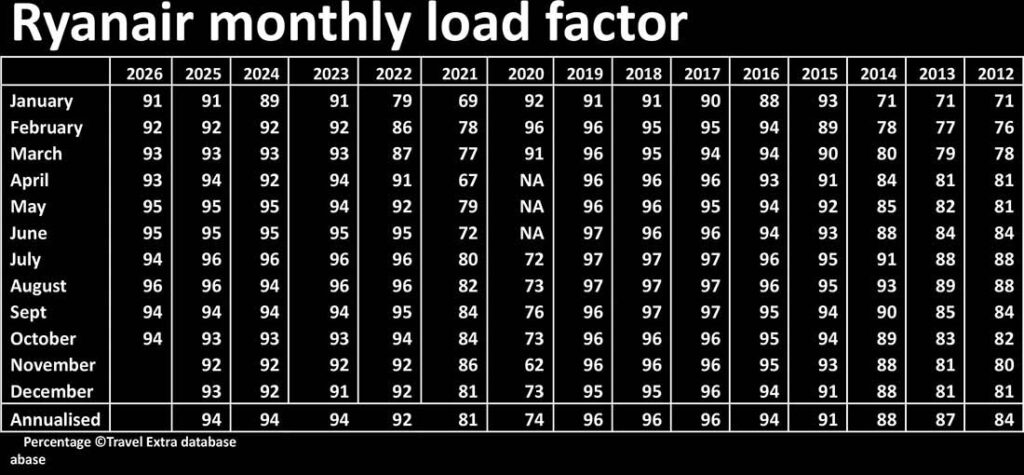
Michael O’Leary of Ryanair says that close in bookings are strong, far out bookings are weak, and responded with his only weapon: price. A series of flash sales ensured his load factor remained high by industry standards, 94pc in September and October, and 96pc in August. This was done at the expense of yield, and is still a few percentage points lower than the figures for like months in 2025. Other airlines have not been as lucky, with load factors dropping below 80pc for some continental airlines.
This shift in consumer behaviour marks a practical adjustment to sustained cost pressures rather than a contraction in the desire to travel, and it requires careful analysis of both the opportunities and the operational demands it places on the sector.
Across source markets in northern and western Europe the combination of elevated jet fuel prices and broader inflation has altered the calculus of holiday planning. Travellers who once secured accommodation and flights months in advance now wait longer before committing, seeking better value or simply managing household budgets more tightly.
Once they do book, many elect to reduce the number of nights away or limit spending on dining and activities outside the main package. The result is a booking curve that peaks closer to departure dates and a more variable pattern of demand that complicates forecasting for hotels, carriers and tour operators alike.
Tui reported a similar trend. Major travel tour operators like TUI Group and Jet2 report a strong surge in late and last-minute holiday bookings as travelers delay purchase decisions amid economic uncertainty, living costs, and geopolitical tension.
TUI recorded a late-summer surge with bookings rising 2pc over a recent four-week window, driven heavily by demand for Greece and Spain (including the Balearics and Canaries). Despite the late boost, cumulative summer revenues were down 5pc year-on-year, with the English market down 7pc and Germany down 2pc. Winter bookings started down 7pc overall (with UK winter bookings trailing by 9pc and Germany by 4pc), though recent momentum narrowed the deficit to just 1pc lower than last year.
More recently the giant holiday firm warned that booking holidays close to departure no longer guarantees budget bargains, noting that there are practically no low-priced last-minute deals due to high fuel costs, rising prices, and steady demand. Research from TUI Group shows that a significant number of late bookers feel anxious (29pc) and overwhelmed (21pc) because shorter booking windows create pressure to “get it right”. There is a sense of “they would say that” about it as the late booking trend has not been impacted.
Further fare increases
Rising jet fuel costs have prompted warnings of further fare increases in 2027 once existing hedging arrangements expire. Low cost and full service carriers alike are reviewing capacity and pricing strategies for the winter and the following summer. In destination markets the preference for later booking is accompanied by a tendency to favour destinations that offer perceived value or climatic relief.
Tour operators have adjusted their own commitment cycles with accommodation suppliers, seeking greater flexibility in room allotments and cancellation terms. Airlines refine yield management systems to capture late demand without eroding revenue from earlier bookings. Hotels invest in digital tools that allow rapid response to short notice enquiries and dynamic pricing that reflects real time availability. The common thread is an acceptance that the advance booking culture of earlier years has given way to a more fluid model in which certainty arrives closer to the travel date.
Higher airfares and living costs reduce discretionary income and encourage more careful timing of expenditure. From the supplier perspective the change requires greater agility in inventory management, staffing and pricing. The overall volume of travel has not declined; the manner in which that volume materialises has altered. Analytical attention must therefore focus on the mechanisms of adaptation rather than on any assumption of underlying weakness in demand.
In the months ahead further fuel cost pressures are expected to feed into ticket prices across Europe. The response of travellers will determine whether the late booking pattern intensifies or stabilises. Hotels and carriers that have already refined their systems for shorter lead times will be better positioned to absorb additional volatility. Destination managers who continue to invest in connectivity, product quality and seasonal spread will help ensure that growth in arrivals and receipts remains broadly based.
The task for operators and policymakers is to align operational and strategic responses with this altered pattern so that the sector converts volume into sustainable returns for businesses, employees and the wider economy.
At the IATA world congress in Brazil, airline Ceos were asked what they feared most form the summer. They mentioned jet fuel price, and jet fuel supply, bot one thing worried them even more. Consumer confidence. The late booker is winning the battle, but the war is not over.