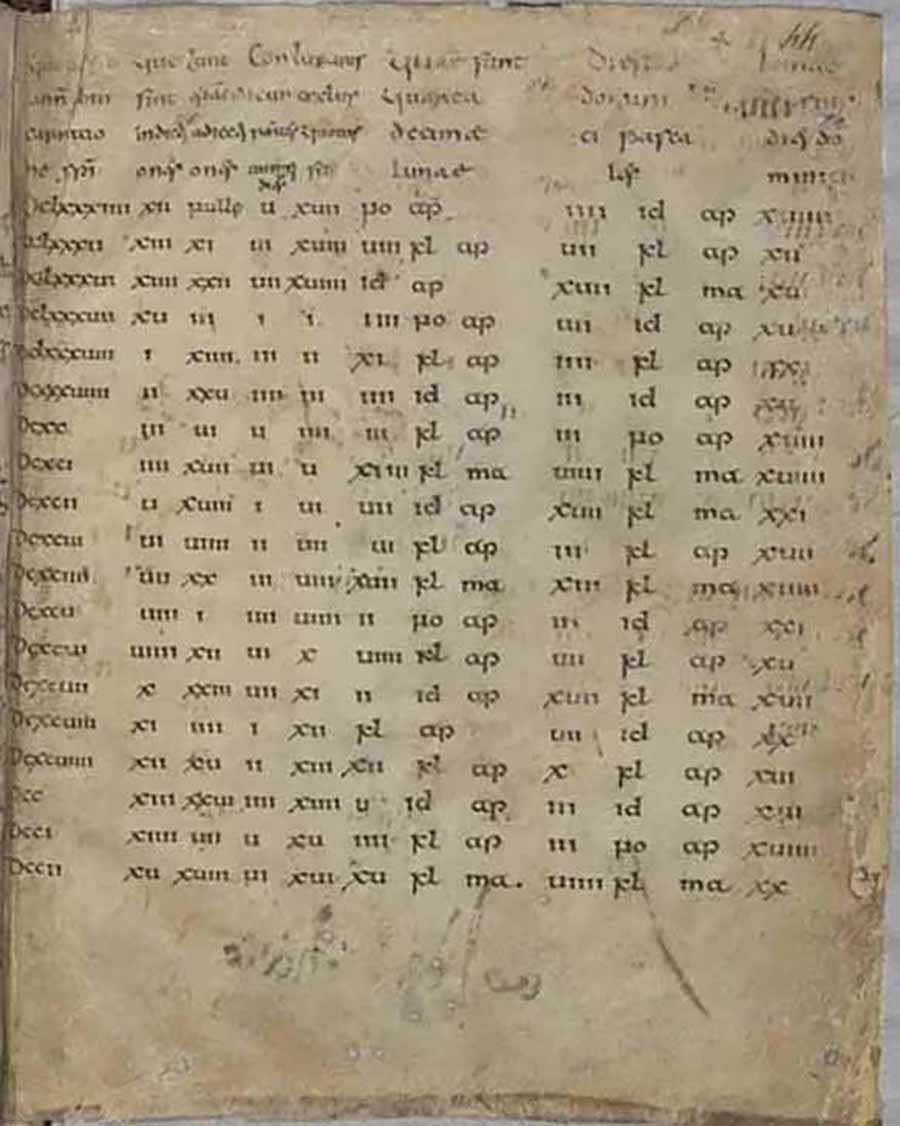
Why, to the inconvenience of airlines and the hospitality industry, does Easter keep moving, and why do we have more than one Easter according to which church we subscribe to? Churches have determined the date of An Cháisc/Easter each year according to ecclesiastical rules established at the Council of Nicaea in 325.
The calculation identifies the first Sunday after the Paschal full moon that falls on or after 21 March and connects the feast to the timing of the Jewish Passover. Various computus tables and cycles developed over the centuries to align the date with lunar and solar movements while churches sought consistency across regions.
Early Christians linked the death and resurrection of Jesus to the Jewish Passover, yet the Synoptic Gospels (Mark, Matthew and Luke) and the Gospel of John present differences concerning the exact day of Passover during those events. As a result, the early churches developed separate traditions for the celebration of An Cháisc/Pascha and for the calculation of its date. Some churches observed An Cháisc/Pascha on the Sunday that followed Jewish Passover, while others marked the feast on the actual day of Passover itself, regardless of the day of the week, in order to emphasise the suffering and death of Jesus.
Early methods relied on cycles of eight or 84 years before the adoption of the 19-year Metonic cycle from Alexandria. Later calendar reforms addressed inaccuracies in the solar year and differences between Eastern and Western practices persisted until widespread conformity occurred.
- Nisan 15: Easter relates to the Jewish Passover which begins on 15 Nisan as the first full moon of spring in the Hebrew lunar calendar. The Jewish lunar calendar frequently fell out of step with the seasons of a solar year, causing Judaism to add an additional month to their calendar every two or three years to ensure Passover would not fall out of season.
- Julian: the Julian calendar which came into effect in 46AD supplied the basis for Easter calculations in the early Christian centuries and is still used by Eastern Othodox churches, meaning easter 2026 falls on April 12. The 55-day Ethiopian Great Lent is longer than the 46-day Christian equivalent and stared on February 16, two days after Christian Lent began
- Early annual announcement by the pope.: The pope announced the date of Easter annually to inform the faithful of the feast and related movable dates in the liturgical calendar. By the 300s as the empire collapsed, communication with distant churches had broken down and local leaders were determining the date by sight.
- Hippolytus of Rome: Hippolytus of Rome devised the earliest known Roman Easter tables in 222 based on eight-year cycles.
- Nicaean: The 1st Ecumenical Council at Nicaea, convened by the Roman Emperor Constantine in 325AD, attempted to promote Christian unity, determining that An Cháisc/Pascha would occur on: the first Sunday after the first full moon occurring on or after the vernal equinox.
- Alexandrian: The Alexandrian computus employed a 19-year Metonic cycle and became the standard method for determining the Paschal full moon from the late fourth century. Alexandrian Easter is next Sunday, April 12.
- Victorius: Victorius of Aquitaine produced a 532-year Easter table in 457 that attempted to adapt the Alexandrian method to Roman practice but incorporated errors. Victorian Easter is today, April 5.
- Dionysius: Dionysius Exiguus constructed 19-year Paschal tables in 525 that adapted the Alexandrian computus to the Julian calendar and also introduced the Anno Domini dating system in 525AD. Dionysian system insisted that Easter must be at least the 15th day to avoid coinciding with Jewish Passover. The oldest surviving Dionysiac table was only discovered in 2004, Willibrord’s Easter table (684-702 AD), compiled in Rath Melsigi near Leighlinbridge in modern-day Carlow, was only discovered in Italy in 1984. Dionysian Easter is today, April 5.
- Celtic: The Celtic calculation, using an 84-year cycle was first compiled by Sulpicius Severus in France. The primary conflict was that the Celtic system occasionally placed Easter on the same day as the Jewish Passover (14th Nisan), which was forbidden by Roman authorities. Additionally, the Celtic system could place Easter before the vernal equinox (March 21) placing the festival between lunar days 14 and 20, while the Dionysian system used lunar days 15 to 21. The Synod in 630 of Mágh Léne, near Tullamore inn modern day county Offaly, prompted the churches of the southern provinces, led by Emly/Cashel, and Kildare, to reluctantly adopt the Dionysian tables. The discrepancy meant that in 664AD the people of Meath were feasting for Easter while the people of Kildare were still fasting for Palm Sunday. The Synod of Whitby in that year led to the adoption of the Roman method in northern England. Armagh and Iona eventually adapted to the Vatican dating system in 716AD. Tradition held that Skellig Micheál was not subject to the change and locals in Kerry could avoid the Lenten fast or the ban on marriage during Dionysian Lent by camping there. The calculation usually gave an earlier Easter, but, if applied today, the Celtic Easter would fall on next Sunday April 12.
- Gregorian: The Gregorian calendar reform of 1582 provided improved accuracy for the calculation of Easter dates in Western churches, supplanting the Julian calendar. From 1582 until 1752 Catholic and Protestant Easter Sunday in Ireland could vary by four weeks.
- The Rudolphine Tables: The Rudolphine Tables compiled by Johannes Kepler in 1627 supplied precise astronomical data that some churches used for Easter calculations. Easter frequently diverged between the Rudolphine (astronomical) and Gregorian (tabular) Easter between 1700 and 1776 in German Protestant states, and until 1844 in Sweden. Protestant states eventaully abandoned the astronomical Rudolphine calculation and adopted the Gregorian Easter calculation.
- Never used reckonings: The Synod of Constantinople and the Synod of Aleppo in 1997 proposed the use of modern astronomical calculations for a common Easter date but the proposals have not been adopted. Vatican II decided that the Vatican could move to a fixed date for Easter but the proposal was not followed through.