
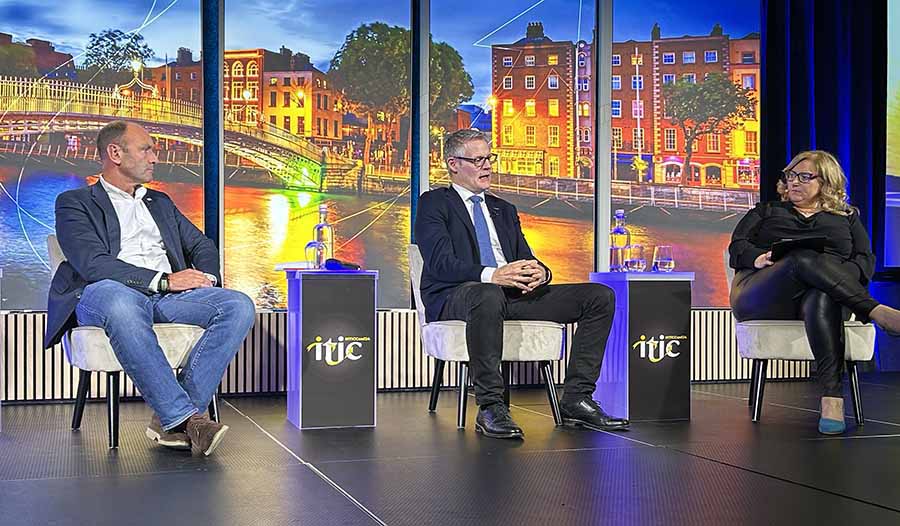
Donal Moriarty of Aer Lingus told the Irish Travel Industry Confederation conference in Dublin that penalising aviation could slow the process to carbon zero.
Both Mr Moriarty and Kenny Jacobs of Dublin airport dismissed as unrealistic suggestions by Junior transport minister James Lawless and tourism minister Catherine Martin that flights be moved to Shannon and Cork to cope with the restrictions at Dublin airport
Mr Moriarty said: We will serve any market that there is—there is the passenger demand to serve. The unique thing that Dublin has developed, and we’ve supported its development, is this hub concept—this idea that you can have an airport that is not simply dependent on point-to-point passenger demand but can accommodate the flow of traffic, what we call behind and beyond. That is a phenomenal success for Dublin Airport over the last 10 or 15 years, and indeed, it’s a stated part of the National Aviation Policy that development as a hub airport has been very successful.
I look back to 2012-2013; we had four North Atlantic routes. Today we have 17, and number 18 is starting next month, and that is all because of the hub strategy. So the idea that you can take some of that capacity and move it, with short haul or long haul, to another airport and expect that demand will transfer when it’s very significantly built on connecting flows of traffic is not how passenger demand works; it’s not how airline economics work.
Dublin Airport opened a lovely new runway, North Runway, in 2022, potentially uh doubling the capacity of Dublin Airport. None of that increased capacity has been accessed. The key to uh more sustainable flying, and uh Aer Lingus and IAG are very committed to this, are two things: new technology aircraft, new technology engines, and sustainable aviation fuel. They’re very expensive. In order to invest in the way we want to invest in new technology aircraft and sustainable aviation fuel, we need to grow, and we can see our emissions per passenger kilometre and our net emissions decreasing by 20230 if we over deliver in terms of use of sustainable aviation fuel, so go above and beyond the mandate required by Europe, and that’s our plan.
We want to do that. We also want to invest in new aircraft, newer technology aircraft, and refleet um our fleet, but to do that, uh we need to throw off the necessary uh profit to invest and to justify that capital expenditure, and the way to do that is by growing. So there is a win-win in terms of growth and reducing um carbon per passenger kilometer and reducing net carbon, but keeping Dublin Airport at 32 million for that reason is actually environmentally detrimental and stops that investment.
From an airline point of view, you have to economically grow to be able to invest in lower emissions. From an airport point of view, it’s exactly the same. We have a two billion investment with the infrastructure application that we launched with Fingal last year, over 400 million of that are sustainability investments that will allow us to reduce carbon and reduce energy usage in the terminals and in the airfield.
Kenny jacobs added: If you cap Dublin, and again it’s really important for people to understand that the cap at Dublin is nothing to do with sustainability reasons; it’s sometimes batched that way now, but it’s to do with traffic congestion, which also doesn’t exist. But the cap at Dublin and saying don’t invest at Dublin is about two things. All that’s going to happen is the facilities will deteriorate, emissions per passenger will actually increase. And then we also have this myth in Ireland that those emissions disappear if the flights go to the regional airports. What about that question? All we’re simply doing by capping Dublin is not moving flights to the regions. Every airline is saying that, we’re saying that, and every airport knows that. If some do move, and I encourage every single airline to move to Cork, to move to Shannon, to move to all our regional airports, if you can’t get what you want at Dublin. But they want both, and we should give them both because all we will lose to is Manchester, Gatwick, and other airports.
The Irish Travel Industry Confederation conference in Dublin attracted 300 leading tourism professionals to the Dublin Royal convention centre to hear the major issues of concern to the industry being discussed.