- EASA extends regional airspace warning until September 30, 2026
- Advisory targets Persian Gulf and Gulf of Oman waters specifically
- Jordanian airspace recommendation lifted with caution maintained
- Iran, Iraq, and Lebanon prohibitions remain in place
- Flight operations permitted for arrivals and departures with safety mitigations
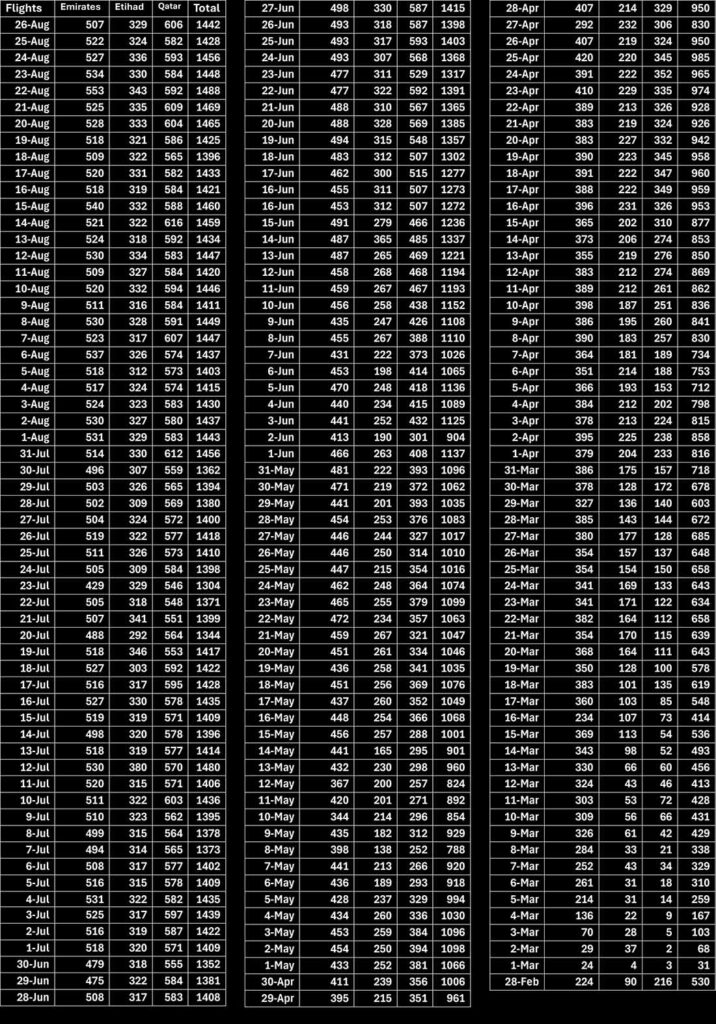
The European Union Aviation Safety Agency has extended its regional airspace warning until September 30, 2026, while revising the advisory to target specific maritime sectors rather than entire national airspaces. EASA has narrowed the previous blanket recommendation that avoided countries’ entire land and air territory to focus specifically on the waters of the Persian Gulf within the flight information regions of Bahrain, Kuwait, Qatar, and the UAE. Operations over the waters of the Gulf of Oman within Oman’s Muscat flight information region remain restricted. The previous recommendation to avoid Jordan has been lifted, though operators maintain caution through September 30. Gulf carrier continue to operate extensive schedules with Emriates, Etihad and Qatar now operating a total of 1600 flights a day.
Airlines proceed with flights strictly necessary for arrivals or departures at airports within these nations under sufficient safety mitigations, though operators exercise caution over land. Prohibitions and warnings against operating within the airspace of Iran, Iraq, and Lebanon remain in place through the end of September, with specific sea-approach exceptions for Beirut. The revised advisory reflects a more targeted approach to regional risk assessment while maintaining heightened alert levels for commercial carriers operating in the Middle Eastern theatre.
The extended warning period covers the duration of heightened regional tensions and provides airlines with a clear operational framework for flight planning through autumn 2026.
European carriers operating routes to Gulf destinations have adjusted flight paths accordingly, with many rerouting to avoid the designated maritime zones while maintaining connectivity to regional hubs. The advisory remains subject to further revision based on evolving security assessments.
The Conflict Zone Information Bulletin (CZIB-2026-07R1) advises against operating flights at all altitudes and flight levels within the following airspaces:
- United Arab Emirates (UAE) (Emirates FIR – OMAE)
- Qatar (Doha FIR – OTDF)
- Bahrain (Bahrain FIR – OBBB)
- Kuwait (Kuwait FIR – OKAC)
- Oman (Muscat FIR – OOMM) – specifically waters west of longitude 58°E
- Jordan – A separate, parallel EASA advisory also restricts flights through Jordanian airspace until 31 August 2026.
- Separate, active EASA bulletins already instructing airlines to avoid Iran, Iraq, and Lebanon remain in effect.
EASA says the restriction is due to “unpredictable military developments, combined with the possible use of missiles, drones, combat aircraft and air-defense systems, create a high risk to civil flights at all altitudes and flight levels within the concerned airspace.”
The advisory follows a sharp escalation in the US-Iran conflict, including repeated nights of airstrikes, drone activity, and active regional air defence systems that pose a severe misidentification risk to civilian aircraft.
The advisory applies strictly to all EU air operators and Third Country Operators (TCO) flying to, from, or within the European Union.
Major international carriers (such as British Airways, Lufthansa, and KLM) have suspended or drastically scaled back services to major transit hubs like Dubai and Doha. Flights between Europe and the Asia-Pacific region are being forced into lengthy detours. Regional airlines like Etihad Airways and Air Arabia have cancelled specific routes, while others continue under highly volatile operational parameters.
The bulletin of July 8 replaces a previous notice that included Lebanon.Airlines operating in the region adjust routes accordingly. The measure protects passenger and crew safety amid geopolitical developments. Irish carriers and others monitor the situation.
Several Gulf states have progressively reopened their flight information regions in recent weeks allowing a gradual recovery in operations although full normalcy remains distant. Most Gulf airspaces including those over the United Arab Emirates Qatar Saudi Arabia Oman Jordan and Kuwait are now accessible with managed corridors and heightened risk assessments in place. This has enabled major carriers such as Emirates Etihad and Qatar Airways to increase flight numbers from the lows seen in early May though volumes continue to fluctuate daily as airlines navigate restricted routes and alternative paths. Iran Iraq and Lebanon however stay subject to strong avoidance recommendations with operators urged not to enter their airspace at any altitude due to persistent safety concerns.
Around ten to twelve countries in the broader Middle East and Persian Gulf area continue to face varying degrees of restrictions or advisories stemming from the period of heightened tensions. Reopening prospects appear positive in the Gulf where ceasefires have held and authorities have lifted many emergency closures but experts warn that any renewed instability could prompt swift changes. European airlines in particular are rerouting long haul services via southern corridors adding flight times and operational costs while Middle Eastern hubs work to rebuild connectivity.
Daily flight data for the three major Gulf carriers illustrates the recovery trend. On 7 June Emirates operated 431 flights Etihad 222 and Qatar Airways 373 for a combined total of 1026. This compares with peaks earlier in May when the trio exceeded 1100 daily flights and dips in mid May when numbers fell below 800 amid tighter restrictions. Operations have stabilised at reduced but functional levels with airlines emphasising flexibility and close monitoring of aeronautical notices.
Passengers planning travel through the region are advised to check directly with airlines and consult official sources for the most current information as schedules can change at short notice. While prospects for further reopenings and increased capacity look encouraging in the coming weeks full restoration of pre tension route networks may take longer particularly for transcontinental flights that once relied on central Middle Eastern corridors..
The current EASA advisory impacts all altitudes/flight levels in the airspace of: Unless otherwise specified, all altitudes/flight levels in the airspace of: Bahrain (Bahrain FIR – OBBB), Iran (Tehran FIR – OIIX), Iraq (Baghdad FIR – ORBB), Israel (Tel Aviv FIR – LLLL), Jordan (Amman FIR – OJAC), Kuwait (Kuwait FIR – OKAC), Lebanon (Beirut FIR – OLBB), Oman (Muscat FIR – OOMM), Qatar (Doha FIR – OTDF), United Arab Emirates (Emirates FIR – OMAE) and Saudi Arabia (FIR Jeddah – OEJD).
EASA shared: “The revised advisory reflects a more targeted approach to regional risk assessment while maintaining heightened alert levels for commercial carriers operating in the Middle Eastern theatre.”
While the overall level of risk has decreased in the region, the sustainability of the ceasefire remains uncertain in the longer term, with a possibility of rapid escalation. Therefore, close monitoring and up-to-date risk assessments remain essential to ensure safety of flights. Should the existing truce break down, the airspaces covered by this Bulletin are likely to be exposed to imminent threats.
In terms of airspace management during the conflict, most of the States concerned have taken measures to address airspace risks by implementing temporary airspace closures and restrictions, thereby contributing to the mitigation of risks to civil aviation.
EASA, together with the Commission and Member States, will continue to closely monitor the situation, with a view to assess whether there is an increase or decrease of the risk for EU aircraft operators due to the evolution of the threat and risk situation.
Air operators should:
- Not operate within the affected airspace of Iran, Iraq, Lebanon at all flight levels and altitudes.
- Exercise caution and take potential risks into account when operating within the airspace of Bahrain, Kuwait, Israel, Jordan, Qatar, Oman, UAE and Saudi Arabia.
- Ensure that an up-to-date risk assessment and a high level of contingency planning are in place for operations within the airspace specified in point 2 above, and be prepared for short notice instructions from the State authorities.
- Closely monitor airspace developments in the region and follow all available aeronautical publications concerning the region, including information shared through the European Information Sharing and Cooperation Platform on Conflict Zones, alongside available guidance or direction from their national authorities.
Air operators are reminded that the following CZIBs remain in effect with recommendations not to operate at all flight levels and altitudes:
- CZIB on airspace of Syria (CZIB-2017-03R19)
- CZIB on airspace of Yemen – Sana’a Flight Information Region (CZIB-2017-07R19)
The present CZIB supersedes the following CZIBs:
- CZIB on Iran and neighbouring airspace (2026-02-R1)
- CZIB on the airspace of Lebanon (2024-01 R7);
- CZIB on the airspace of Iraq (CZIB-2017-04R19);
Scheduled Dublin flights
- Abu Dhabi EY46$09.00 & inbound EY45
- Doha QR20@09.30 & inbound QR19
- Doha QR18@12.55 & inbound QR17
- Dubai EK162@14.20 & inbound EK161
- Abu Dhabi EY48@20.35 & inbound EY47
- Dubai EK164@2200 & inbound EK163