It started, like many of these tales of betrayal do, with England’s controversial 1980s Prime Minister Margaret Thatcher.
The deal she concocted with James Sherwood to sell off taxpayer’s property, the ports of England, Scotland and Wales, at a bargain basement rate was to have a dramatic long term effect on Holyhead. Failure to invest in the port and its infrastructure has led to two berth collapses in the past eighteen months, dramatically affecting the ferry services on the busy route across the Irish Sea. It all goes back to Thatcher and Sherwood, who was a massive donor to the Conservative party.
The mantra that accompanied the privatisation of these ports in the 1980s transferred control of key strategic assets from public hands into private ownership under the guise of efficiency and market forces.
James Sherwood, through Sea Containers, acquired significant interests that included operations at Holyhead. What followed was a period where short-term commercial priorities took precedence over sustained capital investment in infrastructure that served both freight and passenger traffic on the critical Irish Sea corridor. Holyhead, as the primary gateway between Wales and Ireland, depended on reliable berths and facilities to handle the volume of ferries that connect communities and economies on both sides of the water.
Recent events have laid bare the consequences of that approach. In December 2024, Storm Darragh caused serious damage to Terminal 3 at Holyhead Port when berthing incidents involving vessels led to structural collapses. One berth became unusable, forcing the closure of parts of the port and the cancellation of ferry services at a peak time before Christmas. Engineers needed months to assess and repair the damage, with full reopening delayed into 2025. A second incident compounded the problems, highlighting how vulnerable the infrastructure had become after years of underinvestment. Operators such as Stena Line and Irish Ferries had to reroute or cancel sailings, which disrupted passengers, freight logistics, and supply chains that rely on the route for timely deliveries between Britain and Ireland.
The human and economic impact on Holyhead and the surrounding area has been clear. Local businesses that depend on ferry traffic for tourism and trade reported reduced footfall during the closures. Workers at the port faced uncertainty as schedules changed and some services paused. Communities in Anglesey and beyond felt the effects as travel times lengthened and alternatives proved more expensive or inconvenient. The Irish Sea route carries substantial freight that supports industries in both countries, and any prolonged disruption raises costs that pass down to consumers. Successive governments after the initial privatisation failed to impose robust requirements for ongoing maintenance and modernisation on the private operators. Instead, the focus remained on profitability, which left the port exposed when severe weather struck.
Critics of the original sale pointed out at the time that ports perform a public function that extends beyond simple commercial activity. They serve as vital links for national connectivity, especially for island nations and regions such as Wales and Ireland. The decision to sell at low prices to political donors and connected businesses raised questions about accountability and long-term planning. Sherwood expanded his interests into shipping and luxury transport, but the core port infrastructure at locations like Holyhead received insufficient upgrades to meet modern safety and capacity standards. When storms tested the facilities, the weaknesses showed.
Local authorities and the Welsh Government have called for greater oversight and investment since the incidents. Repairs proceeded, yet the episodes exposed how fragile the system remains. Ferry operators worked to restore services as quickly as possible, with sailings between Holyhead and Dublin resuming on adjusted timetables. Passengers adapted to new departure times while the port completed assessments and structural reinforcements. The events of late 2024 and early 2025 served as a reminder that critical transport links require consistent public interest safeguards rather than reliance on private owners whose priorities may shift with market conditions.
The pattern reflects broader issues with infrastructure managed under privatisation models from the Thatcher era. Roads, railways, and ports all faced similar pressures where investment lagged behind usage and environmental challenges. In Holyhead’s case, the Irish Sea route demands resilience against Atlantic weather systems that grow more unpredictable. Without dedicated funding streams tied to public performance criteria, private operators face incentives to minimise expenditure on upgrades that do not deliver immediate returns. This approach contributed directly to the berth collapses that halted operations and affected thousands of travellers and tonnes of cargo.
Residents of Holyhead and Anglesey deserve reliable port facilities that support their economy and connectivity. The route to Dublin remains one of the busiest ferry crossings, with multiple daily sailings by Stena Line and Irish Ferries under normal conditions. Restoring full capacity took considerable time and resources that could have been avoided with proactive maintenance. Political decisions made in the 1980s continue to shape daily realities for people who depend on these services for work, family visits, and business.
Calls have grown for a review of port governance to ensure future resilience. Investment in modern berths, reinforced structures, and contingency planning would protect the route against both weather events and commercial uncertainties. The Holyhead incidents demonstrate that strategic transport assets need long-term stewardship that prioritises reliability over short-term gains. The legacy of the Thatcher-Sherwood deal illustrates how one policy choice can create decades of vulnerability in a key piece of national infrastructure.
Successive vessel contacts’
The berth collapses at Holyhead Port in December 2024 stemmed from two successive vessel contacts with the berthing structures during high winds associated with Storm Darragh. These incidents occurred on 6 and 7 December 2024, just before the storm’s peak, and involved Irish Ferries vessels at Terminal 3. The contacts damaged a critical steel monopile, which then partially collapsed.
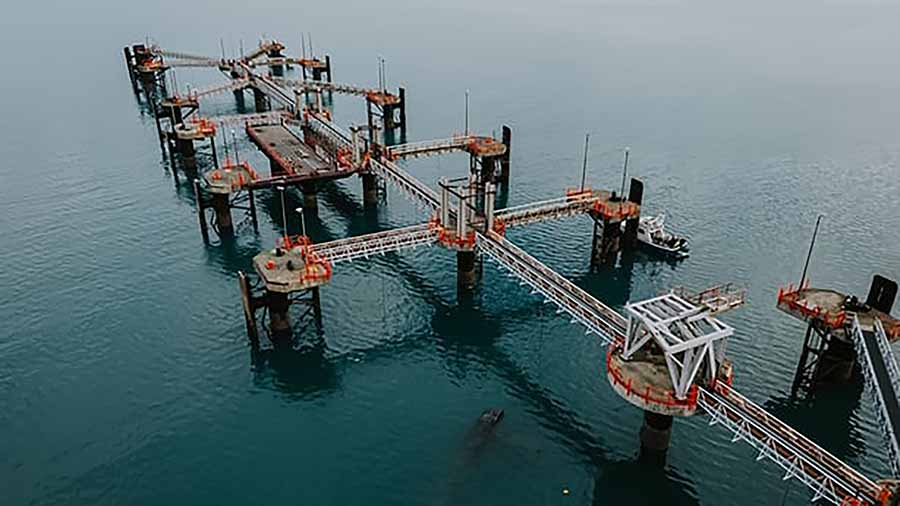
Holyhead’s ferry terminals consist of large steel monopile structures. Each monopile measures roughly 2 metres in diameter and up to 50 metres in length, driven into the seabed and capped with steel-reinforced concrete platforms. The berths feature outer rows with wooden-faced panels and large rubber fender cones designed to absorb berthing energy from vessels. A central spine of piles supports walkways and mooring stations. The two terminals (T3 and T5) connect through an interconnected pile system, which means damage to one affects overall operations.
In the first incident, a ferry made contact with monopile D2.2 while manoeuvring on arrival at Terminal 3. A second contact with the same monopile occurred during departure. The second impact caused the monopile to collapse and fall at an angle. The structure weighed approximately 120 tonnes. Engineers later required specialist barges for removal because the pile could not simply be replaced in its original socket. The fender system and piles are engineered for slow-speed contact, but the combination of wind forces, vessel size (around 200 metres long), and the force of the impacts exceeded the design tolerances in this case.
The interconnected design of the 20 monopiles across the parallel rows amplified the issue. Damage to a single pile required a full structural inspection of the entire berth system, including underwater and intertidal sections. Divers faced delays from poor sea conditions and visibility following the storm. Structural engineers assessed all piles and linking structures before operators could safely reopen the adjacent Terminal 5. Terminal 3 repairs took seven months due to the need to design, fabricate, and install a new monopile, followed by testing.
These engineering features explain the severity and duration of the disruption. The monopile foundation system, while suitable for normal operations in the relatively exposed Holyhead harbour, proved vulnerable when a critical element sustained repeated impacts under stormy conditions. The lack of full redundancy between the two terminals meant that one failure effectively halted operations until assessments concluded. Repairs involved complex marine engineering, including driving a replacement pile into the seabed.
The incidents revealed limitations in the port’s berthing infrastructure resilience when subjected to high lateral forces from large vessels in strong winds.