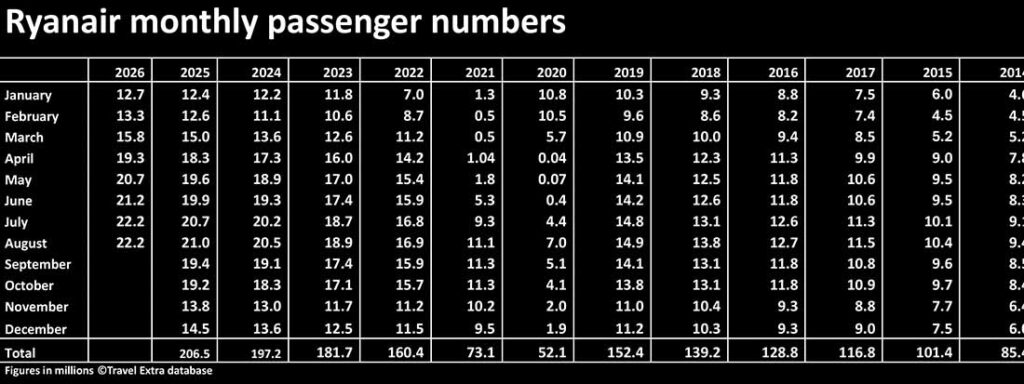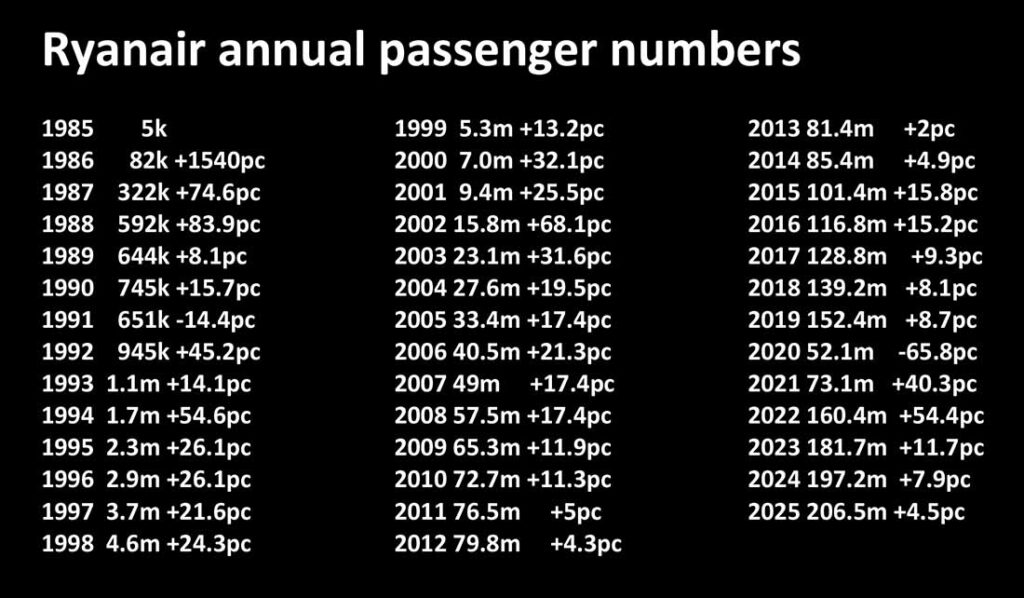
- Ryanair reported Q1 PAT of €538 million, down 34pc year on year.
- Traffic grew 6pc to 61.3 million passengers, but fares fell 6pc.
- Operating costs rose 11pc to €3.81 billion as unhedged fuel costs doubled.
- Ryanair’s FY27 fuel is 80pc hedged at approximately $67 per barrel.
- The Group finalised its €1.2 billion bond repayment in May, leaving it debt free.
Ryanair has reported a Q1 profit after tax (PAT) of €538m, down 34pc from the previous year’s Q1 PAT of €820m. Traffic grew 6pc to 61.3m passengers, but average fares fell 6pc, primarily due to the impact of the Middle East conflict and the first part of the Easter holiday falling into the previous year’s Q4. Revenue rose 1pc to €4.38 billion, while operating costs rose 11pc to €3.81 billion as the price of its 20pc unhedged jet fuel more than doubled.
Unit costs rose 5pc as unhedged Q1 jet fuel prices doubled to $150 per barrel. Ryanair’s FY27 jet fuel is 80pc hedged at approximately $67 per barrel, and FY28 is now 15pc hedged at approximately $85 per barrel. The Group finalised its €1.2 billion bond repayment in May, leaving the Group debt free. The Group’s fleet of 647 aircraft facilitates 4pc FY27 traffic growth to 216m passengers.
Ryanair has opened three new bases in Rabat, Tirana and Trapani, and 130 new summer 2026 routes. The airline’s conservative hedging policy insulates earnings during volatile oil markets and widens its cost advantage over EU competitors. The Group is approximately 90pc through its €750m buyback programme, with over 25m shares purchased and cancelled at an average price of €26.35 per share.
Ryanair CEO Michael O’Leary shared, “Q1 Revenue rose 1pc to €4.38bn. Scheduled revenue dipped 1pc to €2.91bn as traffic grew 6pc but at 6pc lower fares. The Group’s fleet of 647 aircraft facilitates 4pc FY27 traffic growth to 216m passengers. We have opened 3 new bases (Rabat, Tirana and Trapani) and 130 new routes, now on sale.”
Full statement:
Ryanair Holdings plc today (20 July) reported Q1 PAT of €538m, down 34% on PY Q1 PAT of €820m as the price of its 20% unhedged jet-fuel spiked and fares fell 6%, primarily due to the impact of the Middle East conflict and the first part of Easter holiday falling into PY Q4.
| Q1 Ended: | Jun. 2025 | Jun. 2026 | +/- |
| Passengers | 57.9m | 61.3m | +6% |
| Load Factor | 94% | 94% | – |
| Revenue (€) | 4.34bn | 4.38bn | +1% |
| Op. Costs (€) | 3.42bn | 3.81bn | +11% |
| PAT | €820m | €538m | -34% |
Q1 highlights include:
- Traffic grew 6% to 61.3m.
- Rev. per pax fell 5% (ave. fare down 6% & ancil rev. flat).
- Unit costs rose 5% as unhedged Q1 jet-fuel prices doubled to $150bbl.
- FY27 jet-fuel is 80% hedged @ $67bbl. FY28 now 15% hedged at $85bbl.
- 3 new bases (Rabat, Tirana & Trapani) and 130 new S.26 routes.
- Final €1.2bn bond repaid in May, leaving the Group now debt free.
Ryanair CEO Michael O’Leary, shared:
“In Q1 Revenue rose 1% to €4.38bn. Scheduled revenue dipped 1% to €2.91bn as traffic grew 6% but at 6% lower fares. Q1 fares (which benefitted from a full Easter during April 2025) required stimulation as the Middle East conflict led to consumer hesitancy, concerns about EU jet-fuel shortages, economic uncertainty and later bookings. Ancillary revenue grew in line with traffic to €1.47bn. Operating costs rose 11% to €3.81bn as the price of our 20% unhedged jet-fuel more than doubled in Q1, while supplier compensation ceased following delivery of our final B-8200 “Gamechanger” in February 2026.
Ryanair’s conservative hedging policy (FY27 fuel is 80% hedged at c.$67bbl) insulates Group earnings during volatile oil markets and widens our cost advantage over all other EU competitors. We recently extended our fuel hedges (on price dips) into FY28 which is now 15% hedged at c.$85bbl.
Balance sheet & liquidity
Our industry leading balance sheet is underpinned by an unencumbered B737 fleet of 620 aircraft, BBB+ credit ratings and very strong liquidity. At 30 June gross cash was over €2.8bn, after €1.3bn debt repayments and €0.5bn capex. Liquidity is further boosted by the Group’s €1.1bn RCF which is mostly undrawn. This financial strength widens the cost gap between Ryanair and competitor airlines, many of whom are exposed to rising (long-term) finance costs, expensive aircraft leases and unhedged jet-fuel.
We are now c.90% through our €750m buyback programme (over 25m shares purchased and cancelled at an ave. price of €26.35 per share). Over the coming year (following the May repayment of our last €1.2bn bond) our funding priorities include MAX-10 aircraft capex, shareholder dividends and the completion of the current buyback programme from internal cashflows while rebuilding the Group’s gross cash back to €4bn.
Fleet & Growth
The Group’s fleet of 647 aircraft (incl. all 210 B-8200 “Gamechangers”), facilitates 4% FY27 traffic growth to 216m passengers. Boeing continues to expect MAX-10 certification in late summer 2026 and plans to deliver Ryanair’s first 15 MAX-10s on time in Spring 2027, with 300 of these super fuel-efficient aircraft (20% less fuel & 20% more seats) due to deliver by Mar. 2034.
For S.26, Ryanair has opened 3 new bases (Rabat, Tirana and Trapani) and 130 new routes, now on sale. With only 4% FY27 traffic growth, our scarce capacity is being switched to those States, Regions and Airports cutting aviation taxes and lowering fees to incentivise growth (such as Albania, Italy, Morocco, Slovakia and Sweden) as we withdraw flights and traffic away from high tax/high cost markets like Austria, Dublin, Germany and Regional Spain.
We expect European short-haul capacity to remain constrained until at least 2030 as the 2 main OEMs remain well behind on aircraft deliveries, Pratt & Whitney engine repair delays continue, EU airline consolidation accelerates and unprofitable airlines (hit by higher jet-fuel prices and strong US dollar) face a difficult winter. Industry capacity constraints, combined with our widening cost advantage, strong balance sheet, low-cost (fuel-efficient) aircraft orderbook and industry leading ops resilience will, we believe, facilitate Ryanair’s sustainable, profitable growth to over 300m passengers p.a. by FY34.
ESG
During Q1 the Group recorded a record 91% customer satisfaction (CSAT) score (up 2% pts on PY). Our ongoing investment in new technology and operational resilience, coupled with ambitious SAF targets, makes Ryanair one of Europe’s most environmentally efficient airlines. This summer the Group is operating 210 Gamechanger aircraft (4% more seats, 16% less fuel) and preparations are well underway for the first MAX-10s in Q4 (20% more seats & 20% less fuel). We’ll also complete the winglet retrofit programme on all our B737NG fleet (1.5% lower fuel burn and 6% less noise) this winter.
Outlook
FY27 traffic remains on track to grow 4% to 216m passengers (H1 +6% & H2 +2%). Our unit cost leadership continues to widen. Our jet fuel is 80% hedged to March 2027 at c.$67bbl, insulating earnings from oil price volatility and helping offset a €300m increase in EU enviro. taxes, significant crew pay increases under new multi-year CLAs and higher maintenance. Final FY27 unit costs will depend on the price of our 20% unhedged jet fuel over the remaining 3 quarters. While S.26 volumes are strong, the booking window remains closer-in than last year which further reduces visibility. Despite a recent, slight, uptick in volumes, and less price stimulation, Q2 pricing is trending modestly down (y-o-y) and the final H1 fare outcome is heavily dependent on the strength of close-in bookings in Aug. and Sept. As is normal this early in the year, we have zero H2 visibility so it remains far too early to provide any meaningful FY27 PAT guidance.
The final FY27 PAT remains highly sensitive to adverse external developments, incl. conflict escalation in the Middle East and Ukraine, the price of unhedged jet-fuel, macro-economic shocks and continuing European ATC strikes & mismanagement.”