“My enthusiasm to render the State still further service remains undaunted, and my energies became directed towards the establishment and development of commercial aviation linking Ireland with the Continent. My old friend and service comrade, Colonel Charles Russell, came to my assistance in this matter to which we devoted our full attention. Our efforts were, however, fruitless as the Government of the day showed not the slightest interest. Bitterly I came to the conclusion that our stay-at-home compatriots lacked the high qualities of enterprise and endeavour which stood their brothers in such good stead in their activities abroad. Ireland seemed to me to be a land in which only the gombeen man could make good. I felt, somehow, I had had enough.” – Autobiography of Colonel James FitzMaurice, Irish aviation hero.
That was 1928, and Cumann na Gaedheal, the predecessors of Fine Gael, were in power. A committee appointed by Patrick McGilligan, the Minister for Industry and Commerce, had in fact reported in 1928 that a nationally-operated air service would require financial assistance in its early years, and the Government had decided to take no action. Fitzmaurice resigned his Air Corps commission in disgust.
Six years later, a new Fianna Fáil government was in power and Ireland was looking outwards again. The new government was perusing offers for a startup airline from private companies, but all of them were looking for money. Seán Lemass(1959–1966), the Irish revolutionary and later third Taoiseach of Ireland, was the minister in charge.
Firstly, there was solicitor Arthur Cox (1891–1965), who had formed the short-lived Irish Airways Limited “with a view to commencing, with the assistance of a government subsidy, a civil aviation service between Ireland and England and also within Ireland.” Cox’s son, also Arthur, became Ryanair’s legal advisors.
This was followed by Iona National Airways, founded by motor entrepreneur Hugh Cahill (1883–1966). With James C Malone as his minority partner, he founded Ireland’s first commercial airline in July 1930, formally registering Iona National Airways Limited in 1931 with a capital of £2,500. In 1932 they conducted demonstration flights with a Fox Moth, EI-APP, with the intention of establishing a Dublin–London–Berlin route with feeder services to Cork and Galway.
In 1933, a small Glasgow-based operator called Midland & Scottish Air Ferries — founded by bus operator John Sword — launched a scheduled service from Glasgow to Belfast using de Havilland DH84 Dragons. Later that year, the company introduced a route from its subsidiary base at Hooton Park (across the River Mersey from Liverpool) via Speke Airport to Baldonnel. The inaugural flight on this route took place on 14 August 1933 and operated daily until late in the year, primarily using Airspeed Ferries G-ACBT and G-ACFB. However, this early air link across the Irish Sea proved short-lived and was not resumed in 1934.
Midland and Scottish were represented in Ireland by Captain H. J. Hosie of Athy, a director of Industrial Vehicles (Ireland) and distributor for de Havilland aircraft. Operations commenced on Monday, 13 August 1933 with a flight from Hooton, near Liverpool, to Baldonnel via Speke, and continued on a daily basis, Sundays excepted. The service lasted for just six weeks before it ceased on 30 September on account of poor loads, but also because the Department had informed Hosie that he would have to form an Irish company to continue to operate the service, and to include in any such company a representative of the Great Southern Railways, still the major privately or publicly owner transport interest in the country.
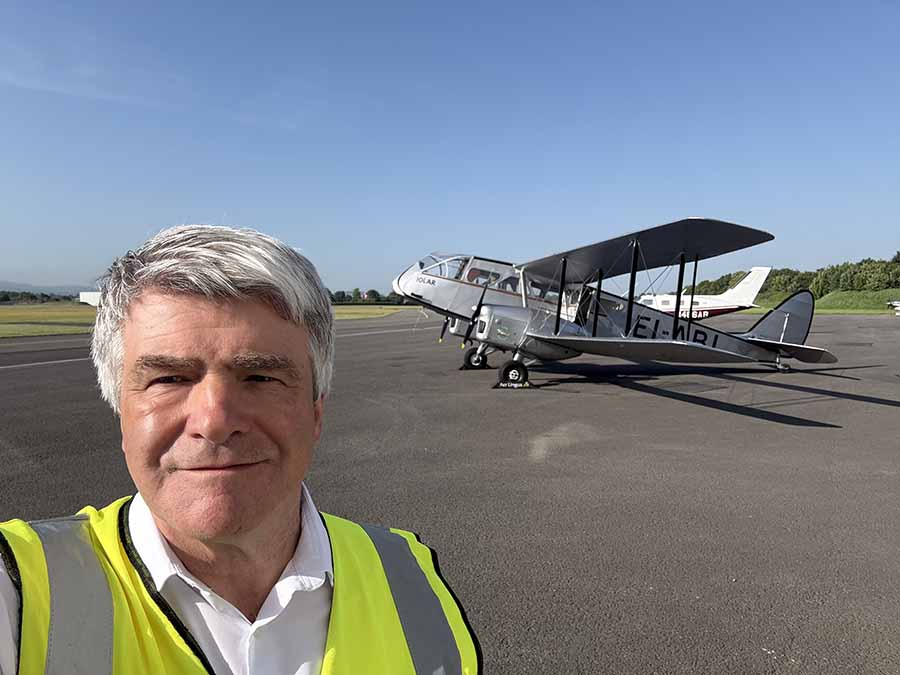
As air travel gained wider acceptance and small independent airlines proliferated across England and Scotland, it was only a matter of time before Ireland secured a more permanent connection with England. Several visionary figures had long advocated for the creation of a national Irish airline, but securing full government backing proved challenging. Finally, in May 1936, Aer Lingus was established with vital support from English independent carrier Blackpool & West Coast Air Services. This company provided initial funding, supplied the first aircraft (a DH84 Dragon), and offered essential technical assistance.
When Aer Lingus commenced operations on 27 May 1936, with its inaugural flight from Dublin (Baldonnel) to Bristol (Whitchurch). Blackpool & West Coast also operated a direct Liverpool–Isle of Man–Baldonnel service using DH84 Dragons, supplemented by four-engined DH86 aircraft during the summer months. The two airlines worked closely together, jointly marketing their Baldonnel–English routes under the banner “Irish Sea Airways”. Aer Lingus additionally launched a seasonal summer service to the Isle of Man in July 1936.
On 14 September 1936, Aer Lingus established the first direct air link between Dublin and London by extending its Bristol route to Croydon with a newly delivered DH86 Express Airliner. At the same time, the DH84 Dragon was introduced on the Dublin–Liverpool route.
In April 1937, Aer Lingus became fully Irish Government-owned through a new holding company called Aer Rianta. This change in ownership did not affect the close cooperation with West Coast (formerly Blackpool & West Coast), which launched its own Croydon–Baldonnel service on 19 April 1937 using DH86s and DH89 Rapides.