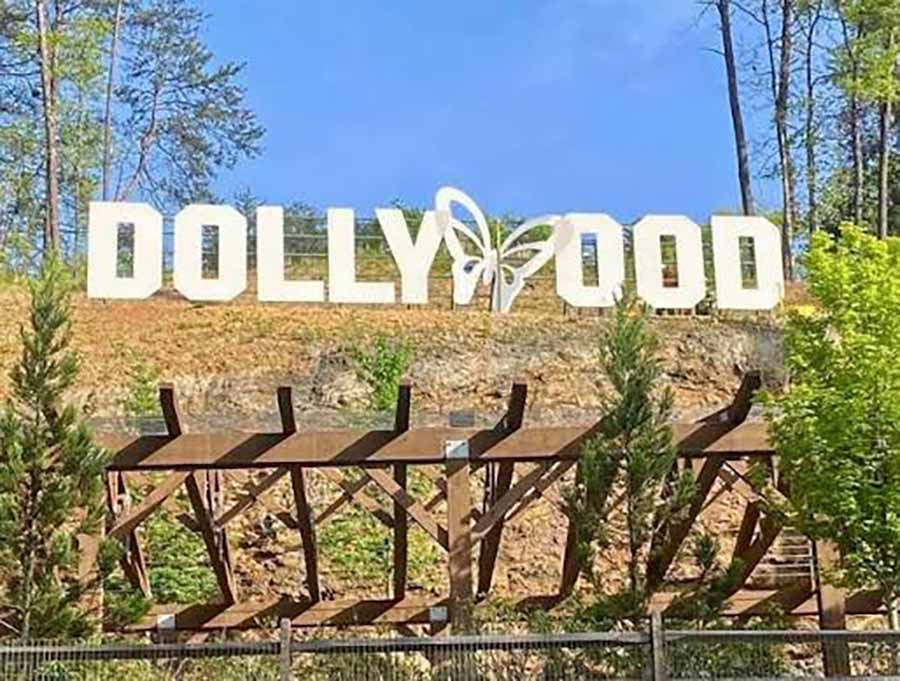
It was Dolly what dun it. Throwback to an evening in 2004, Travel Extra’s editor found himself standing in the middle of a sandy arena in Myrtle Beach South Carolina, throwing a giant plastic horseshoe to wrap it around a pole.
In rural Kildare of my childhood this was a sport known as meggers, featuring real horseshoes. It was also central to cowboy life, and a largely urban crowd who cheered my efforts and my interaction with the MC (form Ireland (big cheer), what is your name, (thanksfully another big cheer, although I was tempted to say Osama Bin laden to see what the reaction would be).
This was wall done in the name of the country cross-over singer whose name is so recognisable that it did not ever need a surname. Her franchise was at its height then. Dolly the doyen Parton was not just a music icon. She was also a pioneer of tourism and brand utilisation, through the creation of Dollywood.
Parton’s decision in the mid-1980s to attach her personal identity to a physical destination in the Great Smoky Mountains was a case study for the evolution of her established public persona into the realm of experiential commerce. On 3 May 1986 the gates of what had previously operated as Silver Dollar City in Pigeon Forge, Tennessee, opened under the new designation of Dollywood, marking the formal launch of a partnership between Parton and the Herschend family.
Attendance in that inaugural season reached 1.3m visitors, constituting an approximate 75pc rise over the figures recorded for the preceding year under the earlier name. This immediate quantitative shift demonstrated the commercial potency of celebrity association when applied to an existing regional attraction already situated near the nation’s most visited national park.
Smoky Mountain fairyland
Parton herself later confirmed the personal motivation behind the project. In remarks reflecting on the enterprise she stated, “I always thought that if I made it big or got successful at what I had started out to do, that I wanted to come back to my part of the country and do something great, something that would bring a lot of jobs into this area.
By 1985 negotiations had advanced to the point at which Parton invested several million dollars to enlarge and rebrand the site. Park officials at the time projected the creation of 150 permanent positions together with an additional 150 temporary roles during construction. Peter Herschend estimated that the renamed operation would attract a further 250,000 visitors annually beyond the 750,000 already drawn to the predecessor park. These projections proved conservative. In 1986 Pigeon Forge recorded a 46pc increase in sales tax revenue and a 37pc rise in lodging tax revenue, while building permits issued the following year for nonresidential projects approached €24m in value.
In a 1982 interview Dolly revealed her ambition for a “Smoky Mountain fairyland,” an aspiration that the Herschend brothers recognised as complementary to their own operational expertise.
The resulting joint ownership structure assigned Parton a 50pc stake, a holding later valued at approximately €152m for the theme park component alone, with additional interests in the adjacent water park and resorts contributing further asset value. Analytical observers note that this arrangement allowed Parton to retain creative influence while leveraging the Herschends’ established infrastructure and management systems. The first season’s addition of Rivertown Junction, incorporating Aunt Granny’s restaurant, Dolly’s Tennessee Mountain Home, a 450-seat theatre and the Smoky Mountain River Rampage, illustrated the deliberate infusion of autobiographical elements into the physical layout.
By the early 2000s the property had more than doubled its original acreage. The introduction of Splash Country in 2001 extended the seasonal calendar into water-based attractions. DreamMore Resort opened in 2015, followed by HeartSong Lodge & Resort in 2023. Capital expenditure on additions and improvements exceeded €101m over the intervening decades. Attendance stabilised above twom visitors per year for extended periods before climbing toward threem and, in the 2025 season, approaching fourm guests across the broader campus. A 2021 Tennessee Department of Transportation study placed the annual direct economic impact at €1.65bn and credited the complex with supporting more than 23,000 regional jobs. These figures position Dollywood as the principal employer within both Pigeon Forge and Sevier County and as a primary generator of state and local tax receipts exceeding €203m annually in more recent assessments.
‘You are making a big mistake’
Reflecting on the initial scepticism she encountered, she revealed, “When I first had the big idea to start Dollywood, my accountants and lawyers all thought I was making a big mistake. But I felt a calling to do this. So I got rid of all of them and brought in people who had faith in me.”
It is an old song worthy of a country singer, intuitive conviction winning out over conventional financial caution proved decisive. On the opening morning of 3 May 1986 she admitted to residual apprehension: “On opening day in 1986, I was just hoping that people would really want to come visit a theme park with my name on it. And even though I always try to dream big, I’ll admit I was a little bit nervous that first morning.”
The arrival of throngs of visitors in the parking lot prompted an immediate sense of relief, relief that she later described in spiritual terms. Such remarks underscore the personal risk inherent in the branding exercise while simultaneously illustrating the rapid validation supplied by market response.
From an analytical standpoint the longevity of the model rests on the consistent integration of regional cultural markers with contemporary amusement technology. The retention of craft demonstrations, the continued operation of a coal-fired steam locomotive dating from 1943, and the presence of a working grist mill that produces thousands of loaves of cinnamon bread daily function as anchors of authenticity. Concurrently the progressive introduction of roller coasters, including wooden and wing designs, has maintained competitive parity with larger national operators. The park’s ranking among the top fifty most attended theme parks worldwide and its repeated recognition as the leading theme park in the United States by independent surveys reflect the successful calibration of these dual imperatives.
The philanthropic extension of the brand through the Dollywood Foundation, established in 1988, further deepens the analytical picture. The foundation’s Imagination Library programme, which distributes free books to children from birth until school age, has operated as a parallel expression of Parton’s commitment to local educational outcomes. While the commercial enterprise generated employment and tax revenue, the foundation channelled resources toward literacy and, on occasion, disaster relief following wildfires in the surrounding area. This dual structure of profit-oriented tourism and targeted social investment distinguishes the overall project from purely extractive celebrity endorsements.
Visitors from 20 states
Guests routinely arrive from more than twenty states on any given operating day, converting the destination into a multi-night rather than single-day proposition for the majority of patrons. The proximity of Great Smoky Mountains National Park supplies a complementary natural draw that amplifies length of stay and secondary spending in lodging, dining and retail. Analytical models of regional tourism therefore treat Dollywood not as an isolated attraction but as the central node within an interconnected visitor economy that has transformed Pigeon Forge from a modest mountain town into a destination capable of sustaining year-round commercial activity, even if the park itself currently operates for approximately 280 to 300 days annually.
And form there it grew. It was expanded into the suite of Dolly shows such as the one Travel Etxra came across in Myrtle Beach in 2004.
- Dolly Parton’s Stampede: Featuring 32 magnificent horses, trick riding, and a four-course family feast, with locations in Pigeon Forge, Tennessee, and Branson, Missouri.
- Pirates Voyage Dinner & Show: An indoor lagoon battle featuring acrobatics and marine animals, with locations in Myrtle Beach, South Carolina; Pigeon Forge, Tennessee; and Panama City Beach, Florida.
- Hatfield & McCoy Dinner Feud: A family-friendly comedy and feast production located in Pigeon Forge, Tennessee
Endangered heritage
Parton’s later reflected that the enterprise remained rooted in a desire “to preserve the Smoky Mountain heritage rather than have Hollywood portray us as they often do.”
The importance of local narrative control, articulated as early as 1985, informed design choices that privileged Appalachian crafts, music and storytelling over generic fantasy themes. In more recent commentary she observed that the surrounding landscape itself furnished the principal source of inspiration: the Smoky Mountains, in her formulation, constitute “the most perfect place that God has created,” thereby framing the park as an amplification rather than a replacement of the natural setting.
The financial architecture of the partnership has proven resilient across four decades. Parton’s retained equity interest has appreciated in tandem with successive capital improvements and attendance growth. Management continuity under Herschend Family Entertainment has ensured operational stability, while Parton’s public appearances at seasonal openings have sustained media visibility and brand association. Attendance records set in 2025, with nearly fourm visitors, indicate that the model retains capacity for further expansion, including the planned addition of major indoor attractions designed to extend operating hours into colder months.
Unlike transient product lines or limited-term residencies, Dollywood constitutes a permanent physical asset whose value derives from repeated visitation and multi-generational family associations. The slogan “memories worth repeating” encapsulates the intentional cultivation of habitual return rather than one-off novelty. Pricing structures, with adult single-day tickets in the region of €87 and season passes ranging higher, position the experience as accessible relative to larger coastal resorts while still generating substantial per-capita revenue through food, merchandise and on-site lodging.
Booming county
Sevier County demographics and infrastructure have been transformed too. The population growth exceede 100pc since 1990 and in the proliferation of complementary hotels, restaurants and secondary attractions. Local officials have repeatedly attributed the transformation of the municipal tax base to the catalytic role of the 1986 rebranding. The first full year of operation already exceeded feasibility studies commissioned prior to the partnership, establishing a pattern of outperformance that has characterised subsequent seasons.
Parton’s insistence upon treating employees as “hosts” rather than merely staff further shapes the operational culture. This linguistic framing, which she has reiterated across multiple interviews, seeks to instil a hospitality ethos consistent with traditional mountain welcome. Guest feedback consistently cites the quality of interpersonal interaction as a differentiating factor relative to more impersonal large-scale parks. The analytical implication is that brand utilisation in this instance extends beyond visual identity and naming rights into the domain of service design and human resource philosophy.
She was always confident that further developments would maintain the balance between innovation and heritage. The planned introduction of advanced attractions, including hybrid indoor experiences, illustrates the adaptive capacity of the model. She was careful to retain core elements such as the original train ride and craft workshops to ensure continuity of identity.
Having begun in 1982 with the ambition, the 1985 partnership agreement, the 3 May 1986 opening, the first-year attendance of 1.3m, the subsequent capital outlays exceeding €101m, the economic impact of €1.65bn and the employment of more than 23,000 people in the region supplies a coherent data set for evaluating the long-term efficacy of celebrity-driven destination branding. Direct quotations from Parton herself consistently reaffirm the primacy of employment generation and cultural preservation as founding principles.
Big decision, big impact. Dollywood and the Dolly evening shows have seen sustained growth in visitation and revenue across forty seasons. Now there’s sweet music.