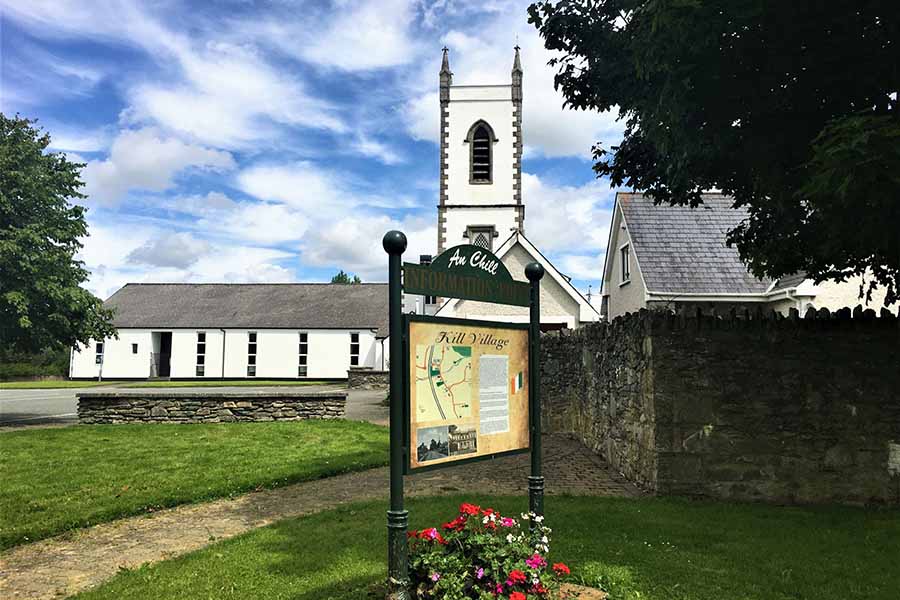
Start your walking tour of Kill in Ireland’s county Kildare outside Saint John’s Church of Ireland in the middle of the village. Human presence around Kill dates to the Stone Age as shown by the Kilwarden Stone discovered north of the village in the 1980s with spiral carvings similar to those at Newgrange dated to at least five thousand years ago now displayed on the ground floor of the National Museum of Ireland.
On Kill Hill above the village a large Bronze Age hillfort traces in field boundaries with excavations before N7 widening northbound uncovering several Bronze Age burial urns and Iron Age settlement traces. The village name derives from the Irish cill meaning church indicating a church site since early Christian times. The present Saint John’s Church stands on the likely location of the first church taken over or rebuilt by Normans in the 12th century. Features include unusual half doors one of the last in Ireland and an organ from the 1700s with black and white keys reversed.
A stone font outside the door probably came from an earlier church on the site. Behind the church at the back of Glendara housing estate the Motte of Kill rises possibly the first fortification by the Norman Haraford family granted lands around Kill though it may also form an earlier burial mound with local tradition holding that several kings of Leinster lie buried there named in ancient annals at Cill Corbain. Head southward from the church past new houses on the probable medieval village green site to a single-storey building once the Garda station originally an RIC station from which patrols set out in August 1920 to Night Bush ambushed at Greenhills with two RIC men shot during the War of Independence the station later burned but rebuilt and used until recent closure.
Cross to the Drew Drop Inn sometimes called Lady Mayo’s Inn modelled on an English inn with early photographs showing two rooms on one side. Return north along the Main Street past a high wall on the left behind which a house began as an Erasmus Smith school funded by Cromwellian cavalry commander Erasmus Smith who later regretted violence and bequeathed money for poor boys’ and girls’ education with 1824 records showing 24 boys and 26 girls of whom 30 Catholic and 20 Protestant. Beside the building a lane once Ards Lane named after teacher Mr Ard reputed first in the village to own a penny farthing bicycle. Opposite the lane a large building served as the dispensary for local doctor and nurse from the 19th century to the late 1980s now vacant.
Further along the Old House pub dates to the 18th century originally single-storey with thatched roof raised and ransacked by Black and Tans in retaliation for the 1920 RIC shootings sign stating built in 1794 rebuilt in 1943 after a fire set back from the street. Beside it a lane once led to Straffan before N7 construction with a forge where river water cooled iron hoops for cartwheels hammered on a showing stone on the bank tradition holding that Empress of Austria who hunted locally lost a horseshoe after a jump replaced at the forge and on one occasion took two local boys to Vienna for court positions returning years later speaking only German.
On the left ,People’s Park occupies the old parochial house site beside the Catholic Church of Saint Brigid built in 1821 under Father Daniel Nolan seven years before Catholic emancipation mentioned in memoirs of Fenian John Devoy. Born in Kill in 1842, he was described by Patrick Pearse as the greatest of Fenians extended and remodelled in the 1970s for population growth.
Next the old national school with gothic windows built in the 1830s served until the 1950s when a new school opened beside it the schoolmaster’s house home to Liam O’Flynn folklore collector and traditional musician whose son Liam O’Flynn joined Planxty and became Ireland’s foremost uilleann piper.
Kill produced other figures after the Second World War Ernest Lyons from Hartwell won the Isle of Man TT on a self-built motorbike. Colm McCoy represented Ireland at the 1960 Olympics where he was eliminated in the round of 32. Pat Taaffe rode Arkle the invincible racehorse while recent years feature the Walsh family Ted, Ruby and Katie, the pioneering woman jockey. A highlight was the millennium year 2000 homecoming after Papillon won the Grand National .trained by Ted Walsh ridden by his son Ruby. Return through the village to the starting point at Saint John’s Church.
Ireland county by county
Antrim – Armagh – Carlow – Cavan – Clare – Cork – Derry – Donegal – Down – Dublin – Fermanagh – Galway – Kerry – Kildare – Kilkenny – Laois – Leitrim – Limerick – Longford – Louth – Mayo – Meath – Monaghan – Offaly – Roscommon – Sligo – Tipperary – Tyrone – Waterford – Westmeath – Wexford – Wicklow
Largest town walking tour
Antrim – Armagh – Carlow – Cavan – Clare – Cork – Derry – Donegal – Down – Dublin – Fermanagh – Galway – Kerry – Kildare – Kilkenny – Laois – Leitrim – Limerick – Longford – Louth – Mayo – Meath – Monaghan – Offaly – Roscommon – Sligo – Tipperary – Tyrone – Waterford – Westmeath – Wexford – Wicklow
Towns
Antrim – Armagh – Carlow – Cavan – Clare – Cork – Derry – Donegal – Down – Dublin – Fermanagh – Galway – Kerry – Kildare – Kilkenny – Laois – Leitrim – Limerick – Longford – Louth – Mayo – Meath – Monaghan – Offaly – Roscommon – Sligo – Tipperary – Tyrone – Waterford – Westmeath – Wexford – Wicklow
Villages
Antrim – Armagh – Carlow – Cavan – Clare – Cork – Derry – Donegal – Down – Dublin – Fermanagh – Galway – Kerry – Kildare – Kilkenny – Laois – Leitrim – Limerick – Longford – Louth – Mayo – Meath – Monaghan – Offaly – Roscommon – Sligo – Tipperary – Tyrone – Waterford – Westmeath – Wexford – Wicklow