- Craigavon (72,301 inhabitants): Craigavon is a planned new town developed in the 1960s to link older settlements. Visitors can expect extensive lakeside paths around Craigavon Lakes for walking and cycling, suitable for families and disabled users. The area includes Lough Neagh Discovery Centre with exhibits on wildlife, RSPB Portmore Lough Nature Reserve for birdwatching, and Brownlow House with grounds near Lurgan Park. Local facilities provide a base for outdoor leisure close to Lough Neagh shores.
- Castlereagh (58,763 inhabitants): Castlereagh forms a suburban district southeast of Belfast, now part of Lisburn and Castlereagh City. Visitors might expect access to nearby attractions such as Belvoir Park Forest with paths along the River Lagan, along with local parks and community amenities. The area offers proximity to Belfast for day trips while providing quieter residential surroundings.
- Lurgan (28,634 inhabitants): Lurgan is a town near the southern shore of Lough Neagh. Visitors can expect Brownlow House with tours of its historic rooms and grounds, Lurgan Park as a large urban park with a man-made lake and woodland paths, and Tannaghmore Gardens with farm animals and open spaces. The town provides local amenities and serves as a base for lakeside exploration.
- Portadown (22,000 inhabitants): Portadown stands on the River Bann with canal features. Visitors might expect riverside scenery, access to nearby nature reserves such as Oxford Island, and local parks for walks. The town offers basic facilities in a flat landscape close to Lough Neagh.
- Armagh (16,310 inhabitants): Armagh is an ancient city with ecclesiastical history. Visitors can expect two cathedrals dedicated to St Patrick overlooking the city, Navan Centre and Fort with exhibits on ancient sites, Armagh Observatory and Planetarium for astronomy displays, and Robinson Library with historical collections. The area includes Gosford Forest Park for woodland trails and serves as a centre for regional history.
- Waringstown (3,866 inhabitants): Waringstown is a large village known for its planned layout from the linen industry era. Visitors might expect a quiet rural setting with floral displays and pleasant appearance, along with local amenities and access to surrounding countryside paths.
- Tandragee (3,545 inhabitants): Tandragee lies on a hillside above the Cusher River, overlooked by a castle. Visitors can expect proximity to the Tayto crisp factory site, local facilities, and a calm town atmosphere with access to nearby rural landscapes.
- Bessbrook (2,892 inhabitants): Bessbrook is a model village built as a Quaker settlement around the linen industry. Visitors might expect historical features such as the Friends Meeting House, a library, and a layout without pubs, pawn shops, or police stations in its original design. The village provides peaceful surroundings close to Newry.
Towns
Antrim – Armagh – Carlow – Cavan – Clare – Cork – Derry – Donegal – Down – Dublin – Fermanagh – Galway – Kerry – Kildare – Kilkenny – Laois – Leitrim – Limerick – Longford – Louth – Mayo – Meath – Monaghan – Offaly – Roscommon – Sligo – Tipperary – Tyrone – Waterford – Westmeath – Wexford – Wicklow
Villages
Antrim – Armagh – Carlow – Cavan – Clare – Cork – Derry – Donegal – Down – Dublin – Fermanagh – Galway – Kerry – Kildare – Kilkenny – Laois – Leitrim – Limerick – Longford – Louth – Mayo – Meath – Monaghan – Offaly – Roscommon – Sligo – Tipperary – Tyrone – Waterford – Westmeath – Wexford – Wicklow
Largest town in the county: a walking tour
Antrim – Armagh – Carlow – Cavan – Clare – Cork – Derry – Donegal – Down – Dublin – Fermanagh – Galway – Kerry – Kildare – Kilkenny – Laois – Leitrim – Limerick – Longford – Louth – Mayo – Meath – Monaghan – Offaly – Roscommon – Sligo – Tipperary – Tyrone – Waterford – Westmeath – Wexford – Wicklow
County Armagh:
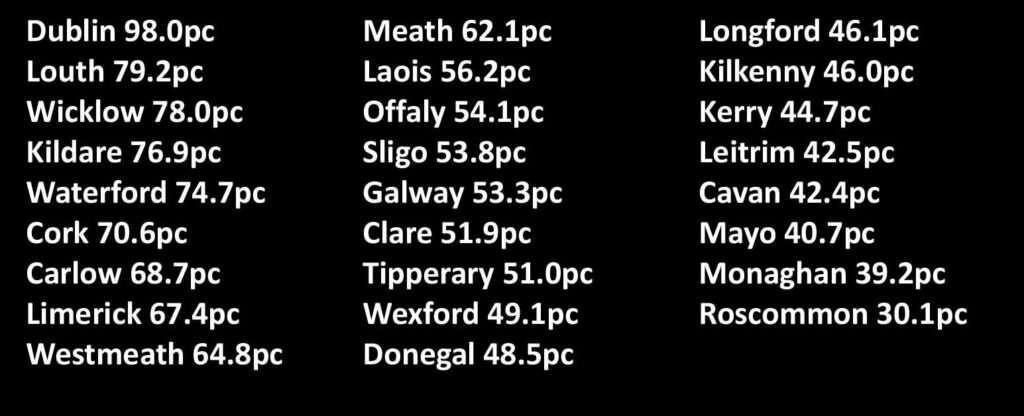
Ireland’s County Armagh is steeped in history and natural beauty, with the Navan Fort, an ancient ceremonial site, offering archaeological intrigue. The Armagh Observatory and Planetarium provide stargazing opportunities, while the city’s two cathedrals reflect its ecclesiastical heritage. Other attractions include the nearby Slieve Gullion Forest Park with its hiking trails and panoramic views. Armagh is Ireland’s fifth smallest county by size (1,253 square km) and tenth largest by population (194,394). Population peaked at 232,393 in 1841 and reached its lowest point, 108,815, in 1937. In terms of hospitality, Armagh is Ireland’s 26th most visited tourist county with around 57,000 international visitors per year.
Introduction – Adventure – Anthem – Archaeology – Attractions – Awards – Birdwatching – Camping – Castles – Churches – Contact list – Cycling – Dining – Equestrian – Festivals – Fishing – Folklore – Gardens – Golf – Graveyards – Happening – Haunted – Highest – Hiking – History – Holy Wells – Hotels – Hotels top 8 – Hunting & shooting – Instagrammable – Itineraries – Largest town – Luxury – MICE – Movies – Music – New – Name – Novelists – Off the beaten track – Poets – Pubs – Quotes – Random Facts – Restaurant Awards – Sacred Places – Saints – Songs – Spas – Sports – Sunsets – Sustainable – Things to do – Towns – Video – Villages – Walking – Wanderlist – Weddings – Wild swimming – Writers – 1837– 1846 – 1852 – 1909 – 1955 – 1980 –