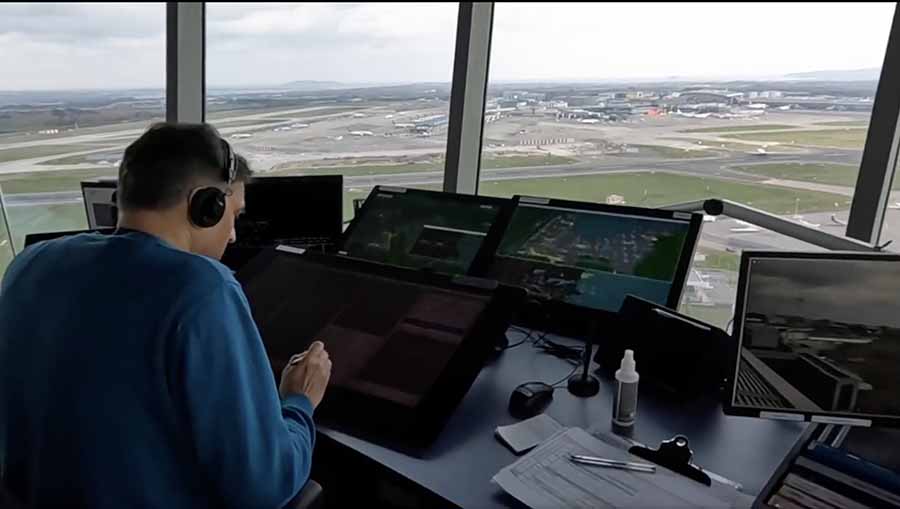
Point Merge Air Traffic System is now operating at 59 airports across 23 countries on four continents, including major hubs like Istanbul, Shanghai, Tokyo, Kuala Lumpur, and Lisbon, where delays fell by over 30pc after its 2024 rollout, implementing a procedure used pre-defined sequencing arcs for arrivals. An advantage is that integration does not require new ground equipment.
The Point Merge system represents a modern approach to sequencing aircraft arrivals in busy terminal airspace, developed by EUROCONTROL in 2006 and first implemented at Oslo Airport in 2011.
Controllers direct aircraft to fly along pre-defined arc-shaped sequencing legs equidistant from a central merge point, then issue a simple “direct-to” instruction when spacing allows, enabling all planes to follow the same fixed path to final approach.
This method replaces traditional radar vectoring, which requires constant heading instructions and heavy radio communication, reducing controller workload and providing pilots with predictable flight paths.
Benefits include support for continuous descent operations, lowering fuel burn and emissions, with studies showing reductions in flight time, distance, and noise exposure. EUROCONTROL maintains an interactive map (beta version) on its website detailing deployment sites, procedures, and characteristics.
Oslo implemented first Point Merge in 2011. The full list of airports are: Bogota, Canary Islands airports (5), Dublin (2012), Guadalajara, Guangzhou, Hannover, Ho Chi Minh City (Tân Sơn Nhất), Istanbul (both IST and SAW), Jeju, Kuala Lumpur, Lagos, Leipzig, Lisbon, London City and Biggin Hill, Mexico City, Oslo Gardemoen (first in 2011), Paris ACC areas, Saint Petersburg, São Paulo-Guarulhos, Seoul, Shanghai Pudong, Shenzhen, Tokyo Haneda, Toluca and Zhengzhou.