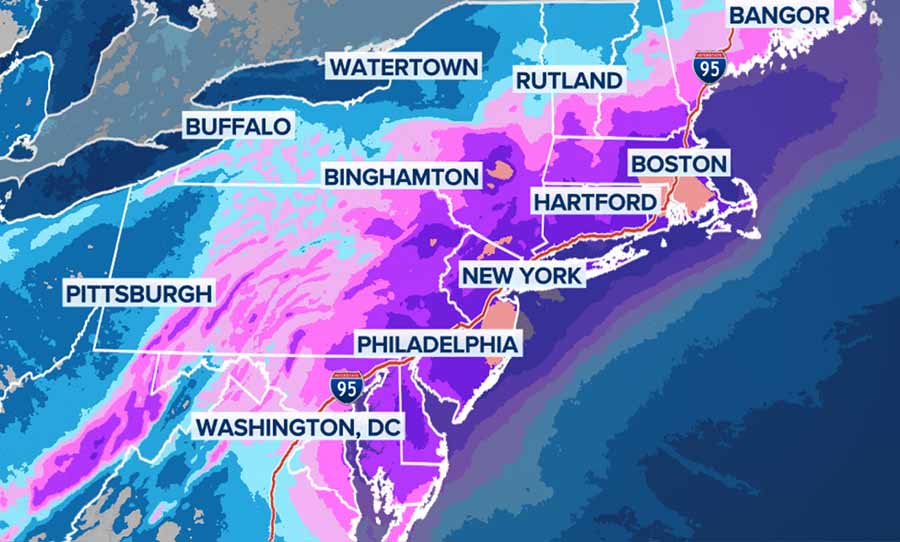
The historic nor’easter, currently intensifying and set to strike the Northeast starting Sunday 22 February 2026, has already triggered widespread disruptions to aviation across major hubs from Washington D.C. to Boston.
Heavy snowfall, expected to reach 18 to 24 inches in areas including New York City, Philadelphia, and Boston, combined with wind gusts up to 50 mph or more, creates blizzard conditions that render runways hazardous and visibility near zero.
Dublin flights affected include:
- New York JFK DL045@10.45
- Philadelphia AA729@11.30
- Newark EI101@13.15
- New York JFK EI107@16.40
JFK EI105@11.15 still scheduled
Airlines have responded proactively by cancelling thousands of flights to avoid stranding aircraft and crews, prioritising safety amid the rapid onset of severe weather.
Over 3,000 flights across the region faced cancellation through Monday, with numbers projected to climb sharply as the storm peaks. Carriers such as Delta, American, United, and JetBlue initiated pre-emptive cuts, particularly at critical hubs.
JetBlue cancelled around 40pc of its schedule for Sunday and 24pc for Monday, while Delta and others grounded operations at New York-area airports like John F. Kennedy, LaGuardia, and Newark Liberty, as well as Boston Logan. Philadelphia International Airport also reported early cancellations and delays.
These actions aim to prevent cascading operational issues, but they leave travellers facing significant itinerary changes.
The storm’s timing, beginning Sunday afternoon and intensifying into Monday, coincides with weekend and early-week travel peaks, amplifying the chaos. New York City, the Northeast’s primary aviation gateway with three major international airports, expects the heaviest impacts, with blizzard warnings in place for the first time in nearly a decade.
Boston Logan anticipates smoother conditions on Sunday but severe deterioration on Monday, when the bulk of snow and winds arrive. Ripple effects extend nationwide and internationally, as cancelled flights disrupt connections and force international carriers to scrub select services to New York. The I-95 corridor’s paralysis compounds problems for ground transport links to airports.
Major airlines, including JetBlue, American, Delta, Southwest, and United, issued travel waivers allowing passengers to rebook affected flights without fees or fare differences, covering departures and arrivals at Northeast airports from Virginia to Maine. These policies ease some financial burdens but do little to mitigate broader inconvenience, such as hotel shortages or extended delays. Airports urged travellers to monitor airline updates before heading out, as conditions make travel dangerous or impossible during peak storm hours. Crews prepared to clear runways, yet sustained heavy snow and winds limit effectiveness.