- Clones Monastic Site: Clones, County Monaghan, approximately 20 km southwest of Monaghan Town (Coordinates: 54.183°N, 7.234°W).. Founded in the 6th century by St. Tigernach (Tighernach), Clones was an early Christian monastic centre. The site includes a 12th-century Augustinian abbey, built on earlier foundations, a 10th-century round tower, and St. Tigernach’s tomb shrine, a sandstone structure resembling an early wooden church, believed to contain the saint’s relics. The monastery was raided by Vikings in 836 AD and destroyed by fire in 1095 AD, but it was re-established as an Augustinian abbey c. 1140. The site features high crosses with biblical carvings, reflecting its role as a centre of learning and art. Archaeological evidence suggests continuous use into the medieval period, tied to the MacMahon clan’s influence in the region. The site is publicly accessible with free entry, managed by the Office of Public Works (OPW). Limited on-site facilities, but interpretive signage is available. Check www.heritageireland.ie for details.
- Mannan Castle: Donaghmoyne, near Carrickmacross, County Monaghan, approximately 6 km northeast of Carrickmacross (Coordinates: 53.987°N, 6.671°W).. Mannan Castle is a well-preserved motte-and-bailey castle, constructed in the late 12th century (c. 1184) by the Anglo-Norman Pipard family. The motte, an artificial earthen mound, stands over 10 metres high, with a rectangular bailey enclosed by a ditch. It served as a defensive and administrative centre during the Norman expansion into Ulster, reflecting the region’s contested history between Norman and Gaelic lords, notably the MacMahons. Archaeological surveys indicate later medieval modifications, including a stone structure on the motte. The site’s name may derive from a local legend or a corruption of “Magh an Inis,” meaning plain of the island. Located on private land but accessible to the public with permission. No formal facilities; check www.archaeology.ie or www.discoverireland.ie for access guidance.
- Inniskeen Motte and Bailey: Inniskeen, County Monaghan, approximately 12 km southeast of Monaghan Town (Coordinates: 54.003°N, 6.586°W).. This 12th-century motte-and-bailey, likely built c. 1190–1200 by the Normans, is one of Monaghan’s best-preserved examples of early Norman earthwork fortifications. The motte, topped with a wooden or stone structure, and the adjacent bailey served as a military outpost in the borderlands between Norman-controlled Louth and Gaelic Ulster. The site is associated with the early Christian monastery of Inniskeen, founded by St. Daig in the 6th century, which included a round tower (destroyed in the 19th century). Archaeological investigations reveal medieval artefacts, highlighting the site’s dual ecclesiastical and military significance. Publicly accessible with free entry, though on private land. Limited signage; check www.archaeology.ie for monument details.
- Lisnadarragh Wedge Tomb: Near Emyvale, County Monaghan, approximately 10 km north of Monaghan Town (Coordinates: 54.360°N, 7.021°W).. Lisnadarragh is a Neolithic wedge tomb, dating to c. 2500–2000 BC, part of Monaghan’s prehistoric megalithic tradition. The tomb features a chamber formed by large stones with a capstone, typical of burial monuments used for communal interments. Its location in a hilly area suggests a ritual landscape, possibly linked to other nearby megaliths. Archaeological surveys indicate that such tombs were often reused in the Bronze Age. The site provides insight into Monaghan’s early farming communities and their funerary practices. Located on private land but accessible with landowner permission. No formal facilities; check www.archaeology.ie or www.irishmegaliths.org.uk for directions.
- Donagh Old Graveyard and Church: Donagh, near Glaslough, County Monaghan, approximately 10 km northeast of Monaghan Town (Coordinates: 54.314°N, 6.943°W).. Donagh is an early Christian site with a medieval church ruin, dating to the 12th–15th centuries, built on a 6th-century monastic foundation. The site includes a graveyard with early Christian cross-slabs and a possible holy well, indicating its religious significance. Archaeological evidence suggests links to the MacMahon clan, who controlled the area in the medieval period. The church’s simple rectangular structure and carved stones reflect typical medieval ecclesiastical architecture in Ulster. Publicly accessible with free entry, managed by Monaghan County Council. Limited facilities; check www.monaghan.ie or www.archaeology.ie for details.
Archaeological sites
Antrim – Armagh – Carlow – Cavan – Clare – Cork – Derry – Donegal – Down – Dublin – Fermanagh – Galway – Kerry – Kildare – Kilkenny – Laois – Leitrim – Limerick – Longford – Louth – Mayo – Meath – Monaghan – Offaly – Roscommon – Sligo – Tipperary – Tyrone – Waterford – Westmeath – Wexford – Wicklow
County Monaghan:
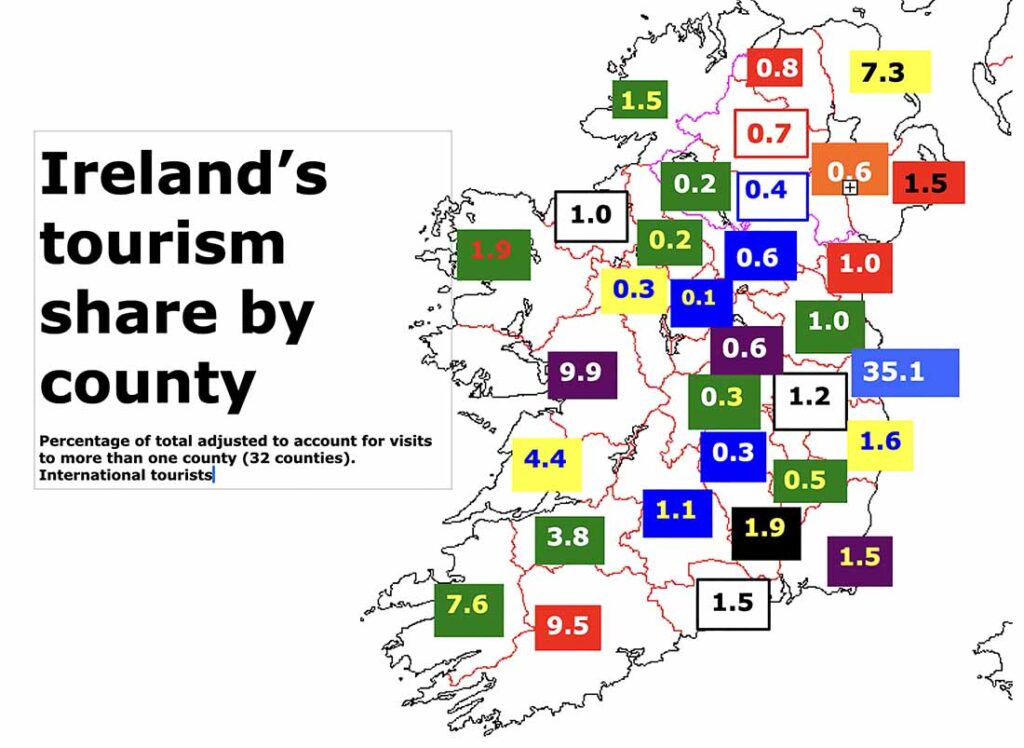
Ireland’s county Monaghan offers a serene blend of rolling hills and cultural heritage, with the Monaghan County Museum showcasing local history through artefacts and exhibits. The scenic Rossmore Forest Park provides walking trails amidst lakes and woodlands, while Castle Leslie’s historic estate offers a glimpse into aristocratic life. Other attractions include the county’s traditional lace-making heritage and quiet countryside. Monaghan is Ireland’s sixth smallest county by size (1,291 square km) and fifth smallest by population (65,288). Population peaked at 200,442 in 1841 and reached its lowest point, 45,732 in 1966. In terms of hospitality, Monaghan is Ireland’s 25th most visited tourist county with around 58,000 international visitors per year.
Introduction – Adventure – Anthem – Archaeology – Attractions – Awards – Birdwatching – Camping – Castles – Churches – Contact list – Cycling – Dining – Equestrian – Festivals – Fishing – Folklore – Gardens – Golf – Graveyards – Happening – Haunted – Highest – Hiking – History – Holy Wells – Hotels – Hotels top 8 – Hunting & shooting – Instagrammable – Itineraries – Largest town – Luxury – MICE – Movies – Music – Name – New – Novelists – Off the beaten track – Poets – Pubs – Quotes – Random Facts – Restaurant Awards – Sacred Places – Saints – Songs – Spas – Sports – Sunsets – Sustainable – Things to do – Towns – Video – Villages – Walking – Wanderlist – Weddings – Wild swimming – Writers – 1837 – 1846 – 1852 – 1909 – 1955 – 1980 –