
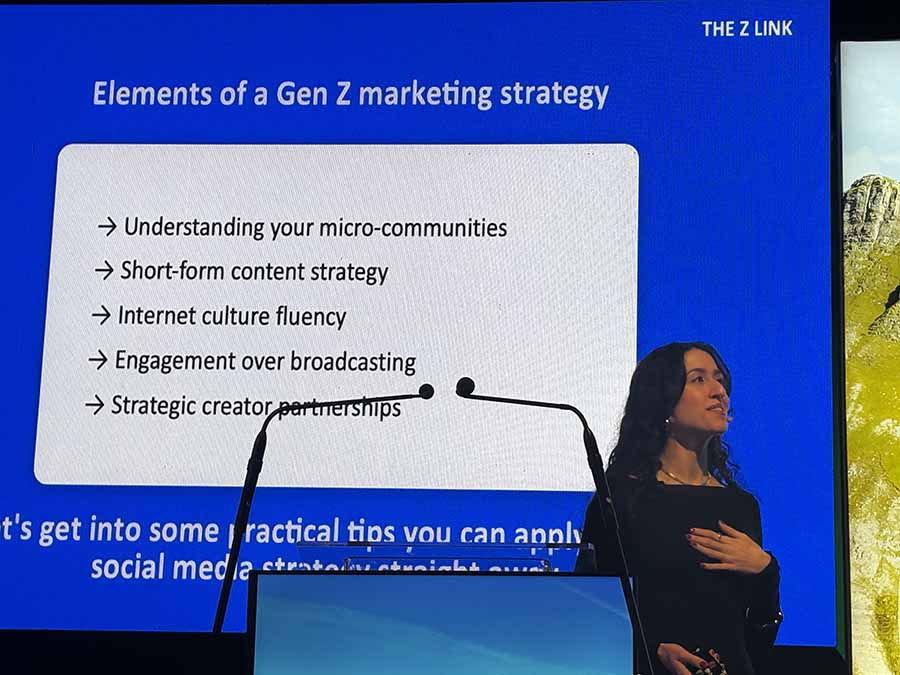
Gen Z marketing expert Erifili Gounari told delegates at the Irish Hotels Federation Annual Conference in Killarney that the first two seconds in all short form content is what matter most. She recommended storytelling that built curiosity without immediate resolution and stressed keeping content human, casual, and relatable nd said that engagement is as important as posting.
Ms Gounari stressed short-form video content with strong opening seconds, storytelling, and a human casual tone to capture attention. She highlighted engagement strategies including active comment sections and direct interaction to show personality and foster community. Ms Gounari shared that Gen Z prioritised work-life balance, fulfilment, hybrid work, training budgets, and output-driven cultures over traditional structures.
Ms Gounari advocated dedicated strategies for comment sections, direct messages, and active participation in target communities to show personality behind the brand.
Ms Gounari explained that brands should focus on core values rather than forcing alignment with every Gen Z concern such as sustainability. She advised identifying authentic purpose and placing it at the forefront of communications to build genuine trust.
She emphasised understanding micro-communities within Gen Z, such as solo travellers or niche interest groups on social media, instead of targeting the broad demographic. Engaging these smaller, highly active communities allowed brands to create relevant content and foster deeper connections.
She praised strategic creator partnerships with niche, value-aligned influencers over large-follower accounts. Gounari cited examples such as an insurance brand gaining 15,000 highly relevant followers in 24 hours through one digital nomad collaboration and Marc Jacobs working with quirky creators to demonstrate cultural fluency.
Gounari noted that Gen Z expected transparency over perfection. Brands that responded openly to feedback and demonstrated real actions on values earned respect, while performative efforts risked losing trust.
In the workplace, Gounari shared research showing 56pc of Gen Z (pronounced Gen Zee rather than Gen Zed) preferred self-employment or entrepreneurship for greater freedom and fulfilment. She explained that 97pc prioritised work-life balance, with personal fulfilment ranking higher than job security.
She reported that 94pc favoured hybrid or remote work, with hybrid preferred for human connection. Gounari advised offering flexibility where possible, providing training budgets, and showing company culture on social media, including job postings on Instagram.
Gounari recommended video-based job descriptions over text, as 80pc of Gen Z preferred them. She stressed output-driven cultures with minimal micromanagement and fluid development opportunities to boost satisfaction and loyalty.
As a 26-year-old leading a team of Gen Z staff, in an engaging and spell binding session she delivered tips and recommendations and shared her approach: empathetic leadership, trust in how work was done, and openness to role evolution. Gounari concluded that Gen Z sought healthier, happier work environments and would not settle for draining roles.
Gen Z marketing hospitality, Erifili Gounari IHF 2026, engaging Generation Z travellers, short-form video tourism strategy, Gen Z micro communities social media, authentic brand values Gen Z, creator partnerships Gen Z marketing, Gen Z workplace preferences, hybrid work Gen Z Ireland, Gen Z work life balance hospitality, digital native employee retention, Irish hotels Gen Z strategy
Erifili Gounari advised brands to lead with authentic core values rather than chasing every Gen Z concern to build genuine trust.
She recommended targeting micro-communities on social media such as solo travellers for more engaged and relevant connections.
Erifili Gounari shared “The first two seconds in all short form content matter a lot. You can have an amazing video and a great concept and a really great strategy and it might just get no traction at all if the first two or three seconds are not intentionally created.”
“The number one thing is understanding the micro communities that are behind your brand’s target audience. Always add an element of engagement in social media strategies. That means a fully developed part of your strategy that’s clear that is solely about how your brand is going to show up in comment sections. Rather than just trying to fit into all the values Gen Z cares about and being like we need to do something to show we care about sustainability, thinking about what do we actually really care about at the core and how can that be at the forefront of what we do so that it’s communicated that we also are a purpose-driven brand.”
Some 56pc of Gen Zers told us that they’re more interested in self-employment and entrepreneurship than in working for someone else, 97pc of Gen Zers work life balance is extremely or somewhat important whle 94pc of Gen Z would rather have hybrid or remote work, but the big majority is for hybrid work.”
Q&A
Moderator Claire Brock passed on questions from Slido, a widely used audience interaction tool for conferences, about Gen Z in the workplace, offering practical guidance on hiring, engaging younger consumers, and adapting to evolving generational mindsets in hospitality. Almost every hotel indicated on a show of hands they were employing Gen Z.
When asked how she helped Gen Z employees grow in their roles and whether they accepted criticism, Gounari replied that both the delivery of feedback and the individual’s openness to it mattered. She prioritised hiring for personality traits such as reliability and a healthy attitude towards constructive criticism over purely practical skills, which she believed could be taught.
On separating marketing to different generations without alienating older customers while targeting Gen Z, Gounari explained that the strategies she recommended remained specific to Gen Z without crossing into extremes that could repel others. She noted that many tactics tapped into internet culture fluency on platforms older audiences might not use, allowing brands to engage younger travellers authentically while preserving broader appeal.
Gounari addressed concerns that freedom of expression in casual social media responses could undermine a company’s broader values narrative. She acknowledged this as a common worry among senior leaders but stated that authentic, well-intentioned engagement rarely backfired. Done thoughtfully, it humanised brands and reinforced values without sacrificing credibility.
When questioned about how the Gen Z mindset might evolve over the next ten years and whether current ideals would fade with experience, Gounari confirmed that mindsets shifted gradually. She pointed to recent changes, such as a move from strong preference for fully remote work towards hybrid models, and stressed the importance of staying attuned to cultural and technological developments. She contrasted Gen Z with emerging Gen Alpha, noting distinct differences already visible.
In response to a student asking for advice on entering hospitality marketing while studying communications and marketing as an F&B assistant, Gounari recommended building a strategic portfolio of mock projects. She suggested creating sample social media strategies, Instagram profiles, or branding concepts for fictional hospitality brands. She explained that employers valued demonstrated ability through such work over additional courses alone, as it clearly showed potential without requiring prior industry experience.
Erifili Gounari shared “Hiring the right people has been so much more about their personality than their practical skills because practical skills can be taught but then having someone that you know is going to be reliable and take criticism healthfully is the biggest thing.”
Tthese strategies and the things that I talk about and want to lean into for these strategies are things that are created specifically to engage Gen Z without alienating older generations.”
It always seems like it will, but then it never actually does. What it does is just it allows people to see you as a company with all these values and at the same time see you as more sort of human than brands.”
“ This is what Gen Z is like right now. But even in the past five, six years, we’ve seen some sort of shift as culture shifts as well with AI or with people preferring to work in person again. It changes over time”
“One thing that we look at a lot and allows us to hire students, where they haven’t had another job in the industry before is, when they’re studying, they build a portfolio of sort of mock projects. So if you’re interested in hospitality specifically, create sort of like a mock strategy or a mock Instagram profile and design and branding for like a brand or a brand brief that you come up with.”
Related posts:
 BARRIERS: Hotel Federation conference is told 45pc of hotel expansions have been put on hold
 ‘We need to reframe the narrative around tourism’ – minister Peter Burke at IHF Conference
 Chantalle Wymbs, Harvey’s Point wins national IHF employee of the year award
 Occupancy in Dublin hotels reached 95pc on 62 nights in 2025 – Sarah Duignan of STR at IHF Conference