Begin your tour at Freedom Square (Plac Wolności) in central Poznań, a spacious and lively starting point that reflects the city’s long struggle for independence. The square was laid out in the 19th century during Prussian rule and was originally named after Kaiser Wilhelm I. After Poland regained independence in 1918, it was renamed Freedom Square to honour the Greater Poland Uprising (1918–1919), when local Polish inhabitants rose against German control and successfully incorporated the region into the newly restored Polish state. The uprising began on 27 December 1918 and lasted until February 1919, marking one of the few successful armed insurrections in Polish history.
From Freedom Square, walk five minutes south-west along Święty Marcin Street, one of Poznań’s historic thoroughfares, to reach the striking Collegiate Basilica of St Mary Magdalene. This impressive Gothic church, founded in the 13th century, is one of the oldest buildings in the city. It served as a key religious centre during the medieval period when Poznań was already an important trading hub on the Amber Road. Spend fifteen minutes exploring its interior, noting the beautiful vaulted ceilings and the fact that it survived relatively intact through centuries of conflicts, including the devastating Swedish Deluge of 1655–1660.
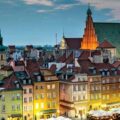
Continue your walk for another ten minutes towards the heart of the Old Town Market Square (Stary Rynek). This vast rectangular square, one of the largest in Europe, dates back to the 13th century when Poznań received its Magdeburg town rights in 1253 under Duke Przemysł I. The square is dominated by the Renaissance Town Hall (Ratusz), constructed between 1550 and 1560 by Italian architect Giovanni Battista di Quadro. Its magnificent three-storey loggia and colourful façade feature a mechanical clock with fighting goats that emerge at noon each day – a tradition dating to the 16th century. The Town Hall witnessed many historic events, including the swearing of oaths during the Greater Poland Uprising and the trials of Polish patriots under Prussian and later Nazi occupation.
Allow twenty-five minutes to wander around the colourful burgher houses surrounding the square, many of which were rebuilt after heavy damage during World War II. Particularly notable is the House of the Dancing Goats and the former weighing house. The square was also the scene of public executions and celebrations throughout Poznań’s turbulent history under Polish, Prussian, and German rule.
From the Market Square, stroll ten minutes north-east to the Imperial Castle (Zamek Cesarski), a massive neo-Romanesque structure built between 1905 and 1910 for German Emperor Wilhelm II. Designed as a symbol of Prussian dominance after the partitions of Poland, the castle served as a residence during the Kaiser’s visits. After 1918 it was used by Polish authorities, and during the Nazi occupation it became the headquarters of Gauleiter Arthur Greiser. Today it houses cultural institutions and stands as a reminder of Poznań’s complex 20th-century history under three different regimes.
Next, head south for a pleasant fifteen-minute walk through the green spaces to Cathedral Island (Ostrów Tumski), the oldest part of Poznań and the birthplace of the Polish state. The Poznań Cathedral, dedicated to St Peter and St Paul, was originally founded in 968 by Duke Mieszko I (c. 930–992), the first ruler of Poland, shortly after he accepted Christianity in 966. This event is regarded as the baptism of Poland and the true beginning of the Polish nation. The current Gothic structure dates mainly from the 14th and 15th centuries, though it incorporates earlier Romanesque elements. Inside the Golden Chapel (Złota Kaplica), built in the 19th century, lie the tombs of Mieszko I and his son, King Bolesław I the Brave (967–1025), who expanded Polish territory and was crowned the first King of Poland in 1025.
Spend twenty minutes on Cathedral Island enjoying the peaceful atmosphere, the historic bridges, and the archaeological park that displays remnants of the earliest settlements. The island was the site of the first bishopric in Poland and played a crucial role in the Christianisation of the region.
Finally, conclude your tour with a short ten-minute walk back towards the city centre, perhaps pausing in one of the many riverside parks along the Warta River. This relaxed two-and-a-half-hour walking tour covers approximately four and a half kilometres and takes you through Poznań’s journey from its origins as the cradle of the Polish state in the 10th century, through medieval prosperity, partitions, uprisings, and 20th-century conflicts, to its present-day vibrant identity as a modern Polish city known for trade, culture, and innovation. The route is mostly flat with good pedestrian paths and several benches for rests.