- Devenish Island Monastic Site: Lough Erne, near Enniskillen, Co. Fermanagh, BT94 1NY. Founded in the 6th century by St. Molaise, this monastic site features a 12th-century round tower, high crosses, and church ruins, including St. Molaise’s House (oratory). Viking raids were recorded in 837 AD. A key early Christian centre, it’s accessible by boat from Trory Point, managed by the Department for Communities, with a small visitor centre.
- White Island Ecclesiastical Site: Castle Archdale Bay, Lower Lough Erne, Co. Fermanagh, BT93 1RF. An early Christian site (c. 6th-10th century) with a Romanesque church containing eight carved stone figures, possibly pre-Christian or early medieval. The site, on an island, reflects a blend of pagan and Christian traditions. Accessible by ferry from Castle Archdale, it’s managed by the Department for Communities, offering a serene historical experience.
- Boa Island (Caldragh Cemetery): Caldragh, Lower Lough Erne, Co. Fermanagh, BT93 8AE. This early Christian cemetery features two iconic stone figures: the Janus-like statue (c. 1st century AD) with two faces, possibly a Celtic deity, and the Lustymore Man, a smaller carved stone. Likely a pre-Christian ritual site Christianised later, it’s accessible by road and managed by the Department for Communities, showcasing Fermanagh’s ancient spirituality.
- Enniskillen Castle: Castle Barracks, Enniskillen, Co. Fermanagh, BT74 7HL. Built c. 1428 by Hugh “the Hospitable” Maguire, this castle on the River Erne was a Gaelic stronghold, later converted into a 17th-century Plantation fort. It played a role in the Nine Years’ War and 1641 Rebellion. Now a museum managed by Fermanagh and Omagh District Council, it offers tours and exhibits, reflecting medieval and colonial history.
- Tully Castle: Tully Point, near Blaney, Co. Fermanagh, BT93 7DX. A 17th-century fortified house and bawn built in 1612 by Sir John Hume, it was burned in 1641 by Rory Maguire during the Irish Rebellion, with many inhabitants massacred. The ruins, set on Lough Erne, are a state-care monument managed by the Department for Communities, accessible with parking, showcasing Plantation-era conflict.
- Castle Archdale (Old Castle): Castle Archdale Country Park, Lisnarick, Co. Fermanagh, BT94 1PP. A 17th-century Plantation castle built c. 1615 by John Archdale, with remnants of a bawn and earthworks. Destroyed in 1689 during the Williamite War, it reflects early colonial settlement. Accessible via park trails, managed by the Department for Communities, it complements the park’s visitor facilities.
- Aghanaglack Dual Court Tomb: Near Boho, Co. Fermanagh, BT74 5AG (Grid Ref: H1080 4620). A Neolithic court tomb, c. 4000-3000 BC, with two galleries for communal burials, set in a scenic upland area. Known locally as the “Giant’s Grave,” it reflects early farming communities’ funerary practices. A state-care monument, it’s accessible via public paths on private land with permission, showcasing Fermanagh’s megalithic heritage.
- Reyfad Stones: Reyfad, near Boho, Co. Fermanagh, BT74 5AQ (Grid Ref: H0940 4650). A group of prehistoric rock art panels, likely Bronze Age (c. 2000-1500 BC), featuring cup-and-ring markings. These enigmatic carvings suggest ritual or territorial significance. A state-care monument, accessible on private land with permission, it offers insight into Fermanagh’s prehistoric artistic traditions.
- Monea Castle: Monea, near Enniskillen, Co. Fermanagh, BT74 8FE. A 17th-century Plantation castle built c. 1618 by Malcolm Hamilton, featuring a Scottish-style tower house and bawn. It was attacked during the 1641 Rebellion and abandoned by the 18th century. A state-care monument managed by the Department for Communities, it’s freely accessible, reflecting Fermanagh’s Plantation history.
- Castle Coole (Archaeological Context): Enniskillen, Co. Fermanagh, BT74 6JY. While primarily an 18th-century neo-classical mansion, the estate includes prehistoric features like a possible Bronze Age ring barrow and nearby crannogs (c. 2000 BC-400 AD). Managed by the National Trust, the grounds are accessible with guided tours, offering a blend of prehistoric and Georgian heritage.
Archaeological sites
Antrim – Armagh – Carlow – Cavan – Clare – Cork – Derry – Donegal – Down – Dublin – Fermanagh – Galway – Kerry – Kildare – Kilkenny – Laois – Leitrim – Limerick – Longford – Louth – Mayo – Meath – Monaghan – Offaly – Roscommon – Sligo – Tipperary – Tyrone – Waterford – Westmeath – Wexford – Wicklow
County Fermanagh:
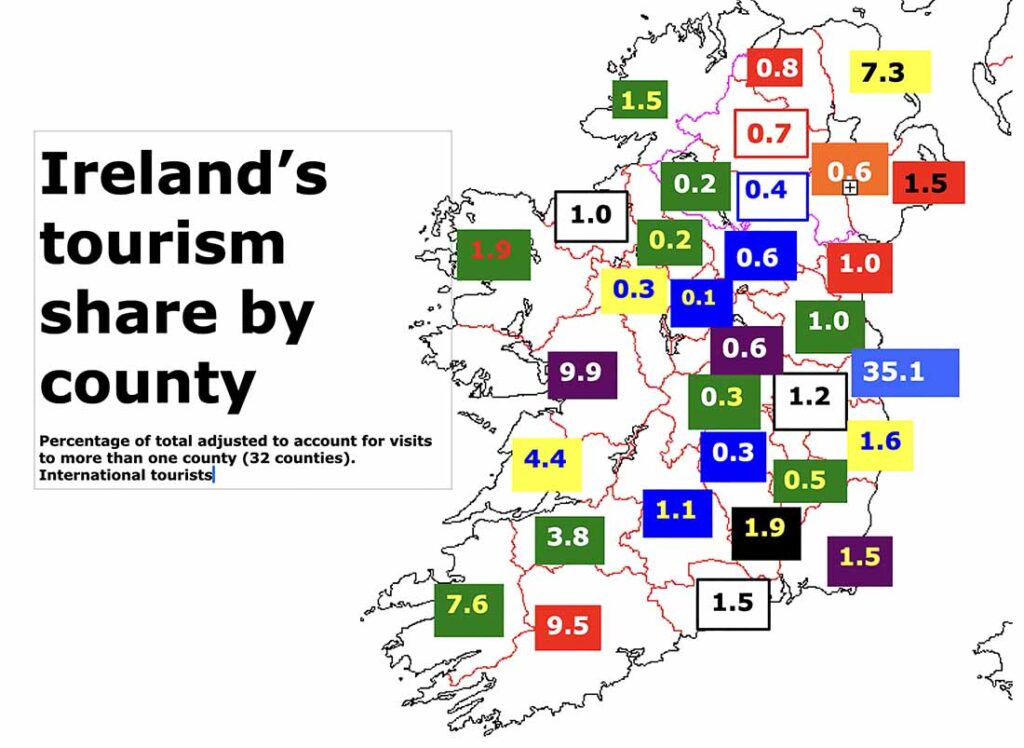
Ireland’s county Fermanagh is a county of lakes and historic charm, with Lough Erne’s waterways offering boating and fishing amidst serene islands. Enniskillen Castle and its museums explore local history, while the Marble Arch Caves, part of a UNESCO Geopark, showcase stunning underground caverns. Other attractions include the historic Florence Court estate and its gardens. Fermanagh is Ireland’s 20th largest county by size (1,876 square km) and fourth smallest by population (63,585). Population peaked at 156,481 in 1841 and reached its lowest point, 49,886 in 1966. In terms of hospitality, Fermanagh is Ireland’s 28th most visited tourist county with around 43,000 international visitors per year.
Introduction – Adventure – Anthem – Archaeology – Attractions – Awards – Birdwatching – Camping – Castles – Churches – Contact list – Cycling – Dining – Equestrian – Festivals – Fishing – Folklore – Gardens – Golf – Graveyards – Happening – Haunted – Highest – Hiking – History – Holy Wells – Hotels – Hotels top 8 – Hunting & shooting – Instagrammable – Itineraries – Largest town – Luxury – MICE – Movies – Music – Name – New – Novelists – Off the beaten track – Poets – Pubs – Quotes – Random Facts – Restaurant Awards – Sacred Places – Saints – Songs – Spas – Sports – Sunsets – Sustainable – Things to do – Towns – Video – Villages – Walking – Wanderlist – Weddings – Wild swimming – Writers – 1837 – 1846 – 1852 – 1909 – 1955 – 1980 –