The highest point in County Fermanagh is Cuilcagh Mountain, standing at 665 meters (2,185 feet). Straddling the border with County Cavan of Ireland, Cuilcagh is the highest peak in both counties and is renowned for its dramatic tabletop plateau and the Cuilcagh Boardwalk Trail, often called the “Stairway to Heaven.” Situated within the Cuilcagh Lakelands UNESCO Global Geopark, the world’s first cross-border geopark, Cuilcagh offers a unique hiking experience.
- Geological and Cultural Significance: Cuilcagh, derived from the Irish Binn Chuilceach (“chalky peak”), is composed of sandstone and shale, topped with blanket bog and heather, despite its name suggesting chalk. Its southern slopes in Cavan are the source of the River Shannon, Ireland’s longest river. The mountain’s geology, featuring gritstone cliffs, limestone sinkholes, and cave systems, is a highlight of the geopark. Culturally, it lies in the historic Breifne region, with nearby prehistoric sites like the Cavan Burren Park adding archaeological depth.
- Scenic Beauty: The summit plateau offers panoramic views across Fermanagh’s lakelands, including Upper and Lower Lough MacNean, Lough Erne, and, on clear days, distant peaks like Slieve League in Donegal or the Sperrin Mountains. The stark, cliff-edged plateau and vast bog create a striking, remote landscape.
Approaching Cuilcagh Mountain
- Primary Access Point: The most popular route is the Cuilcagh Boardwalk Trail, starting at the Legnabrocky Car Park (43 Marlbank Road, Legnabrocky, Florencecourt, County Fermanagh, BT92 1ER), about 15km southwest of Enniskillen. This paid parking area (booking required online) is near the Marble Arch Caves Visitor Centre, making it the main hub for visitors. The trailhead is well-signposted and accessible from Fermanagh, with Cavan hikers often crossing the border to start here.
Trail Options:
- Cuilcagh Boardwalk Trail (Stairway to Heaven): This 7.4km linear trail (14.8km round trip, 2.5–4 hours) is the primary route. It begins with a gravel track through farmland, transitions to a 1.5km wooden boardwalk protecting the blanket bog, and ascends via a steep staircase to the summit plateau. The final 1km to the summit cairn crosses open bog with waymarkers. This moderately challenging trail suits most fitness levels, though the staircase and exposed summit require care.
- Northern Approach via Hiker’s Trail: A less common route starts from the same Legnabrocky Car Park but follows the Hiker’s Trail, bypassing the boardwalk for a rougher path through bog and moorland. This 8–10km round trip (3–4 hours) is steeper and less defined, better for experienced hikers.
- Cross-Border Routes: From Cavan, hikers can approach via Gortalughany Viewpoint (off the A32, signposted from Florencecourt) or Aghnacollia Lane near the Shannon Pot, ascending via Benbeg (539m) to Cuilcagh. These routes (10–12km round trip, 4–5 hours) are more challenging, with faint paths and boggy terrain, requiring strong navigation skills.
- Navigation and Preparation: The boardwalk trail is well-marked, but the summit plateau can be disorienting in fog, with waymarkers hard to spot. Hikers should carry a map (OSNI 1:50k, Sheet 26), compass, or GPS, especially for non-boardwalk routes. Waterproof boots, gaiters, and rain gear are essential due to wet bog and frequent rain. Bring water and snacks, as no facilities exist on the trail. Dogs are allowed but must be leashed to protect livestock and wildlife. Book parking in advance for Legnabrocky, and check weather forecasts, as the summit is exposed to wind and sudden weather changes.
Hiking Experience:
- The Boardwalk Trail is the highlight, with its eco-friendly boardwalk preserving the bog while making the ascent accessible. The staircase is steep but manageable, leading to a viewing platform with dramatic views before a short walk to the summit cairn. The trail’s popularity (over 60,000 visitors annually since 2015) means it can be busy, especially in summer, so early starts or weekday visits are ideal.
- Alternative routes, like the Hiker’s Trail or cross-border approaches, offer a wilder, quieter experience but demand more skill due to boggy, unmarked terrain.
- The summit plateau is expansive, with gritstone cliffs and a large cairn. Its stark beauty and isolation contrast with the bustling boardwalk below.
- Views and Photography: Clear days yield stunning views of Fermanagh’s lakes, Cavan’s drumlins, and distant mountains. The boardwalk, staircase, and plateau are iconic for photography, especially at sunrise or sunset when the light enhances the bog’s golden hues. The cliffs and vast sky create a dramatic backdrop.
- Wildlife and Nature: Cuilcagh’s blanket bog, one of Ireland’s largest, supports unique flora like sphagnum moss, sundews, and heather. Wildlife includes skylarks, hen harriers, and rare water beetles (e.g., Agabus melanarius). Nearby Lough Atona is a biodiversity hotspot. Grazing sheep and cattle are common, adding to the pastoral setting.
- Cultural and Historical Context: Cuilcagh’s location in the Breifne region ties it to Gaelic history, with nearby Cavan Burren Park featuring prehistoric tombs and rock art. The Shannon Pot, the River Shannon’s source, is a cultural landmark in Cavan, a short drive away. The geopark’s cross-border status symbolizes peace and cooperation.
- Amenities: Legnabrocky Car Park has minimal facilities (portable toilets seasonally), so hikers should be self-sufficient. The Marble Arch Caves Visitor Centre (4km away) offers a café, restrooms, and geopark information, ideal for post-hike refreshments. Enniskillen, 15km away, provides dining, lodging, and supplies.
- Seasonal Considerations: Spring (April–May) and autumn (September–October) offer vibrant scenery and milder weather (8–15°C / 46–59°F). Summer (June–August) is warmest (15–20°C / 59–68°F) but busiest. Winter (November–March) may bring snow or ice, requiring caution on the staircase. Fermanagh’s 1,300–1,500 annual sunshine hours allow for clear views, but rain is frequent, so waterproof gear is a must.
- Cuilcagh Mountain is a must-visit in County Fermanagh, offering an accessible yet awe-inspiring hike via the Cuilcagh Boardwalk Trail. Its unique geology, sweeping views, and rich biodiversity make it a highlight of the Cuilcagh Lakelands Geopark. Whether you’re a casual walker or seasoned hiker, the mountain delivers a memorable experience, with nearby attractions like the Marble Arch Caves enhancing a visit. For more details, visit cuilcaghlakelands.org or consult Kieron Gibbons’ Ireland’s County High Points – A Walking Guide.
Highest point in county
Antrim – Armagh – Carlow – Cavan – Clare – Cork – Derry – Donegal – Down – Dublin – Fermanagh – Galway] – Kerry – Kildare – Kilkenny – Laois – Leitrim – Limerick – Longford – Louth – Mayo – Meath – Monaghan – Offaly – Roscommon – Sligo – Tipperary – Tyrone – Waterford – Westmeath – Wexford – Wicklow
County Fermanagh:
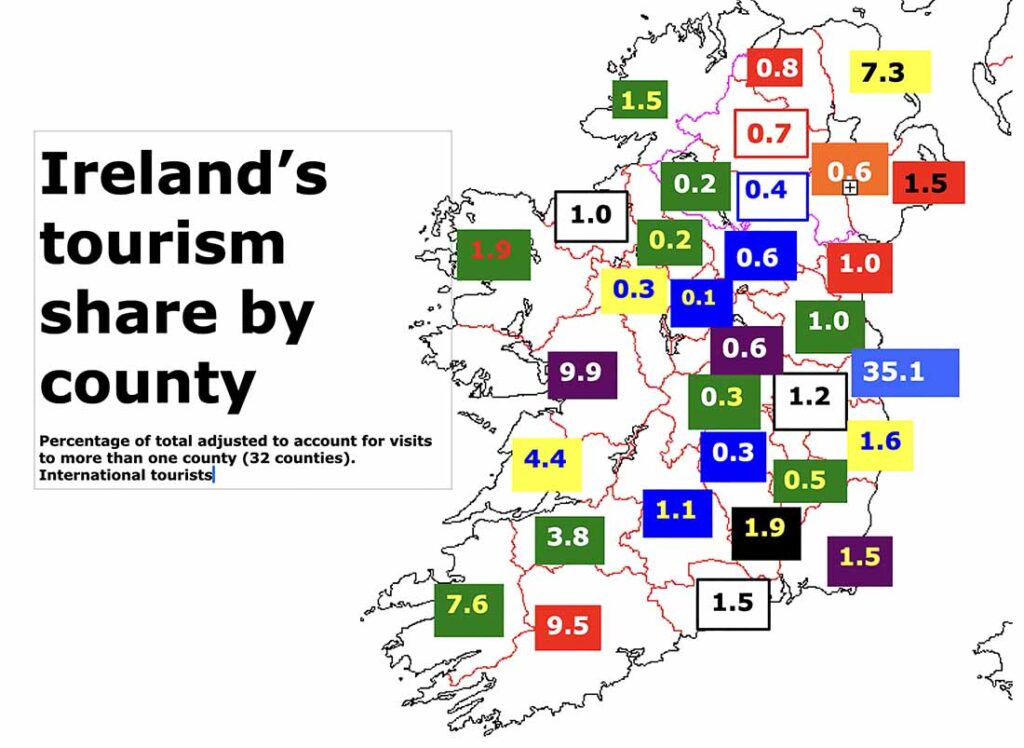
Ireland’s county Fermanagh is a county of lakes and historic charm, with Lough Erne’s waterways offering boating and fishing amidst serene islands. Enniskillen Castle and its museums explore local history, while the Marble Arch Caves, part of a UNESCO Geopark, showcase stunning underground caverns. Other attractions include the historic Florence Court estate and its gardens. Fermanagh is Ireland’s 20th largest county by size (1,876 square km) and fourth smallest by population (63,585). Population peaked at 156,481 in 1841 and reached its lowest point, 49,886 in 1966. In terms of hospitality, Fermanagh is Ireland’s 28th most visited tourist county with around 43,000 international visitors per year.
Introduction – Adventure – Anthem – Archaeology – Attractions – Awards – Birdwatching – Camping – Castles – Churches – Contact list – Cycling – Dining – Equestrian – Festivals – Fishing – Folklore – Gardens – Golf – Graveyards – Happening – Haunted – Highest – Hiking – History – Holy Wells – Hotels – Hotels top 8 – Hunting & shooting – Instagrammable – Itineraries – Largest town – Luxury – MICE – Movies – Music – Name – New – Novelists – Off the beaten track – Poets – Pubs – Quotes – Random Facts – Restaurant Awards – Sacred Places – Saints – Songs – Spas – Sports – Sunsets – Sustainable – Things to do – Towns – Video – Villages – Walking – Wanderlist – Weddings – Wild swimming – Writers – 1837 – 1846 – 1852 – 1909 – 1955 – 1980 –