- The Rose of Mooncoin: A romantic ballad celebrating a beautiful woman from Mooncoin, likened to a rose, set against the backdrop of the River Suir. It captures local pride and Kilkenny’s rural charm, often sung at hurling matches. Written by Watt Murphy, a Mooncoin schoolteacher, written in the early 20th century; popularized by Dick Delaney and others.
- Kilkenny’s on My Mind: A nostalgic song about longing for Kilkenny, reflecting on its streets, hurling culture, and community spirit. It evokes the county’s identity as a hurling stronghold and its vibrant city life. Written by Liam Ryan, a Kilkenny native; performed by local artists.
- The Boys of Callan Town: A folk song celebrating the men of Callan, focusing on their camaraderie and local pride. It reflects Kilkenny’s small-town community spirit and historical traditions. Traditional; part of Kilkenny’s folk repertoire.
- Inistioge: A lyrical ode to Inistioge, a picturesque village in Kilkenny along the River Nore, capturing its serene beauty and rural tranquility. The song evokes nostalgia for the county’s quieter corners. Traditional.; often performed locally.
- The Kilkenny Louse House: A humorous folk song about a night spent in a Kilkenny workhouse, detailing the antics of lice and local characters. It reflects the county’s social history and storytelling tradition with a comedic twist. Traditional; recorded by artists like Christy Moore.
- The Fair of Thomastown: A traditional song about the bustling market fair in Thomastown, capturing Kilkenny’s rural economy and community gatherings. It highlights local traditions and social life. Traditional.; part of Kilkenny’s oral tradition.
- The Risin’ of the Moon: A republican ballad set during the 1798 United Irishmen rebellion, with Kilkenny as a key location for resistance activity. It celebrates the county’s revolutionary history and defiance, often tied to local lore. Written by John Keegan Casey, written in the 1860s under the pseudonym Leo, when resistance culture music and art was rigorously persecuted by the colonial regime.
- The Banks of the Suir: A folk song praising the River Suir, which flows through Mooncoin and other Kilkenny communities. It reflects the county’s natural beauty and connection to its waterways. Traditional; often sung in Kilkenny.
- The Pride of Piltown: A song celebrating Piltown, a village in south Kilkenny, focusing on its community spirit and rural charm. It evokes local pride and the county’s tight-knit villages. Traditional.; part of Kilkenny’s folk tradition.
- The Cats of Kilkenny: A playful folk song inspired by the Kilkenny legend of cats fighting, symbolizing the county’s nickname, “The Cats,” tied to its hurling prowess. It reflects Kilkenny’s sporting identity and folklore. Traditional; often performed at local events.
Songs
Antrim – Armagh – Carlow – Cavan – Clare – Cork – Derry – Donegal – Down – Dublin – Fermanagh – Galway – Kerry – Kildare – Kilkenny – Laois – Leitrim – Limerick – Longford – Louth – Mayo – Meath – Monaghan – Offaly – Roscommon – Sligo – Tipperary – Tyrone – Waterford – Westmeath – Wexford – Wicklow
County Anthem
Antrim – Armagh – Carlow – Cavan – Clare – Cork – Derry – Donegal – Down – Dublin – Fermanagh – Galway – Kerry – Kildare – Kilkenny – Laois – Leitrim – Limerick – Longford – Louth – Mayo – Meath – Monaghan – Offaly – Roscommon – Sligo – Tipperary – Tyrone – Waterford – Westmeath – Wexford – Wicklow
County Kilkenny:
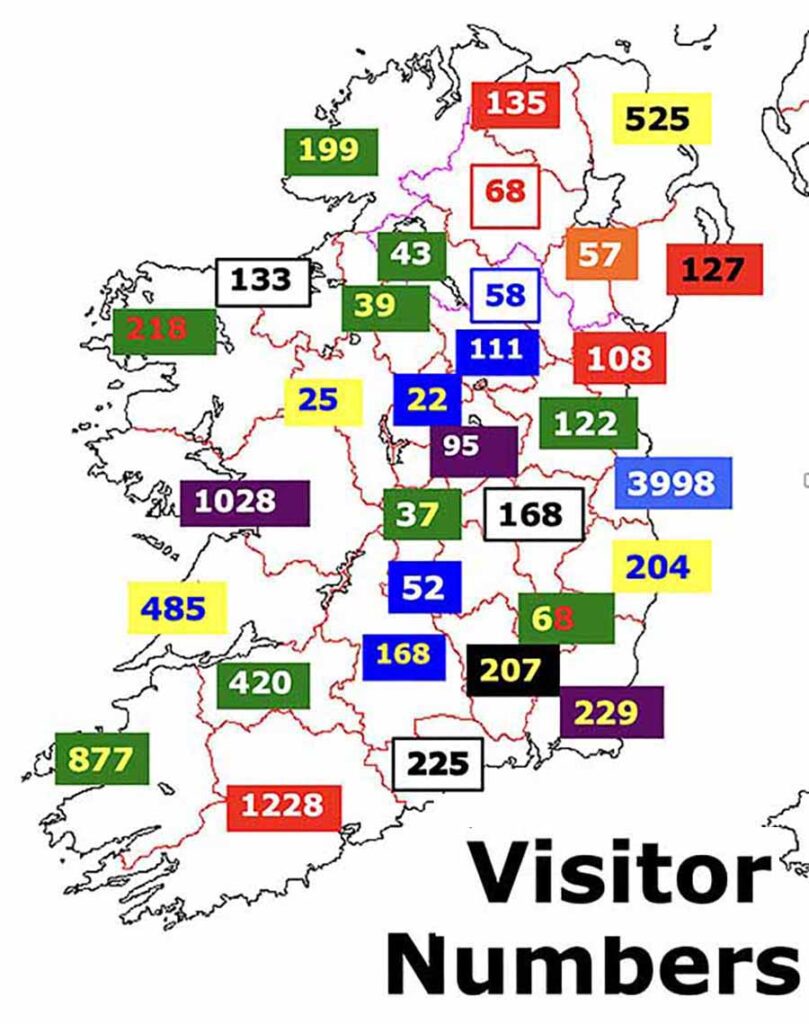
Ireland’s county Kilkenny is a county of medieval charm, with Kilkenny City’s castle and St Canice’s Cathedral showcasing well-preserved architecture and round towers. The Dunmore Cave offers intriguing limestone formations, while the Nore Valley’s walking trails provide scenic beauty. Other attractions include the historic Jerpoint Abbey’s intricate carvings. Kilkenny is Ireland’s 16th largest county by size (2,062 square km) and 21st largest by population (104,160). Population peaked at 202,420 in 1841 and reached its lowest point, 60,463 in 1966. In terms of hospitality, Kilkenny is Ireland’s eleventh most visited tourist county with around 207,000 international visitors per year.
Introduction – Adventure – Anthem – Archaeology – Attractions – Awards – Birdwatching – Camping – Castles – Churches – Contact list – Cycling – Dining – Equestrian – Festivals – Fishing – Folklore – Gardens – Golf – Graveyards – Happening – Haunted – Highest – Hiking – History – Holy Wells – Hotels – Hotels top 8 – Hunting & shooting – Instagrammable – Itineraries – Largest town – Luxury – MICE – Movies – Music – Name – New – Novelists – Off the beaten track – Poets – Pubs – Quotes – Random Facts – Restaurant Awards – Sacred Places – Saints – Songs – Spas – Sports – Sunsets – Sustainable – Things to do – Towns – Video – Villages – Walking – Wanderlist – Weddings – Wild swimming – Writers – 1837 – 1846 – 1852 – 1909 – 1955 – 1980 –