- Kilkenny’s Witch Trial: In 1324, Dame Alice Kyteler fled Kilkenny after being accused of witchcraft, leaving her servant Petronilla to be Ireland’s first woman burned at the stake.
- Black Abbey’s Name: The Black Abbey, a 13th-century Dominican priory, was named for the black habits worn by its monks:
- Kells Priory’s Fortified Walls: Kells Priory, founded in 1193, has seven defensive towers, resembling a castle more than a monastery:
- Kilkenny’s Cat Statue A bronze cat statue in Kilkenny city commemorates the phrase “fighting like Kilkenny cats,” linked to a 19th-century tale of tied-together felines.
- Rothe House’s Alligator Beam: Rothe House, a 16th-century merchant’s home, has a roof beam carved with an alligator, possibly a gift from a New World explorer.
- Jerpoint Abbey’s Tomb: Jerpoint Abbey contains a 15th-century tomb with carvings of weeping monks, a rare depiction in Irish monasteries.
- Dunmore Cave’s Viking Massacre: Dunmore Cave holds evidence of a 928 AD Viking attack, with remains of over 40 people, mostly women and children, found inside.
- Kilkenny’s Marble City: Kilkenny is nicknamed the Marble City due to its local black limestone, polished to resemble marble in buildings.
- Smithwick’s Brewery Age: Smithwick’s Brewery, founded in 1710, is Ireland’s oldest operating brewery, producing its red ale in Kilkenny.
- Castlecomer’s Coal Mines: Castlecomer had Ireland’s deepest coal mines, operating from the 17th century until 1969, now a discovery park.
- “The Last Rose of Summer” poem written in 1805 by Thomas Moore (1779–1852) was inspired by a rose at Jenkinstown Castle in County Kilkenny).
Random facts
Antrim – Armagh – Carlow – Cavan – Clare – Cork – Derry – Donegal – Down – Dublin – Fermanagh – Galway – Kerry – Kildare – Kilkenny – Laois – Leitrim – Limerick – Longford – Louth – Mayo – Meath – Monaghan – Offaly – Roscommon – Sligo – Tipperary – Tyrone – Waterford – Westmeath – Wexford – Wicklow
County Kilkenny:
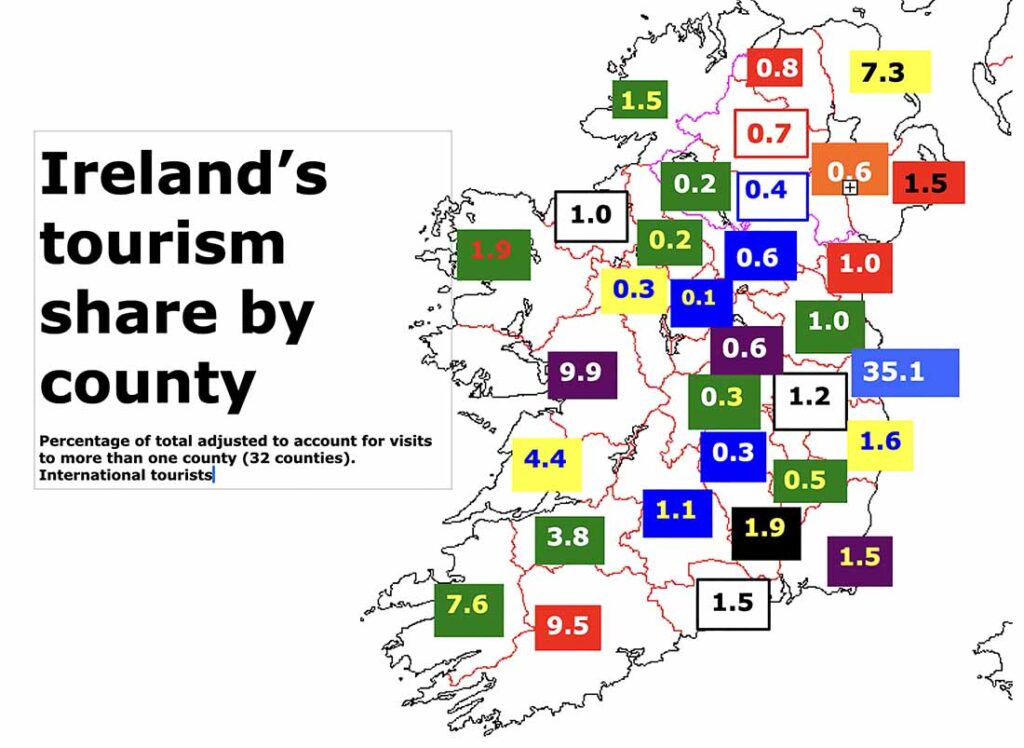
Ireland’s county Kilkenny is a county of medieval charm, with Kilkenny City’s castle and St Canice’s Cathedral showcasing well-preserved architecture and round towers. The Dunmore Cave offers intriguing limestone formations, while the Nore Valley’s walking trails provide scenic beauty. Other attractions include the historic Jerpoint Abbey’s intricate carvings. Kilkenny is Ireland’s 16th largest county by size (2,062 square km) and 21st largest by population (104,160). Population peaked at 202,420 in 1841 and reached its lowest point, 60,463 in 1966. In terms of hospitality, Kilkenny is Ireland’s eleventh most visited tourist county with around 207,000 international visitors per year.
Introduction – Adventure – Anthem – Archaeology – Attractions – Awards – Birdwatching – Camping – Castles – Churches – Contact list – Cycling – Dining – Equestrian – Festivals – Fishing – Folklore – Gardens – Golf – Graveyards – Happening – Haunted – Highest – Hiking – History – Holy Wells – Hotels – Hotels top 8 – Hunting & shooting – Instagrammable – Itineraries – Largest town – Luxury – MICE – Movies – Music – Name – New – Novelists – Off the beaten track – Poets – Pubs – Quotes – Random Facts – Restaurant Awards – Sacred Places – Saints – Songs – Spas – Sports – Sunsets – Sustainable – Things to do – Towns – Video – Villages – Walking – Wanderlist – Weddings – Wild swimming – Writers – 1837 – 1846 – 1852 – 1909 – 1955 – 1980 –