County Antrim is a maritime county in the extreme northeast of Ulster. It is bounded on the north by the Atlantic Ocean, on the east by the North Channel, on the southeast and south by County Down, and on the west by Counties Tyrone and Derry. Its southern and southeastern boundary, except for about 5 miles adjacent to Lough Neagh, is formed by Belfast Lough and the River Lagan; its western boundary, except for about 7 miles adjacent to the ocean, is formed by Lough Neagh, Lough Beg, and the River Bann. The county is thus nearly insulated between a sweep of the sea and an alternate chain and line of fresh waters.
It lies between 54° 40′ and 55° 12′ 18″ north latitude, and between 5° 40′ and 6° 37′ longitude west of Greenwich. Its greatest length, from Bengore Head on the north to Spencer’s Bridge on the south, is about 44 miles; its greatest breadth, from the Gobbins on the east to Island Reagh Troone on the west, is about 24 miles; and its area, exclusive of the county of the town of Carrickfergus, is approximately 775,000 acres (modern measurements give about 1,192 square miles or 3,086 km²).
Surface — The area is physically distributed into significant water bodies, towns, plantations, mountain and bog, and arable land. Much of the water is in Lough Neagh, which appears more like a fringing sea than an interior lake. Bog is dispersed across mountains and plains. Overall, the land surface can be regarded as approximately one-third uplands and two-thirds dales, valleys, and undulating expanse.
The upland division forms a wild and waste declining platform, with its seaward face shorn into bold escarpments and shelving or colonnaded precipices. The summits and interior contours are tamely outlined and slenderly diversified, while the westward declivity is a slowly descending slope toward the basin of Lough Neagh. The summit-line runs so near the coast that most interior streams falling directly into the sea or into the systems of the Bann and Lagan have short courses (except the Bush River, often less than three miles). Along the summit-line and across the seaward declivity, the mountains form a picturesque gallery of landscapes, combining power, grandeur, romance, and beauty in rare proportions. At points like the Giant’s Causeway, Fair Head, and Glens, they thrill the fancy and awe the mind, making them worthy of their fame among tourists seeking the picturesque and sublime.
The mountains (rather hills, moderate in altitude) commence some miles southwest by south of Belfast and extend in an almost unbroken but curving and sinuous chain around the contour of the boundary with Derry. Principal summits include Slemish (central) and Knocklayd (north), both under 1,600 feet above sea level. Ravines and glens channel roaring hill-torrents to the sea, forming singular foils to immense masses of basalt and limestone projecting as headlands and promontories in fantastic or architectural forms. Among seaward heights, Fair Head reaches 636 feet, Garron Point 792 feet, Ballygally Head 797 feet, Carrowmurphy 819 feet, and Lurigethan 1,154 feet.
A belt of fertile, well-cultivated, and tastefully embellished land from Belfast around to Glenarm is the main low ground between uplands and beach. The valley of the Six-mile-Water is a fine expanse of beauty and cultivation, soft and uniform but gay with artificial ornaments. Valleys of the Glenwherry and Braid are smaller but verdant with crops and wood. The Ravel valley is screened by hills and features an isolated basaltic eminence. The Maine valley, receiving lateral streams and descending southward to Lough Neagh (parallel but opposite to the Bann), is undulating rather than plain, with fruitful views but steep banks near the stream. The Bush valley deflects among northern heights toward the Giant’s Causeway, and the Bann (draining much of the county but shared with Derry) reserves fuller description, as do noble coastal features.
The area between the Bann’s efflux from Lough Beg and the Maine’s influx to Lough Neagh includes reclaimable bog and hillocks with close landscapes looking onto Lough Neagh. From the Maine’s east side along Lough Neagh to the southern boundary with Down lies the most extensive level tract, resembling English scenery in contour, soil, cultivation, wood, hedges, orchards, and houses. The Lagan valley (shared with Down, flanked by hills) is undulating, rich, profusely ornamented, brilliant with water and mountain perspectives, and comparable to celebrated valleys. As noted in surveys, few tracts of similar extent exceed it in scenic beauty or productive value, enhanced by excellent habitations, plantations, fences, gardens, and bleach-greens.
Waters — Principal rivers (Six-mile-Water, Glenwherry, Braid, Ravel, Bush, Bann, Lagan, Carey, Glenshesk, etc.) and lakes (Neagh, Beg, Portmore, Guile, plus minor ones like Lynch, Hill, Mourne) feature prominently, with chalybeate and other springs near Ballycastle, Knocklayd, Kilroot, Carrickfergus, and Islandmagee.
Minerals and Geology — Primary rocks are limited to a small northeastern group around Knocklayd (mica schist, skirting Fair Head coalfield). Old red sandstone is restricted. Coal occurs on the north coast around Fair Head (ancient workings, possibly among Britain’s oldest). The remainder is upper secondary series capped by thick tabular trap (basalt). The trap field (extending into adjacent counties) features high tableland rising precipitously from sea or low country. Cliffs from Belfast to Red Bay show black trap (200–300 feet thick) over chalk (60–100 feet, hard “white limestone”), with underlying green sand, lias, marls, and red sandstone. Chalk is stratified, fossil-rich (terebratulae, pecten, etc.), harder than England’s. Trap alters chalk to marble in contact zones; strata show regular bedding with ochreous layers aiding identification. Tertiary lignite and clay occur south of Lough Neagh.
Soils — Strong loam (with trap debris) prevails in plains and valleys over retentive clay. Uplands have shallower mould, brown/yellow till, then peat/moss. Sandy loam tracts west of Lagan and along Lough Neagh support cereals. Chalk-derived soils (where exposed) are excellent for cultivation and fruit. Mountain basalt soils are loose, rusty oxides lacking cohesion but suitable for grazing.
Woods — Natural woods (e.g., Portmore, Glenarm parks) have declined, but extensive planting by landowners has compensated, creating wooded aspects in areas like Massarene, Six-mile-Water, Broad valley, Lisburn to Carrickfergus, and around castles. In 1841, plantations totaled over 10,000 acres, plus detached trees.
Estates and Farms — Estates are mostly freehold from crown grants (except church lands). Principal titled properties (e.g., Antrim estate) are extensive, often let in perpetuity. Proprietors’ houses are convenient and elegant; leaseholder homes neat, enhancing the landscape.
Farming Leases — Farming leases have, for two generations or so past, been shorter than at a former period. The lands being improved and the buildings good, less reason is supposed to exist than before for securing to a tenant a lengthened possession. Leases of a prolonged kind are given for lives and years; some for lives alone; bishops’ leases for 21 years, often with clause of renewal; and all sorts are, in general, freehold. Building leases in towns are usually given long, with a view of enhancing the value of the circumjacent lands.
Farms — Farms differ in tenure from the con-acre or patch for a single crop to the lease in perpetuity or actual estate; and they differ in extent from the merest pendicle to the most noble expanse. Where the land is uniform and free from moor or moss or mountain, the surface is sectioned, divided, and subdivided by a pressure of circumstances which defies all reference to system and lies as yet beyond all prospect of amenability to control. In many instances, large tracts of verdant upland are held by distant occupiers and confined to the supervision of resident herdsmen; and along the mutual border of mountain and valley, a considerable quantity of high land is usually let along with a belt or section of plain. But across by far the greater portion of the arable area, farms are aggregately so small that they would not probably average twenty acres, or—if a few of the larger were deducted—would not probably average eleven or twelve.
A person with English or Scottish ideas, but without discretion to guide them, scorns the littleness of an Irish farm and wonders that so fine a county as Antrim should not have quite renounced the paltriness and peddling of minute subdivision and imitated the grandeur of British allotments to the farmer. But when he sports his exclamations of taste, flaunts his wise lessons of economy, and limns his gay and invidious pictures of the superiority of his country, he only proclaims his profound ignorance of Ireland and proves himself a smatterer and a pedant. “The large and the small farms,” pithily says Mr. Dubourdieu, “are so interwoven, and the tenures are so various, and misery would ensue to so many persons by a radical change, that though the question of the most profitable division of land may be a matter of speculation in this country, it can scarcely ever be looked to as a matter of practice.” In 1841, the total number of farms, exclusive of those in the county of the town of Carrickfergus, was 23,526; of these, 6,855 measured from 1 acre to 5 acres each, 10,563 from 5 to 15 acres each, 4,220 from 15 to 30 acres each, and 1,888 upwards of 30 acres.
Agriculture — Wheat is very generally cultivated in the south parts of the baronies of Toome and Antrim, the west and south parts of Massarene, and those parts of Belfast which lie south and west of the mountains. It is raised also in many other districts, but either on a limited scale or only as an occasional crop. Preparation for it by clover has been found unsuitable; by plain fallow still partially prevails; and by potato fallow is most common or even general. Barley, though far from being a favourite crop, is cultivated on dry and gravelly swells as well as occasionally in other situations, and for the most part either succeeds wheat in two ploughings or is introduced by a potato fallow.
Oats are far the predominant cereal produce; their grain, jointly with potatoes, forms the chief food of the people, and their straw the chief support of the cattle. Though a secondary object in the wheat and barley districts, they almost engross attention in all other parts of the county. They are sometimes sown on grass grounds which have been limed or otherwise manured, but are too generally scourged year after year out of the ground of potato fallow, or that of plain fallow, or even from a pared and burned surface, until the disheartened and utterly exhausted soil has power to return little more than the bulk of the seed. Yet in the wheat districts, on the larger arable farms, and increasingly throughout the county, they are treated on comparatively enlightened and skilful principles; and the ground being preserved both clean and in good heart, they are at once luxuriant in growth, large in bulk, and excellent in quality.
Beans, so far back as 30 years ago, had long been cultivated in the parish of Carncastle, yielding upwards of 70 bushels per Irish acre; but pease as a field crop were then unknown. Flax is a prominent crop in very fluctuating demand, so that the quantity of seed annually imported for it into Belfast was at one time 35,000 bushels, at another comparatively trifling, in 1835 upwards of 108,000 bushels, and in 1843 about 84,000. Potatoes are a large object of attention and are raised in all sorts of ways, from the lazy-bed method of the scarcely reclaimed bog or moor to the most approved culture on the wheat-bearing loam.
Though clover has been extensively introduced, the other artificial grasses, and also turnips and vetches, are either unknown or very inadequately appreciated. As to methods of cultivation, rotations of crops, implements of husbandry, and details of rural economy, we are deterred both by the rapidity of progress with which improvements are going on and by the disgusting misrepresentations current in topographical writing from stating any particulars. Some alleged pictures of Antrim agriculture would be accurate representations of the state of things in the least improved parts of Ireland but are hideous caricatures not only of what Antrim is now but even of what it has been during nearly two generations. So large have been the achievements of agricultural reform during even the last ten years that cereal produce has increased more than 50 per cent, while the increase in butter, cattle, pigs, and poultry, though not equally large, has been considerable.
Live Stock — In 1841, the total of live stock on farms not exceeding 1 acre was 906 horses and mules, 3,886 cattle, 809 sheep, 5,382 pigs, 30,209 poultry, and 85 asses; on farms of from 1 acre to 5 acres: 1,920 horses and mules, 6,825 cattle, 1,614 sheep, 3,720 pigs, 18,064 poultry, and 24 asses; on farms of from 5 to 15 acres: 8,447 horses and mules, 23,607 cattle, 5,778 sheep, 11,061 pigs, 47,787 poultry, and 20 asses; on farms of from 15 to 30 acres: 5,938 horses and mules, 18,230 cattle, 4,647 sheep, 7,351 pigs, 32,134 poultry, and 8 asses; and on farms above 30 acres: 5,438 horses and mules, 17,090 cattle, 5,302 sheep, 5,368 pigs, 25,478 poultry, and 8 asses.
The total number and estimated value of each class of stock was: 22,651 horses and mules (£181,208), 69,638 cattle (£452,647), 18,150 sheep (£19,965), 32,882 pigs (£41,102), 153,672 poultry (£3,842), and 145 asses (£145). Total value of the whole live stock: £698,909.
Manufactures — The linen manufacture, long so prominent in Antrim, belongs in a loose sense to about one-half of Ireland and emphatically to the province of Ulster (for an outline of its history and condition, see article Ulster). The ordinary linens of Antrim rarely or never exceed 32 inches when bleached and are generally or almost characteristically 27 inches. Fine yard-wide cambrics, lawns, and diapers are made in the district along Belfast Lough and the Lagan. Weavers very generally purchase their own yarn, weave it in their own houses, and sell their webs to the bleachers. Some employ journeymen, and others let a loom or two to poorer fellow-weavers. But nearly all earn smaller profits than the cultivator of the soil; and not a few are forced by necessity or induced by economy to combine, on an exceedingly humble scale, the occupations of manufacturer and farmer. For a view of the bulky parts of the linen manufacture as well as kindred productive pursuits, see the articles on the larger towns, particularly Belfast.
The cotton manufacture was projected at Belfast in 1777 by Messrs. Joy & M’Cabe; it has been doubled in extent since 1800; it now employs from 25,000 to 27,000 persons in the district along Belfast Lough and the Lagan; and it has been regarded as a chief means of the assimilation of that district in competency and comfort to the manufacturing sections of England and Scotland. The manufacture of canvas was introduced to Belfast in 1784; rope-making about 32 years earlier; paper-making at Dunmurry by a person of the name of M’Manus and in a short time at different places in 10 mills; blanket-making at Lambeg by the Wolfenden family, who settled in Ireland about 250 years ago; and the manufacture of sulphuric acid near Lisburn by Mr. Gregg of Belfast. Stockings and coarse woollen cloth are very generally woven throughout the county; silk-weaving employs about 20 persons; soap and candles have been bulkily produced for exportation; leather was at one time manufactured in almost every town; the casting of iron makes some figure in Belfast; a manufactory for turning and fluting iron was established about 40 years ago near Lisburn; potteries for coarser wares at Lambeg, Ballycastle, and near the Maze; ship-building has been considerably carried on at Belfast; and saddlery, scythe-stones, and various articles for home use compose a large and diffusive miscellaneous manufacture.
Commerce — The interior traffic of the county, while large, animated, and very various, does not easily admit of being estimated. The overland traffic with other counties is chiefly concentrated in an exterior direction at Dublin, Armagh, and Coleraine, and in an interior direction at Belfast; and falls to be included in a vidimus of the trade at the ports and by the railway. The exports and imports, though the line of coast is so extensive, are almost or altogether confined to Belfast, Carrickfergus, Larne, Ballycastle, and Portrush (see these articles) and could not be summarily exhibited here without wasteful anticipation.
Fairs — The principal fairs held within the county are: Antrim (Jan., May 12, Aug. 3, Nov. 12); Ballintoy (June 3, Sept. 4, Oct. 14); Ballycarry (June 21, Aug. 21, Oct. 31); Ballycastle (Jan. 1, March 3, April 21, May 29, July 26, Aug. 28, Oct. 30, Nov. 3 and 27); Ballyclare (Jan. 28, May 19, July 21, Aug. 25, Oct. 20, Nov. 24); Ballymena (July 26, Oct. 21); Ballymoney (May 6, July 10, Oct. 7); Ballinure (May 15, Sept. 4, Oct. 20); Belfast (Aug. 12, Nov. 8); Bernice (Jan. 16, Feb. 20); Broughshane (June 17, Sept. 1); Bushmills (March 30, June 29, Aug. 24, Oct. 21, Dec. 14); Carrickfergus (May 12, Nov. 1); Carnmoney (May 12, Nov. 17); Clough (Feb. 10, April 20, May 27, Aug. 5, Nov. 9, Dec. 10); Connor (Feb. 1, May 1, Aug. 2, Oct. 28); Craigelly (June 26, Aug. 21); Crumlin (1st Monday of every month); Cushendall (Feb. 14, March 17, May 14, June 29, Aug. 14, Sept. 29, Nov. 14, Dec. 22); Dervock (Jan. 13, Feb. 24, May 18, June 22, Aug. 12, Oct. 27); Drimbar (May 21); Dunloy (Feb. 15, May 15, Aug. 15, Nov. 15); Dunluce (Nov. 12); Kells (Jan. 8, March 1, June 10, Sept. 12); Larne (July 31, Dec. 1); Lisburn (July 21, Oct. 5); Loughgill (Feb. 19, Aug. 19, Nov. 19); Mosside (May 21, July 21, Nov. 23); Mountbill (July 1, Oct. 1); Newtowncrommelin (2nd Tuesday of every month); Oldstone (June 13, Oct. 22); Parkgate (Feb. 7, May 7, Aug. 7, Nov. 4); Randalstown (July 16, Nov. 1); Roughfort (May 26, Nov. 24); Shane’s Castle (July 3, Oct. 8); Templepatrick (May 3, July 10, Oct. 27).
Fisheries — A fishing ground near Carrickfergus, from Silver Stream eastward to Kilroot, is remarkable for cod, codling, and flat fish. A fish bank measuring 4 by 2 furlongs, lying off Blackhead, is remarkable for cod, ling, and herrings. A fishing ground a mile in length, running due south from the south end of Muck Island, is the resort of turbot in summer and of cod and ling in winter. A fishing ground about 3½ miles northeast of Larne harbour abounds in cod and in a species of black pollock called blockens (see Larne). At four places called Trystes, on a reef from 1½ to 5 miles from Ballygelly Head, are cod, pollock, and whiting. On a bank about 1½ miles from the coast at Glenarm are cod and ling. Fishing grounds between Carnlough and Port Scalbeg are frequented by cod, ling, and conger. Boxer’s bank, within two miles of the shore at Cushendall, is frequented by cod, ling, and flat fish. A bank about 4 miles in length, 2 miles off Torr Head, is remarkable for cod and ling. Ballintoy or Dunsaverick bank, a mile broad, upwards of 3 miles long, extending from Sheep Island to Bengore Head, produces cod, ling, and some turbot. The Skerries bank, 2 miles broad, 16 miles long, and distant about 7 miles from Portrush, yields cod, ling, turbot, haddock, conger, and other fish.
No persons between the Giant’s Causeway and Carrickfergus are employed more in fishing than in other occupations, but the majority of the inhabitants on the coast resort to it as an occasional summer occupation. In 1830, according to the Commissioners of Irish Fisheries, the county had engaged in its fisheries 15 decked and 27 half-decked vessels, 337 open sail boats, 116 row-boats, and 2,126 fishermen; and in 1836, according to the officers of the coast-guard, it and the coast of Derry eastward from Lough Foyle had 5 decked and 3 half-decked vessels, 13 open sail boats, 242 row-boats, and 816 fishermen. A view of the salmon fisheries belongs to our notices of the rivers and of Lough Neagh.
Communications — The Ulster Railway, open from Belfast to Lurgan at the close of 1841, affords communication from the commercial metropolis of Antrim to Armagh; and a line laid down by the Commissioners will continue the communication southward to a junction at Navan with the line from Enniskillen to Dublin. The roads of the county are in general excellent but are so abundant and intricately ramified that they can be intelligibly exhibited only on a map. The most notable of them, a new road along the coast, was quite recently completed by the Commissioners of Public Works: it was formed with prodigious labour and at very great expense; it is conducted in one place under a considerable extent of rock rising sheer up some hundreds of feet from the sea, and in others along portions of very steep hills of moving clay bank; and in its aggregate character it affords both a striking contrast to the mountain-climbing roads of a former period and a fine specimen of engineering skill and execution (for a brief notice of a section of this work, see article Glenarm). In 1842, the county surveyor had under his charge 1,900 miles of road; and from the date of his appointment in 1836 till the close of 1841, he had superintended the formation of 135 miles of new road.
The only interior navigation—though even it is strictly interior over only a brief detour and runs in general along the boundary with Down—is the navigation of the Lagan (which see). The Newry Canal, though nowhere impinging on the county, affords communication to the district lying on Lough Neagh. A canal was at one time projected from that great lake to Dublin but is not likely to be ever formed. The public conveyances within the county in 1838, with the exception of the very numerous corps which diverged from Belfast (see that article), were cars or caravans from Ballycastle, Ballymena, Bushmills, Dervock, and Portrush to Coleraine; from Ballycastle and Larne to Cushendall; and from Ballymoney and Portglenone to Ballymena.
Divisions — By far the greater part of Antrim, from the north coast southward, formed for a series of centuries the ancient kingdom of Dalriada, while the southern border of the county was probably in alternate possession of the Dalriadans and their neighbours of Down. At a subsequent period, the territory from Belfast Lough and the Lagan westward to Lough Neagh was called North Claneboy in contradistinction to South Claneboy in Down; a part of this territory, won by the Scots of the clan MacDonnell, was called Bryan Currough’s country; the territory from Olderfleet or Larne northward to near Ballycastle and westward to the mountains was called the Glynnes, from the ravine or narrow valley character of the ground; Island Magee was subordinate to Claneboy and dependent on the castle of Carrickfergus; and all the rest of the country, the reduced and successional territory of Dalriada, was called the Route and occasionally, in Elizabeth’s reign, MacSorley Boy’s country.
An arrangement into baronies was made by Sir John Perrot in 1584 but was not for a considerable time completely acknowledged or rendered practical; and it has since been so modified that even a comparatively modern list of baronies does not quite correspond with the present distribution.
— The divisions according to which all taxes upon the county are now apportioned consist of the county of the town of Carrickfergus and the 14 baronies: Lower Antrim, Upper Antrim, Lower Belfast, Upper Belfast, Carey, Lower Dunluce, Upper Dunluce, Lower Glenarm, Upper Glenarm, Kilconway, Lower Massarene, Upper Massarene, Lower Toome, and Upper Toome.
Tonaghs were a division sometime in use; they have been supposed to correspond to baronies, but were in reality much smaller. Though they partly survive in name and may be vaguely traced within ill-defined localities, they have long ceased to be recognised by either law or topography.
Cin-ament, another antiquated denomination, seems to have corresponded with the Scotch sense of the word barony, designating the estate or territorial possession of a family.
Ploughlands, a third obsolete division, were instituted in the reign of Mary and consisted each of 100 acres.
The subdivisions still recognised are half-baronies, constablewicks, and townlands. As the names of the townlands are nearly all Erse (Irish) and describe some quality, feature, or physical relation of the lands, their institution may be regarded as somewhat ancient.
Ecclesiastical Position — In ecclesiastical position and arrangement, the county so nearly coincides with the diocese of Connor that all the statistics and most of the other details must be stated in our account of the diocese (see Connor). Of the 76 parishes into which the county is divided, only that of Aghalee is not in Connor; and of all the parishes within the diocese, only those of the Liberties of Coleraine are not in Antrim.
In addition to the parishes are the seven granges or extra-parochial little districts of Muckamore, Nuttall, Ballyscullion, Deagh, Shilvoden, Killagan, and Drumtullogh; and all these, excepting Ballyscullion, are also in Connor. But in the population books of 1831, we find only the first three recognised as granges, Killagan entered as a parish, and the other three apparently confounded with the parishes to which they are contiguous or attached; and in the population books of 1841, we find one of the seven entered as a parish, and all the other six as granges, and find also the additional granges of Ballyrobert, Ballywalter, Molusk, Umgall, Innispollan, Layd, Killyglen, Dundermot, and Carmavy. The granges appear to have been appendages of monastic establishments; and, excepting in one or two instances, they are tithe-free.
Towns and Villages — Named in the order of the baronial divisions, the towns, villages, and principal hamlets are:
- Carrickfergus, the capital of its separate jurisdiction and the assize-town of the whole county;
- Broughshane, Kells, Connor, and Henryville in Lower Antrim;
- Antrim, Ballyclare, Ballyeaston, Doagh, Fourmileburn, and Parkgate in Upper Antrim;
- Ballyclare, Ballinure, Ballycarry, Carnmoney, Whiteabbey, Whitehouse, Glynn, Inverbeg, Invermore, and Roughfort in Lower Belfast;
- Belfast, Milltown, Dunmurry, Lambeg, Springfield, and Templepatrick in Upper Belfast;
- Ballycastle, Bushmills, Armoy, Ballintoy, and Mosside in Carey;
- Portrush and Dervock in Lower Dunluce;
- Ballymoney and Stranocum in Upper Dunluce;
- Glenarm, Cushendall, Carnlough, and Straight-Kelly in Lower Glenarm;
- Larne and Oldmills in Upper Glenarm;
- Newtowncrommelin, Clough, and Cloughmills in Kilconway;
- Massarene in Lower Massarene;
- Lisburn, Crumlin, Aghalee, and Glenavy in Upper Massarene;
- Ballymena, Portglenone, Ahoghill, Gracehill, Carnearney, Cullybackey, and Galgorm in Lower Toome;
- Randalstown and Toome in Upper Toome.
- Carrickfergus, Belfast, Antrim, and Lisburn are corporate towns; and the majority of both the towns and villages are the scenes of markets and fairs.
Statistics — The prisons of the county are the county gaol at Carrickfergus, the house-of-correction at Belfast, and bridewells at Antrim, Ballymoney, and Ballymena. In 1841, the number of committals for offences against the person was 80; for violent offences against property, 33; for unviolent offences against property, 529; for malicious offences against property, 1; for offences against the currency, 7; and for offences not included in the above classes, 58. The number of convictions was 532; of capital punishments, 2; of transportations for 14 years, 10; and of transportations for 7 years, 56. The number of summary convictions was 104; and of committals for drunkenness, 1,270. The expense of the constabulary force for 1841 was £11,163.
The county lunatic asylum, situated at Belfast, and the county infirmary at Lisburn, will be noticed in connection with these towns. Workhouses have been provided, or are in the course of being erected, for the several Poor-law unions of Antrim, Ballycastle, Ballymena, Ballymoney, Belfast, Larne, and Lisburn.
The annual amount of the valuation of the county, under 6 and 7 Will. IV., but exclusive of the county of the town of Carrickfergus, is £474,524 17s. 2d. The amount of county cess levied for local purposes in 1824 was £32,094; in 1834, £45,612; in 1838, £53,256.
The county itself sends two members to parliament; and, including Belfast, Lisburn, and Carrickfergus, six members, for a total population of 360,875. Constituency in 1835: 3,933, of whom 622 were £50 freeholders, 457 £20 freeholders, 2,403 £10 freeholders, 73 £20 leaseholders, 368 £10 leaseholders, 2 £50 rent-chargers, and 8 £20 rent-chargers. Constituency in 1841: 2,157, of whom 268 were £50 freeholders, 213 £20 freeholders, 1,469 £10 freeholders, 33 £20 leaseholders, 165 £10 leaseholders, and 9 £20 rent-chargers.
Educational as well as ecclesiastical statistics, as elicited both by the Commission on Public Instruction and by that on Ecclesiastical Revenues and Patronage, follow the diocesan arrangement and will be noticed in the article on Connor. In 1824, according to Protestant returns, the number of schools was 516, of scholars 20,050 (male 11,613, female 8,118, unspecified sex 349); scholars connected with the Established Church 3,865, Presbyterian denominations 11,640, other Protestant Dissenters 430, Roman Catholic community 3,785, religious connection not ascertained 330. According to Roman Catholic returns: schools 515, scholars 20,255 (male 11,718, female 8,004, unspecified 533); Established Church 3,845, Presbyterian 11,644, other Dissenters 409, Roman Catholic 3,947, not ascertained 410.
The statistics which follow, excepting only the statements of population for periods preceding 1841, are all exclusive of Belfast and Carrickfergus. In 1841, there were 3 inspectors of schools, 310 male school-teachers, 91 female school-teachers, 123 male ushers and tutors, 46 female ushers and tutors, 42 governesses, 3 male teachers of music, 6 female teachers of music; 37 clergymen of the Established Church, 13 Methodist ministers, 85 Presbyterian ministers, 2 Moravian ministers, 22 Roman Catholic clergymen, 53 ministers or clergymen whose denominational connection was not specified, 3 missionaries, 4 parish-clerks, and 11 scripture-readers.
The total number of males above 5 years of age who could read and write was 57,599, who could read but not write 33,618, who could neither read nor write 24,645; females above 5 years: read and write 32,707, read but not write 60,212, neither 32,943. Thus the proportions of the three classes of males were nearly as 50, 29, and 21, and of females as 26, 48, and 26.
The total number of males attending primary schools was 9,737 and attending superior schools 10,531; females attending primary schools 7,743 and superior schools 18,722. The percentage of the male population of 17 years of age and upwards unmarried was 42, married 53, widowed 5; female population: unmarried 41, married 47, widowed 12.
The population of the county in 1821 was 262,860; in 1831, 372,938; in 1841, 360,875. Males: 1821 125,053, 1831 152,178, 1841 133,213; females: 1821 137,807, 1831 164,731, 1841 142,975. Families: 1831 59,959, 1841 50,910.
In 1841, the total of inhabited houses was 47,380, uninhabited 2,674, in course of erection 41; families in first-class houses 1,108, second-class 3,519, third-class 21,918, fourth-class 14,365. Families chiefly employed in agriculture 27,174, manufactures and trades 20,239, other pursuits 3,497; chiefly dependent on property and professions 1,089, directing of labour 20,233, own manual labour 28,910, means not specified 678.
Males at 15 years and upwards ministering to food 45,658, clothing 18,814, lodging etc. 5,070, health 123, charity 3, justice 413, education 439, religion 242, objects not included 3,361; females: food 1,970, clothing 33,721, lodging etc. 78, health 35, charity 3, justice 1, education 184, religion 3, ends not included 8,216. Males and females at 15 years and upwards with no specified occupations: 5,140 and 45,850 respectively.
History and Antiquities — The ancient or uncorrupted name of Antrim is Aondruim or Endruim, “the habitation upon the waters”; a name which probably refers to one locality whence a designation was diffused over the whole county, yet which has been thought expressive of the county’s nearly insulated position. The early history of the district is strictly that of the kingdom of Dalriada (which see); and the later history is so unconsecutive, or so generally identified with the towns and strengths, that it must be narrated piecemeal in our notice of celebrated localities.
Cairns, cromlechs, pillar-stones, raths, and earthen mounds, all strictly similar to those which prevail from Belfast Lough to Meath, abound along the whole coast and occur somewhat numerously even in the interior. The most remarkable of the cairns—all of which are rude and indicate the work of quite a barbarous people—are one on Colin mountain (3 miles north of Lisburn), one on Slieve True (west of Carrickfergus), and two on Colinward. The chief cromlechs are one near Cairngrainey, one near Ballintoy, and one at the north end of Island Magee. Raths and mounds are so plentiful that no fewer than 237 have been enumerated in the two parishes of Killead and Muckamore; and they are so featureless that only 7, situated at respectively Dunethery, Dundermot, Dunmacalter, Dunmaul, Cushendall, Camlent, and Ballykennedy, may be named as in any respect interesting specimens.
Archdall enumerates 48 monastic establishments in Antrim, but says that 20 of them had ceased to be known. The only ones which now figure in either ruin or history will be noticed in the articles on Carrickfergus, Woodburn, Glenarm, Kells, Massarene, Muckamore, Whiteabbey, Killead, Rathlin, Ballycastle, and Glynn. The round towers of the county, 4 in number, are situated at Antrim, Trummery, Armoy, and in Ram’s Island. The chief deserted or ruinous military castles are those of Carrickfergus, Olderfleet or Larne, Dunluce, Dunseverick, Red Bay, and Cushendall; and the only modernized and inhabited ones are Shane’s Castle and Castle-Upton. All these antiquities, as well as any others which deserve notice, will figure in the articles on their respective localities.
Ireland in 1846
Antrim – Armagh – Carlow – Cavan – Clare – Cork – Derry – Donegal – Down – Dublin – Fermanagh – Galway – Kerry – Kildare – Kilkenny – Laois – Leitrim – Limerick – Longford – Louth – Mayo – Meath – Monaghan – Offaly – Roscommon – Sligo – Tipperary – Tyrone – Waterford – Westmeath – Wexford – Wicklow
County Antrim:
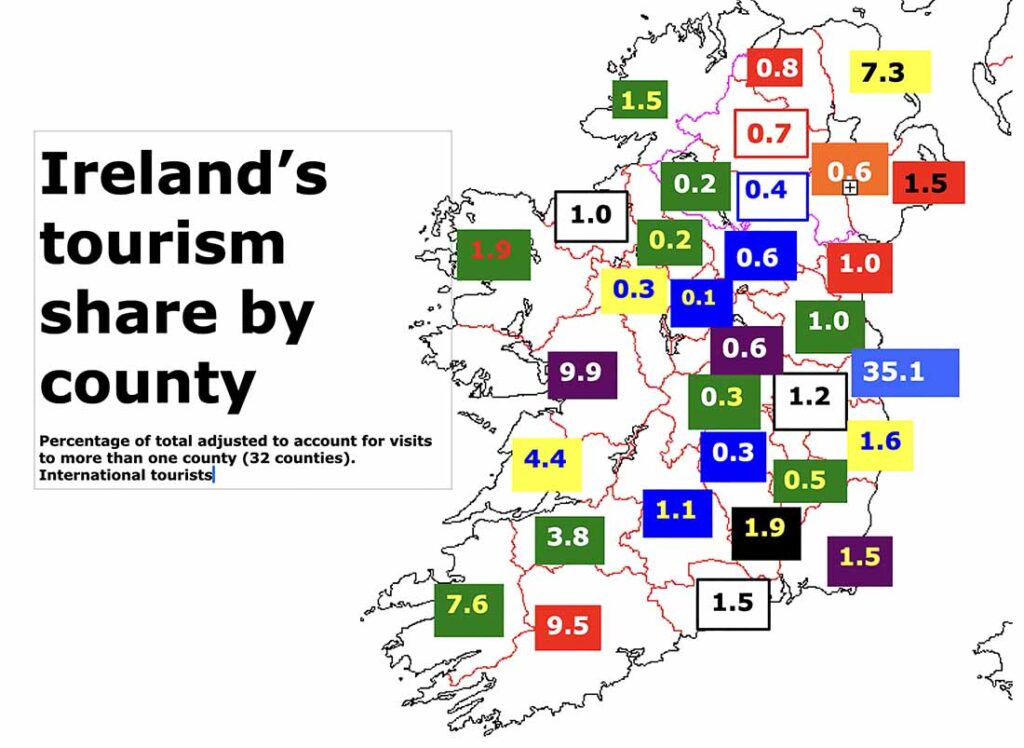
Ireland’s County Antrim offers a stunning blend of coastal beauty and historic sites, with the Giant’s Causeway, a UNESCO World Heritage Site, showcasing unique basalt columns along the rugged shore. Carrickfergus Castle provides a glimpse into medieval history, while the Glens of Antrim offer scenic drives through rolling hills. Other attractions include the Belfast Botanic Gardens and coastal. Antrim is Ireland’s ninth largest county by size (3,046 square km) and second largest by population (651,321). In terms of hospitality, Antrim is Ireland’s fifth most visited tourist county with around 525,000 international visitors per year.
Antrim:
Introduction – Adventure – Anthem – Archaeology – Attractions – Awards – Birdwatching – Camping – Castles – Churches – Contact list – Cycling – Dining – Equestrian – Festivals – Fishing – Folklore – Gardens – Golf – Graveyards – Happening – Haunted – Highest – Hiking – History – Holy Wells – Hotels – Hotels top 8 – Hunting & shooting – Instagrammable – Itineraries – Largest town – Luxury – MICE – Movies –Music – Name – New – Novelists – Off the beaten track – Poets – Pubs – Quotes – Random facts – Restaurant Awards – Sacred Places – Saints – Songs – Spas – Sports – Sunsets – Sustainable – Things to do – Towns – Video – Villages – Walking – Wanderlist – Weddings – Wild swimming – Writers – 1837 – 1846 – 1852 – 1909 – 1955 – 1980 –