A maritime county of the province of Connacht, is bounded, on the north, by the Atlantic Ocean; on the east, by Leitrim; on the south, by Roscommon and Mayo; and on the west, by Mayo and the Atlantic Ocean. Its greatest length, from north-east to south-west, is about 45 miles; its greatest breadth, from east to west, is about 35 miles; and its area is 721,550 statute acres, or about 1,127 square miles, of which about 450,000 acres are arable or under cultivation, 200,000 bog and mountain (including large tracts of moor and unreclaimed land), 20,000 woodland, and the rest towns, villages, roads, and water (including portions of bays and loughs).
POPULATION, In 1831, 129,995; in 1841, 155,297, showing an increase of 25,302, or about 19.5 per cent. Houses in 1841, 25,614. Families chiefly employed in agriculture, 20,614; in manufactures and trade, 3,000; in other pursuits, 2,000. Families dependent chiefly on property and professions, 800; on the direction of labour, 6,614; on their own manual labour, 16,614; on means not specified, small number.
The county is divided into 6 baronies: Carbury, Coolavin (or Tirerrill), Corran, Leyny, Tireragh, and Tirerill (with subdivisions noted). It contains 41 civil parishes, and parts of others; about 1,200 townlands. Poor Law Unions: Sligo, Tobercurry, and parts of Boyle, Carrick-on-Shannon. The Poor-Law valuation is about £180,000 to £220,000.
SURFACE AND TOPOGRAPHY, The surface is highly diversified: the north and west form a bold, rocky, and indented coast with bays, inlets, and headlands; the interior is mountainous in the south-east (Ox Mountains rising to 1,785 feet in Knocknarea or other peaks, Slieve Daeane, etc.); the centre and east are undulating plains with fertile valleys; extensive bogs in low tracts (reclaimable); limestone prevails in east and centre, affording good manure; sandstone, slate, and quartz in mountains; scenery picturesque with lakes, glens, sea-views, and wooded demesnes.
RIVERS AND LAKES, The chief rivers are the Garavogue (flows from Lough Gill to Sligo Bay, navigable in lower part); the Moy (forms southern boundary in part, navigable); the Owenbeg, Owenmore, Drumcliff River, etc. Lakes: Lough Gill (beautiful, about 8 miles long, with islands and wooded shores); Lough Arrow, Lough Talt, Glencar Lough, etc.; numerous smaller loughs in mountains. Fisheries valuable (salmon in rivers, herring and other sea-fish on coast; Sligo Bay good harbour).
SOIL AND AGRICULTURE, The soil varies: rich limestone loam in valleys and east (good for oats, barley, potatoes); lighter gravelly or sandy near coast; moorish and rocky in mountains; bogs extensive but improvable. Crops: oats (principal), barley, potatoes extensive, flax, wheat limited. Pasture supports cattle and sheep; dairy produce fair. Tillage improving with liming and rotation; farms small; husbandry backward in mountainous districts but advancing near Sligo town.
CLIMATE, Mild, moist, equable; heavy rainfall from Atlantic exposure; salubrious though damp; storms frequent on coast.
MINERALS, Limestone abundant; sandstone, slate (good quality quarried); lead ore (worked at Glencar, etc.); copper, iron traces; coal seams thin (not extensively); peat extensive in bogs.
TRADE AND MANUFACTURES, Chiefly agricultural; trade at Sligo (seaport, exports grain, butter, provisions, bacon, wool; imports coal, timber, salt, manufactures). Fisheries important (herring, salmon). Manufactures limited: coarse linen, brewing, distilling, milling.
TOWNS, Sligo (county town, seaport and market, pop. about 10,000-12,000; harbour, bridges, markets); Tobercurry (pop. about 2,000); Ballymote (pop. about 2,000); Collooney, Strandhill, Dromore West, etc.
ECCLESIASTICAL, Diocese of Elphin (province of Tuam; parts); Roman Catholic diocese of Elphin; numerous chapels. Protestant churches in towns. Tithes commuted.
ANTIQUITIES, Numerous: Sligo Abbey (Dominican, ruins); Carrowmore (great megalithic cemetery with dolmens, cromlechs); Knocknarea (cairn, Queen Maeve’s tomb legend); Drumcliff round tower and high cross; castles (Sligo, Ballymote, Collooney); raths, forts, ancient churches; Glencar waterfall and scenic sites.
Ireland in 1846
Antrim – Armagh – Carlow – Cavan – Clare – Cork – Derry – Donegal – Down – Dublin – Fermanagh – Galway – Kerry – Kildare – Kilkenny – Laois – Leitrim – Limerick – Longford – Louth – Mayo – Meath – Monaghan – Offaly – Roscommon – Sligo – Tipperary – Tyrone – Waterford – Westmeath – Wexford – Wicklow
County Sligo:
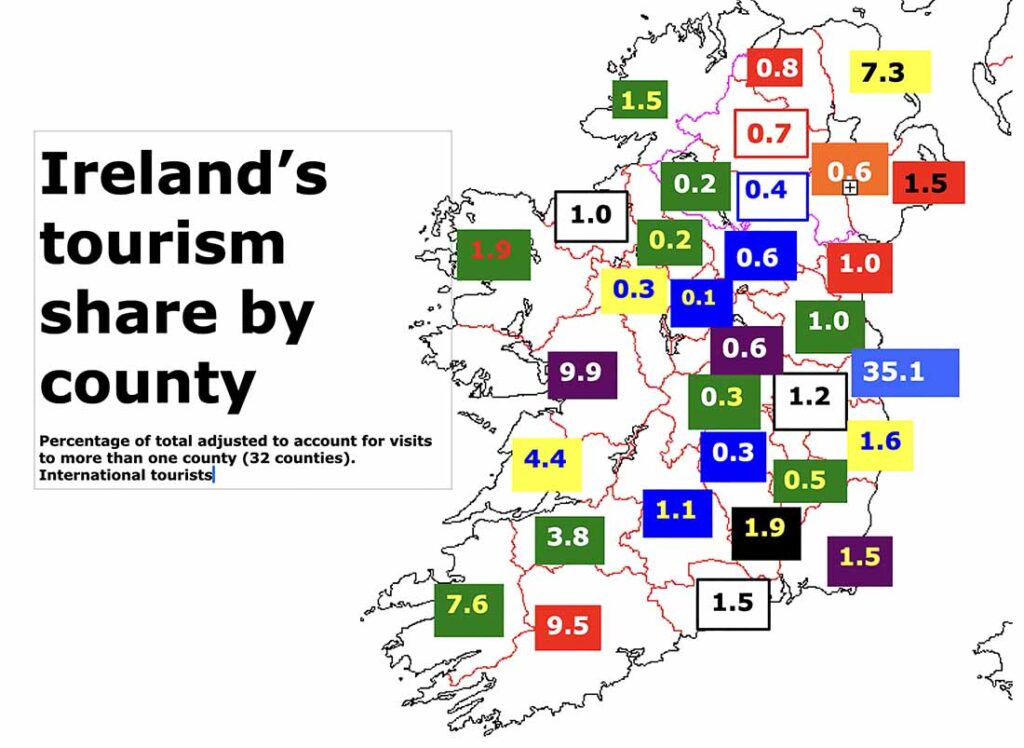
Ireland’s county Sligo is renowned for its poetic heritage and coastal scenery, with the Carrowmore Megalithic Cemetery offering one of Europe’s oldest prehistoric sites. The Benbulben mountain provides striking hiking trails, while Strandhill’s beaches are ideal for surfing. Other attractions include the historic Lissadell House and its gardens. Sligo is Ireland’s 22nd largest county by size (1,796 square km) and seventh smallest by population (70,198). Population peaked at 180,886 in 1841 and reached its lowest point, 50,275 in 1971. In terms of hospitality, Sligo is Ireland’s 17th most visited tourist county with around 133,000 international visitors per year.
Introduction – Adventure – Anthem – Archaeology – Attractions – Awards – Birdwatching – Camping – Castles – Churches – Contact list – Cycling – Dining – Equestrian – Festivals – Fishing – Folklore – Gardens – Golf – Graveyards – Happening – Haunted – Highest – Hiking – History – Holy Wells – Hotels – Hotels top 8 – Hunting & shooting – Instagrammable – Itineraries – Largest town – Luxury – MICE – Movies – Music – Name – New – Novelists – Off the beaten track – Poets – Pubs – Quotes – Random Facts – Restaurant Awards – Sacred Places – Saints – Songs – Spas – Sports – Sunsets – Sustainable – Things to do – Towns – Video – Villages – Walking – Wanderlist – Weddings – Wild swimming – Writers – 1837 – 1846– 1852 – 1909 – 1955 – 1980 –