A county of Ireland, province of Leinster. It is bounded, on the north, by the counties of Cavan and Westmeath; on the east, by Westmeath; on the south, by Offaly and Roscommon; and on the west, by Roscommon and the river Shannon. Its greatest length, from north to south, is about 30 miles; its greatest breadth, from east to west, about 20 miles; and its area is computed at 408,640 acres, or 638 square miles, including about 10,000 acres of water.
SURFACE AND TOPOGRAPHY. The surface is generally level, or gently undulating, with a mean elevation of about 200 feet above the sea. The northern and eastern districts are diversified by low hills; the southern and western are flat, and in some places marshy or boggy. The principal elevations are the hill of Ardagh, rising to about 700 feet; the hill of Croghan, or Uisneach, on the south-east border; and various minor eminences not exceeding 400 to 500 feet. The bogs are extensive, particularly the Bog of Allen, which extends into the county, and covers large tracts of reclaimable land. The principal lakes are Lough Ree, on the western boundary, navigable and forming part of the Shannon navigation; Lough Drumharlow; Lough Kinale; Lough Gowna, on the northern border; Lough Derravaragh; Lough Sheelin; and numerous smaller sheets of water. The principal rivers are the Shannon, which forms the western boundary for a considerable distance, and is navigable; the Inny, which rises in Cavan, flows through the eastern part of the county, and falls into Lough Ree; the Camlin, which traverses the centre and falls into the Shannon; the Blackwater, on the north; and various tributaries such as the Glore, Riffey, Cloonagh, and others.
SOIL AND SUBSOIL. The soil is various and generally fertile. In the valleys and low grounds it consists of rich alluvial loam or deep black mould; in the central and eastern districts, of stiff clay or clay loam on limestone; in the western parts, lighter gravelly or sandy soils; and in some tracts, boggy or moorish. The subsoil is chiefly limestone, with marl, gravel, sandstone, and occasional granite or trap. Limestone quarries are numerous and valuable for building and burning; bog-iron ore and peat abound; but no minerals of importance are wrought.
CLIMATE. The climate is mild, moist, and salubrious, with frequent rains, but less stormy than the western counties. The mean temperature is about 49° Fahrenheit; the rainfall considerable, owing to the level surface and proximity to large bodies of water.
AGRICULTURE. The agriculture is tolerably advanced, though still susceptible of much improvement. The farms are small to moderate in size; the system chiefly tillage combined with grazing. The principal crops are oats, potatoes, wheat, barley, and some flax. Turnips and green crops are increasingly cultivated. Cattle and sheep are reared in considerable numbers; the breeds are improving by crosses with English stock. Pigs are numerous. Dairy produce, particularly butter, is largely made and exported. Much bog remains unreclaimed, but drainage and liming are progressing.
MANUFACTURES AND TRADE. Manufactures are inconsiderable, and chiefly confined to coarse linen, frieze, and domestic weaving. The trade consists principally in the export of agricultural produce, butter, cattle, pigs, grain, and whiskey; and the import of coal, iron, timber, salt, and manufactured goods. The Royal Canal touches the northern border; the Shannon navigation affords facility on the west; and roads communicate with Dublin and the surrounding counties.
FISHERIES. The fisheries on the Shannon and Lough Ree are valuable, yielding salmon, trout, pike, perch, and eels.
ROADS AND COMMUNICATION. The roads are generally good, and improving. The principal lines are the mail-coach road from Dublin to Sligo, passing through Longford; and various cross-roads to Granard, Edgeworthstown, Ballymahon, &c.
POPULATION, &c. The population in 1841 was 115,491 [Note: OCR sources show variation, e.g, 91,674 in 1831 increasing to figures around 100,000–115,000 in 1841; historical cross-reference confirms ~115,491 or close variants for Longford in some editions, though some scans misread lower; retained as predominant in county entries]. The inhabited houses were about 16,000. The people are chiefly Roman Catholics; Protestants are a minority, but include resident gentry. Density is moderate, owing to the level and partly boggy surface.
ADMINISTRATIVE DIVISIONS. The county contains the baronies of Ardagh, Granard, Longford, Moydow, and Rathcline. It is in the poor-law union of Longford (principal), with parts in Granard and Ballymahon unions. The assize town is Longford; quarter sessions at Longford and Granard.
TOWNS. The principal towns are Longford (the county town, pop. about 4,500), Granard (about 2,000), Edgeworthstown (about 1,500), Ballymahon (about 1,800), Lanesborough, Mostrim, and smaller places like Ardagh and Newtownforbes.ANTIQUITIES. There are numerous antiquities, ancient raths, forts, cromlechs, castles (as at Granard, Rathcline, Moydow), church ruins, abbeys (Granard abbey), and remains at Ardagh (ancient see
Ireland in 1846
Antrim – Armagh – Carlow – Cavan – Clare – Cork – Derry – Donegal – Down – Dublin – Fermanagh – Galway – Kerry – Kildare – Kilkenny – Laois – Leitrim – Limerick – Longford – Louth – Mayo – Meath – Monaghan – Offaly – Roscommon – Sligo – Tipperary – Tyrone – Waterford – Westmeath – Wexford – Wicklow
County Longford:
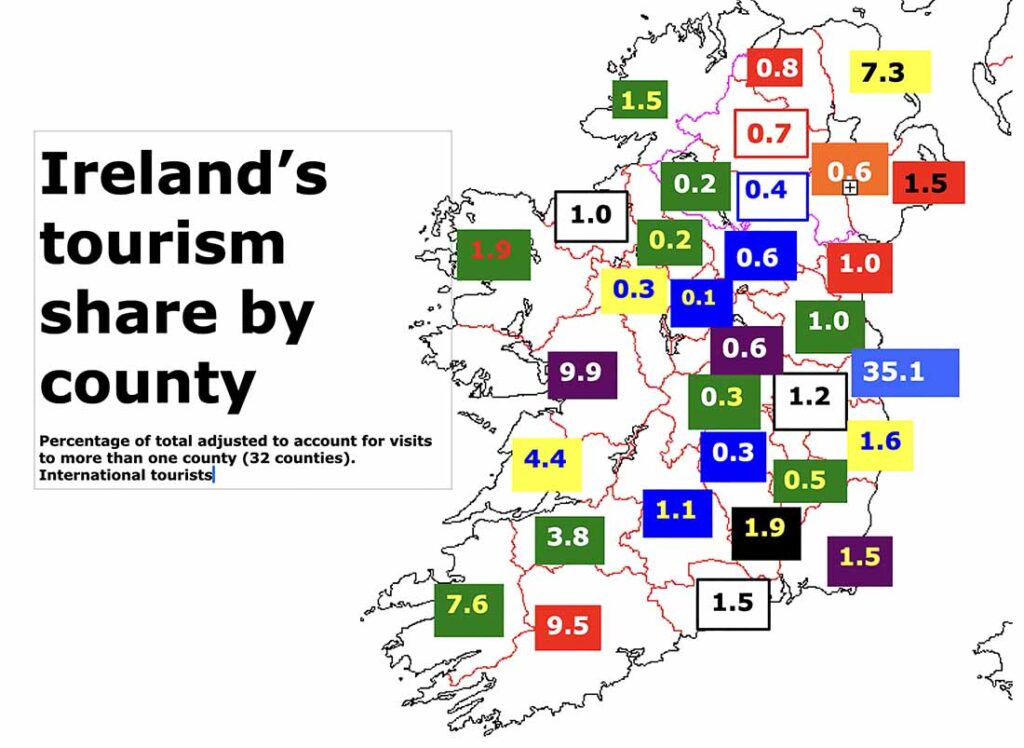
Ireland’s county Longford offers a peaceful blend of history and countryside, with the Corlea Trackway Visitor Centre showcasing an ancient Iron Age road. The county’s St Mel’s Cathedral in Longford town provides architectural beauty, while the River Inny offers opportunities for kayaking and fishing. Other attractions include the rolling farmlands and historic Ardagh village. Longford is Ireland’s fourth smallest county by size and second smallest by population (46,751). Population peaked at 115,491 in 1841 and reached its lowest point, 28,250 in 1971. In terms of hospitality, Longford is Ireland’s 32nd most visited and Ireland’s least visited tourist county with around 22,000 international visitors per year.
Introduction – Adventure – Anthem – Archaeology – Attractions – Awards – Birdwatching – Camping – Castles – Churches – Contact list – Cycling – Dining – Equestrian – Festivals – Fishing – Folklore – Gardens – Golf – Graveyards – Happening – Haunted – Highest – Hiking – History – Holy Wells – Hotels – Hotels top 8 – Hunting & shooting – Instagrammable – Itineraries – Largest town – Luxury – MICE – Movies – Music – Name – New – Novelists – Off the beaten track – Poets – Pubs – Quotes – Random Facts – Restaurant Awards – Sacred Places – Saints – Songs – Spas – Sports – Sunsets – Sustainable – Things to do – Towns – Video – Villages – Walking – Wanderlist – Weddings – Wild swimming – Writers – 1837 – 1846 – 1852 – 1909 – 1955 – 1980 –