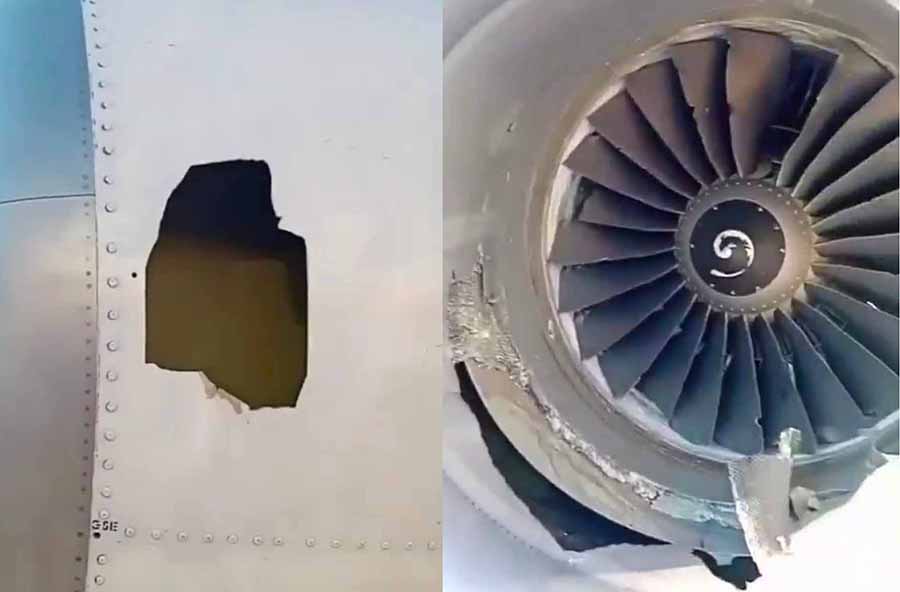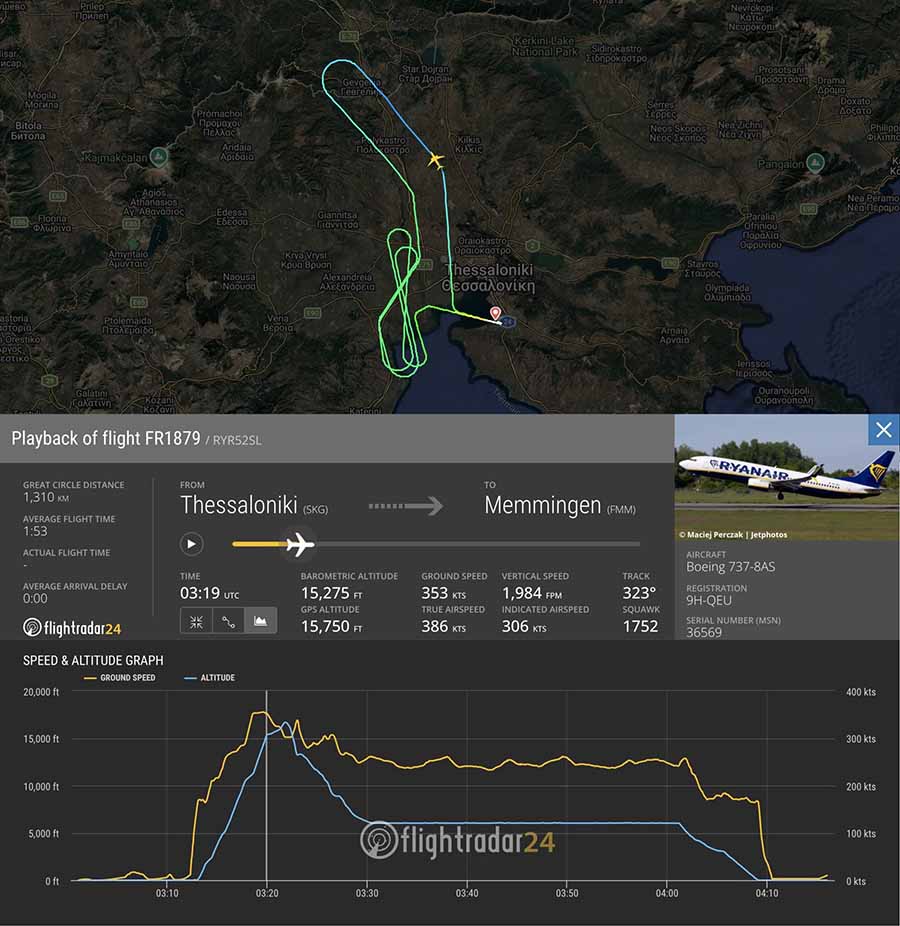
It rarely happens, but when it does, it can be dramatic. Ryanair flight from Greece to Germany suffered a serious safety incident when a passenger window shattered at 16,000 feet, causing uncontrolled decompression and injuring a passenger who was partially pulled toward the opening.
The event occurred on what was Ryanair’s 41st birthday, turning a routine short-haul flight into one of the most serious safety episodes in the airline’s history.
Aviation expert Eoghan Corry, editor of Travel Extra, described the drama in a radio interview, noting that while the outcome could have been far worse, the incident has raised urgent questions about engine reliability.
The Boeing 737 NG was operating from Thessaloniki, Greece, to Memmingen, Munich’s secondary airport in Germany. Just six minutes after takeoff, as the aircraft was climbing through 16,000 feet, a window beside a passenger blew out. The sudden loss of cabin pressure triggered violent decompression. Loose items in the cabin, phones, pillows, and other objects, were immediately thrown toward the breach as air rushed out.
The male passenger seated next to the window was pulled forcefully toward the opening. He sustained friction injuries consistent with being partially exposed to the extreme forces and was also treated for a neck injury. His wife, seated beside him, held onto him as the chaos unfolded.
The passenger’s seatbelt was the decisive factor in preventing a catastrophe. Corry explained: “No matter how loving your wife is, she won’t be able to hold you in a decompression event.” He noted that while aircraft windows are not large enough for a person to be sucked through, the outward force of escaping air is extremely powerful and traumatic for everyone on board.
Initial investigations point to an uncontained engine failure as the likely cause. In such failures, engine components break free from their casing and can damage the aircraft. In this case, debris is believed to have struck and shattered the window. Unverified social media reports circulating after the incident appear to show a missing fan blade from one of the engines.
Corry compared the force to “a bullet hitting the side of the plane” travelling at high speed. “A contained failure means all the broken parts stay inside the engine casing,” he said. “An uncontained failure means parts break free and scatter. They can cut fuel lines, pierce the fuselage, and cause major damage.”
The aircraft involved is a Boeing 737 NG equipped with CFM56-7B engines, not the more controversial 737 Max variant. Ryanair has long praised the CFM56 series for its efficiency, low fuel burn, and reduced noise. However, like rival Pratt & Whitney engines, the CFM56 runs at very high temperatures and has faced maintenance and supply chain challenges in recent years.
This engine type has a documented history of uncontained failures. In 2016 and 2018, Southwest Airlines experienced two high-profile incidents involving CFM56 engines, which led to significant scrutiny of the design and maintenance practices.
Four passengers were taken to hospital following the incident, with three later released. The passenger seated by the window remained under observation for further tests.
Ryanair operates an all-Boeing fleet and is known for its exceptionally high utilisation rates. The airline flies approximately 116,800 flights per month, roughly the same number of flights that Aer Lingus operates in an entire month. Despite this intense schedule, Ryanair has maintained an outstanding safety record. Corry highlighted that apart from a bird strike in 2018 that caused minor injuries to a small number of passengers, the airline has avoided serious incidents throughout its 41-year history.“