About 25pc of passengers are afraid of flying to some extent, an extraordinarily high number, and 10pc have a great fear of flying. So what has the aviation industry done to counter that? Despite decades of theorizing, practical solutions to the problem seem as elusive as ever.
And while the major airlines confirm that about a quarter of passengers feel scared of flying and that many more people will not go anywhere near an airport, let alone get on to an aircraft.
Denis Bergkamp and Whitney Houston would agree with that assessment. Flying phobia counts as an irrational terror, and many people turn to sedatives or alcohol to manage it. The condition brings real consequences for sufferers, who often speak of claustrophobia, agoraphobia, timeshares never visited and grandchildren never seen.
Everything x 4
Modern passenger aircraft carry four different electrical systems, four generators and four hydraulic systems that operate independently from two different sources. Only one system is necessary for flight. Pilots train and receive regular testing to fly manually if the autopilot fails. Toilet doors and overhead lockers rattle on take-off because designers create them to fit perfectly under pressure. A snug fit on the ground would cause them to stick once the cabin pressurises. The sudden drop in power after take-off occurs because aircraft level off for noise reduction and clearance to climb to cruising altitude. The sound appears more dramatic than the reality.
Famous individuals have spoken about their own experiences. Nigel Benn attended a course and confirmed that afterwards he could fly without the trauma. Denis Bergkamp refused away games that required air travel because he froze up. David Bowie avoided flying for 20 years and travelled by sea and bus before coming to terms with the phobia. Dina Carroll felt trapped and wanted to be sick when the fear struck. Aretha Franklin could not perform in Europe because of her fear. Whoopi Goldberg described panic, shaking, sweating, crying and moaning. Whitney Houston spent large sums to avoid flying. Lesley Joseph has suffered a lifelong phobia.
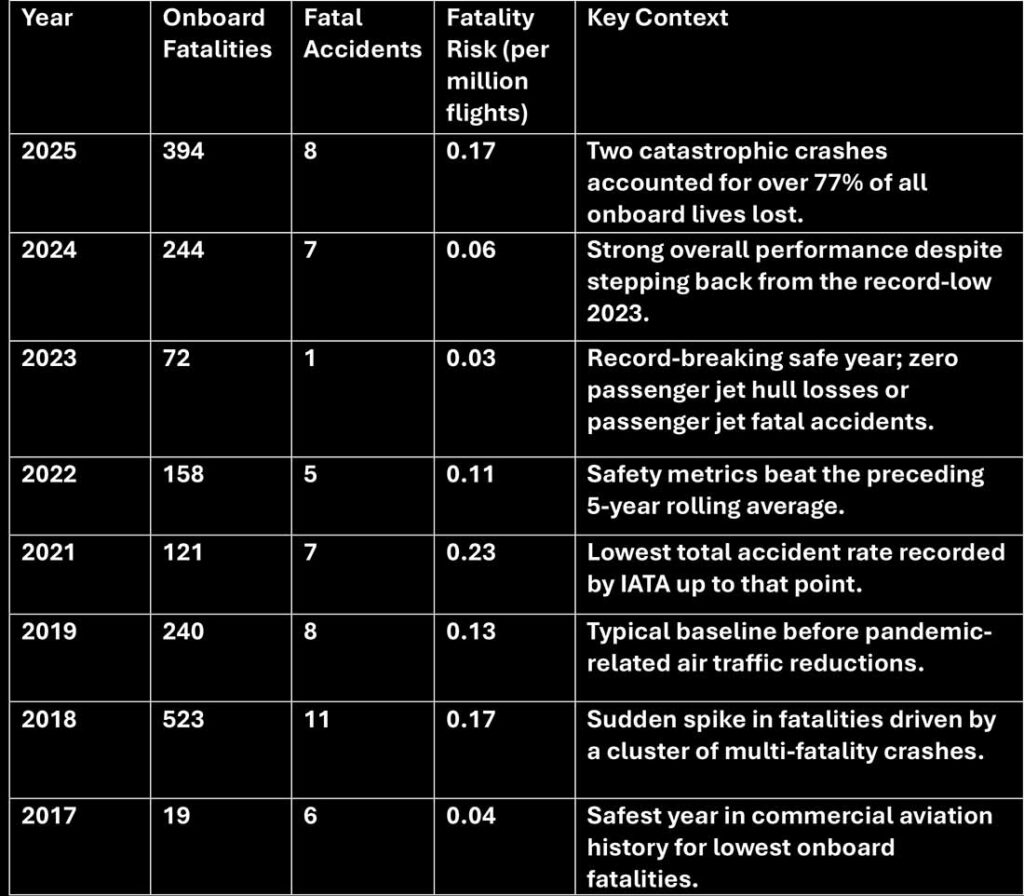
Safety statistics support the reassurance offered in these courses. According to the latest figures from the International Air Transport Association (IATA) Annual Safety Reports, commercial aviation has maintained a strong long-term trend toward reducing accidents and fatalities. In 2025, the industry recorded 394 onboard fatalities across 8 fatal accidents globally, a rise from the 244 onboard fatalities (across 7 fatal accidents) tracked in 2024, but reflecting an overall reduction from historical peaks decades ago.
IATA monitors scheduled commercial flight safety using a five-year rolling average to account for yearly statistical spikes. The table below breaks down recent global commercial aviation fatalities and fatal accidents based on annual updates published in the IATA Safety Reports:
Data collated by IATA show that in 2014 4.8 billion people flew on commercial aircraft i, rising to nearly 5 billion (and projected up to 5.2 billion) for 2025. There were 37.9 million flights in 2024, 7 fatal accidents which caused 244 fatalities, 54 total accidents, a fatality risk of 0.06 and an all account risk of 1.42 per million flights, a one in 13.7 million chance of dying in an aviation crash, comparable the chances to giving birth to identical quadruplets (the chances of being killed y a shark is one in 28 million).
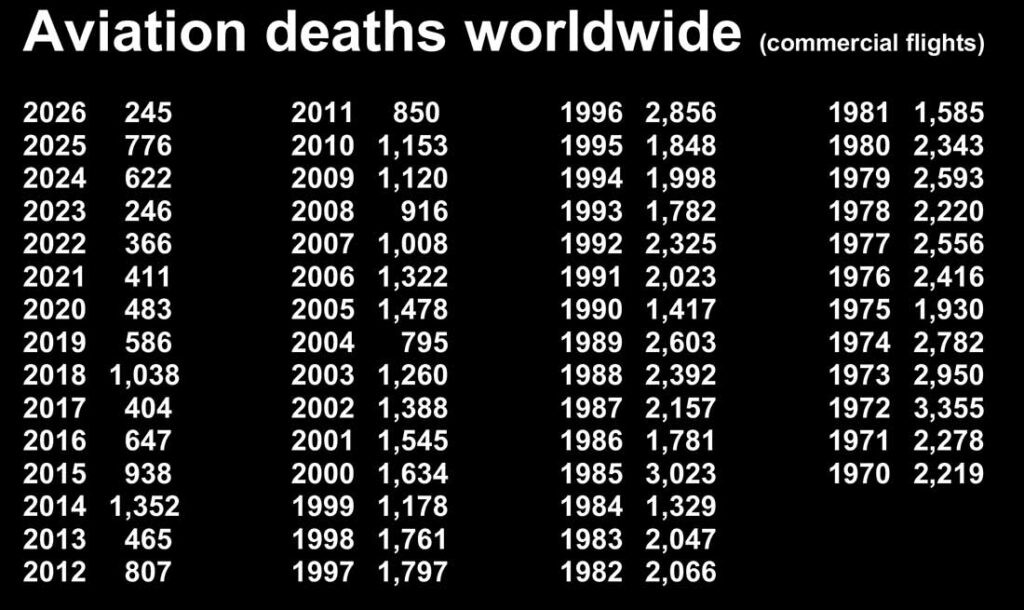
The figure has fallen for years. The deadliest crash in aviation history occurred in 1977 in Tenerife when 583 people died after two jumbos collided on the runway. In comparison that many people die from heart disease in America every eight hours.
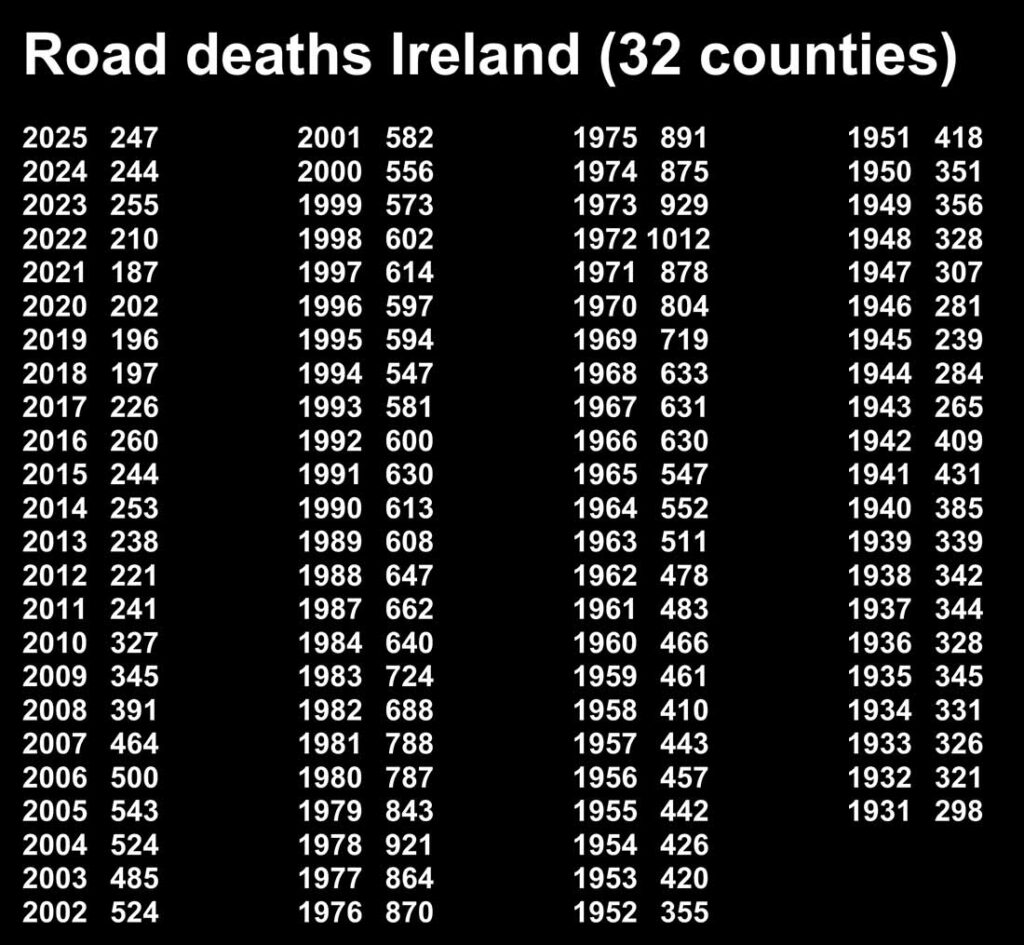
The World Health Organisation confirmed over 1.16 million road traffic deaths around the world in 2025. Road accidents remain the leading cause of death among people aged 15 to 29. On the island of Ireland, 247 people died in road accidents in 2025. The University of Oxford calculated that in 2006 people in Britain had odds of one in 36,512 of dying in a motor accident and one in 3.5 million of dying in an aircraft crash. Stairs count as a far more dangerous mode of transport, with around 80 deaths in Ireland each year.
IATA has been working to improve even those, lower figures. Nick Careen, director Operations, Safety and Security at the Geneva based body, has campaigned on physical safety compliance and passenger behavior during emergency evacuations with the “Leave Your Bag, Save a Life” Campaign
A study highlighted by IATA revealed that while 80pc of travelers believe they know what to do in an emergency, only 61pc correctly understand that they must leave carry-on baggage behind.
About 40pc of passengers admit they would attempt to retrieve carry-on items during an evacuation, which creates life-threatening bottlenecks in the aisle. Careen stated that passenger education is the first priority of the campaign, but warned that if behavior does not improve, the industry may resort to hard-locking overhead bins during flights.
The initiative also cautions against passengers stopping to film or take photos during an emergency exit, which delays evacuation times
Gulf wars, I, II and III
Economic effects appear when fear rises. During the Gulf war in 1991 many Americans avoided flying because of concerns about bombs on planes. One surgeon booked a Club Med ski holiday to France when prices dropped and enjoyed an almost empty aircraft for about €380 including return flights, ski passes and all food and drink. After 11 September Europe saw reduced American travel, which created availability at hotels such as the Hotel Splendido in Portofino, the Villa San Michele in Florence and the Cipriani in Venice. British travellers began booking winter sun holidays later than usual and tour operators offered discounts. Destinations within range of potential conflict such as Egypt, Cyprus or Turkey provided cheap deals at that time.
The travel industry monitors these patterns closely. TUI predicted that a war in Iraq could affect the sector even more than the Gulf war. Company collapses could leave people stranded abroad and force lengthy claims for reimbursement. Scheduled airline bookings without insurance or credit card payment risked total loss. The Gulf war II caused the collapse of ILG, which took with it a scheduled airline and brands including Intasun and the former Club 18-30. The Association of British Travel Agents planned its annual congress in Cairo and some members hesitated because of safety concerns at the venue.
Fear of flying courses achieve results for many participants. In one British Airways course five people out of 162 did not board the flight over the Isle of Wight, but some managed to step onto the plane and viewed that as progress. One attendee confirmed that the course had sorted out anxieties about a boyfriend and a job, after which flying no longer formed the main issue. Another woman prepared for a flight to South Africa to visit family. A third planned a weekend away by plane with her husband as soon as finances allowed. One participant flew to Argentina on a mildly turbulent night flight and repeated the mantra turbulence is uncomfortable but not dangerous until sleep came.
These programmes combine technical knowledge with psychological support. Captains with extensive experience provide authority while psychologists address the mental patterns that sustain fear. Relaxation techniques, factual explanations and simulator sessions give participants tools to manage their responses. The approach leaves irrational fears aside and focuses on what actually happens during commercial flights. Staff tread carefully with language to avoid increasing anxiety, choosing analogies with care and maintaining a supportive atmosphere.
Persistence of fear
The persistence of fear despite safety improvements shows the power of irrational responses. Billions of passengers fly safely each year while road travel and everyday activities carry higher risks. Courses cannot eliminate every worry but they equip people with information and strategies that reduce the terror. Participants often report that understanding normal operations, from crew communications to aircraft behaviour in turbulence, changes their perspective. The realisation that wings flex far more than turbulence demands or that multiple redundant systems protect the aircraft brings calm.
Demand for these courses remains steady because the fear affects a large portion of the population. Airlines invest in the programmes as a service to customers and a way to encourage travel. Independent providers such as those in Dublin add options for people in different regions. Books like the one by Maeve Byrne Crangle serve as refreshers for those who have completed a course or prefer self-paced learning. The combination of expert input from pilots, doctors and psychologists creates a comprehensive resource.
Maeve Byrne Crangle wrote the book Conquer Your Fear of Flying, released by Gill and Macmillan in its third edition in 2010. Her husband John Crangle worked as a flight instructor and contributed chapters on the pilot’s day, aircraft diagrams and flight plans. These sections offer helpful familiarisation tools for the nervous flyer. The authors deal logically with the fears that clients report and explain how to calm those fears in a rational and uncritical manner. One reader who attended a therapy course with Maeve Byrne Crangle confirmed that something the psychologist said about the normal operations of flying a commercial passenger airplane slotted things into place and reduced many fears. Knowledge of the little things that happen on a flight, such as how the crew communicate through the bell system, what happens to the body parts of an aircraft during flight, and how flight paths receive mapping for the smoothest and safest ride possible, proved especially useful.
Travel patterns shift when global events heighten anxiety, but the underlying statistics on aviation safety continue to improve. Comparison with road deaths or common illnesses puts the risks in perspective. For individuals the personal cost of avoidance, missed family visits, unvisited holiday homes and limited opportunities weighs heavily. Courses offer a path forward that many have followed successfully.
Fear of flying courses
Courses offered by airlines and independent providers give participants a structured way to address these concerns. A typical course lasts a full day and takes place at or near an airport. Participants meet a uniformed captain with decades of flying experience and a reassuring number of rings on his sleeves. A doctor or psychologist joins the session along with a team of compassionate staff, usually working crew or flight attendants who volunteer their time. Some programmes include an actual flight while others provide a Zero Flight Time trip in an aircraft simulator because participants sometimes worry about the flight itself and forget the material covered.
Captains explain key facts about aircraft construction and operation. The wings form a single structure that goes right through the chassis rather than attaching separately to each side. During testing the wing tips bend up to an angle of about 70 degrees at breaking point, and even the worst turbulence creates only a fraction of that force. Pilots describe how an aircraft stays in the air, how staff calculate its weight down to the last pound, and how the plane can glide without engines if necessary.
Medical doctors on some courses discuss the causes of fears and phobias, which often overlap with conditions such as depression or claustrophobia. Psychologists teach relaxation techniques to break the cycle of panic and confirm that a single incident can trigger a phobia. Participants learn to picture themselves coping successfully with a flight instead of focusing on possible disaster. When turbulence occurs the instruction is simple: turbulence remains uncomfortable but not dangerous. Psychologists advise people to stop the mental images of the aircraft breaking up as soon as those thoughts appear.
The Virgin Atlantic Flying Without Fear programme, set up in November 1997, occasionally holds courses in Dublin. Aer Lingus periodically runs fear of flying courses while Aviatours also offers them. British Airways and Virgin Atlantic follow a similar pattern in England. Attendees often include more women than men. Many share stories of gripping the armrests throughout flights or avoiding travel altogether. Writing fears down on large sheets of paper and pinning them up reveals common themes of crash, death, loss of control, turbulence and claustrophobia.
One captain picked up a model plane to demonstrate construction points. After showing how model wings come off easily, he revealed that on a real plane the wings form a single structure through the chassis. This type of explanation removes pointless fears of aircraft noises and movements. As people gain interest they ask questions that they had held back for years. Laughter ripples through the room at familiar symptoms while mentions of turbulence bring groans.
The psychological parts of the courses differ slightly. One provider used a medical doctor to cover causes of fears and phobias. Others supplied psychologists who taught relaxation techniques and confirmed that phobias could stem from a single incident. In one case a woman traced her problem to the birth of her first child, when labour represented the first true loss of control she had experienced. Once plane doors close she felt the same horror and preferred to avoid the situation entirely.
Smaller groups allow greater warmth and intimacy. Name badges help participants connect quickly and become more interested in other people’s stories than their own. One man had suffered a panic attack on a flight from Greece 23 years earlier and had not flown since. He had bought a timeshare in Alicante with his business partner after dreaming about it for 10 years but could not board the plane. His children wanted to visit America and that situation left him feeling guilty. Another participant had never flown at all while a third felt simply petrified. Every person in that group boarded the flight at the end.
Larger courses sometimes create time pressure because of the number of questions. Technical sections that explain systems such as TCAS, the Traffic Collision Avoidance System, which lets an aircraft know if the safety bubble around it has been invaded and takes avoiding action, may end early. Some attendees prefer the directness and the sense that instructors tell the truth. One woman identified her particular problem as anticipatory fear that begins days before a flight and focuses on turbulence. Instructors explain that no such thing as an air pocket exists and that planes never drop thousands of feet. They compare the situation to an egg in a pan of boiling water that bounces around but stays intact.
Practical questions receive clear answers. If all engines fail the chances stand at several millions to one, but modern jets can glide for at least 100 miles without engines. A tyre burst on take-off or landing has negligible effect because each wheel carries several tyres, for example a Jumbo has 18 tyres. The chances of a mid-air collision remain incredibly slim and continue to decrease thanks to TCAS, which uses on-board equipment to inform aircraft of each other’s positions. Any invasion of the space around an aircraft counts as an air-miss and receives investigation. Planes fly in a box of air that usually measures 2,000 feet above and below and three miles on either side. On North Atlantic routes the vertical distance between aircraft flying in the same direction has reduced to 1,000 feet, which TCAS makes perfectly safe.
Ongoing efforts
The aviation industry maintains its efforts to address passenger fears through education and support. Captains, crew and specialists volunteer time to run the sessions because they see the difference the information makes. Participants leave with practical knowledge about how planes work, why certain sensations occur and how to respond to anxious thoughts. Over time these tools allow more people to travel confidently. The solutions may not satisfy every theorist but they deliver results for those who attend.