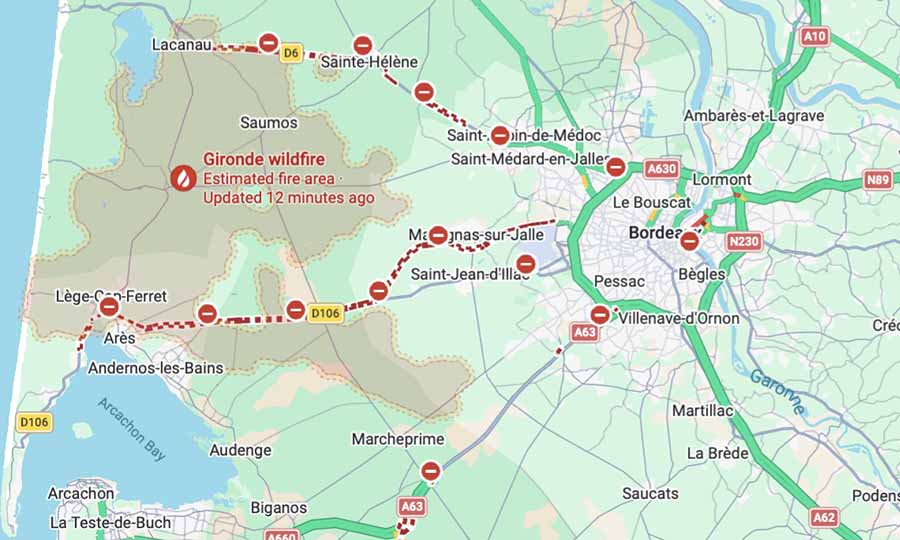
- 330,000 residents have been evacuated due to wildfires.
- Lacanau resorts evacuated on Tuesday
- 3,000 holiday makers moved from holiday parks near the Spanish border now returning.
- Spain declared its first-ever national emergency over wildfires.
- La Sirène campsite remains open and safe; Le Brasilia suffered damage.
- 62 campsites evacuated & 600 still facing disruption
At least 62 campsites have been fully evacuated across southwestern and southern France due to intense wildfires driven by extreme heatwaves and high winds. The blazes have triggered one of France’s largest peacetime displacements on record. Tens of thousands of holidaymakers have been forced to flee tourist hotspots, severely disrupting the peak summer travel season. Firefighters are managing widespread regional disruptions affecting an estimated 600 campsites.
- Gironde & Landes: The coastal pine forests along the Atlantic coast are heavily impacted. The entire Cap Ferret peninsula west of Bordeaux was ordered to undergo a full evacuation, with hundreds escaping by boat.
- Atlantic Coast Closures: Precautionary clearance orders displaced 4,000 tourists from sites in Lacanau-Océan, Biscarrosse, Parentis-en-Born, and Arcachon.
- Pyrénées-Orientales: Near the Spanish border, a fire tore through 500 hectares of land. It completely destroyed a campsite and forced more than 3,000 tourists to flee villages like Saint-André, Sorède, and Argelès.
- Southeastern Spots: Evacuations and maximum alert levels have expanded to southeastern holiday spots, including Fréjus (Var), Gard, and Aude.
Because campsites generate 80pc of their revenue during July and August, impacted operators report an immediate 15pc drop in seasonal revenue, cutting their total yearly profitability nearly in half.
Regional authorities have explicitly pleaded with travellers to stay away. The prefect of Gironde issued an advisory urging tourists not to come and asking current visitors to find alternative destinations. Thousands of tourists are currently sleeping in temporary shelters like sports halls. Abandoned campgrounds remain filled with tents, toys, and vehicles left behind during rapid 30-minute evacuations.
Despite the immediate local devastation and warnings, European travel agencies report that overall international demand remains resilient, with few global cancellations for regions outside the immediate fire zones. .
Gironde & Landes (Atlantic Coast)
This region is the epicenter of the destruction, heavily impacting high-capacity holiday parks:
- Cap Ferret Peninsula: Over 40,000 residents and tourists have been evacuated from this area.
- Lacanau: Precautionary orders have resulted in 4,000 tourists leaving, with Yelloh! Village Les Grands Pins ordered closed.
- Andernos-les-Bains & Le Porge: Sites such as Fontaine Vieille and Camping La Grigne are closed and cleared.
- Biscarrosse & Parentis-en-Born: Numerous large sites, including Mayotte Vacances, La Rive, and Lac Biscarrosse, have been fully evacuated. An additional 3,000 people were cleared from sites near Parentis, including Camping Calède, Les Cottages, Le Pison, and Le Pipiou.
Southern France (Pyrenées-Orientales)
- Over 3,000 vacationers left holiday parks near the Spanish border.
- Several campsites near Argelès-sur-Mer were destroyed by fire.
- The La Sirène campsite remains open.
While the fire zone remains volatile, authorities allowed a limited, partial return for approximately 15,000 evacuees in parts of Sanguinet and Parentis-en-Born. However, officials warn that high alert remains necessary due to the risk of secondary flare-ups from heatwaves.
The National Federation of Outdoor Lodging highlights that guests face significant financial losses, with insurance unlikely to cover compensation due to government-imposed bans on new bookings.
Returning to inspect properties
While some evacuees near Biscarrosse have begun to tentatively return to inspect properties under tight civilian checkpoints, authorities remain vigilant due to shifting winds and lingering smoke pollution. Broader restrictions persist across affected zones where fires have already burned tens of thousands of hectares. Tourism operators in the region report significant disruption with many campsites standing empty during what is normally a peak season. No fatalities have been linked directly to the blazes in these tourist areas but dozens of properties including at least one campsite have sustained damage.
Firefighters supported by military personnel and water bombing aircraft are working to secure perimeters while authorities urge the public to avoid the regions and check official updates before travel. Compensation schemes are expected for those affected by forced closures though details are still emerging. The situation remains fluid with potential for further evacuations if conditions worsen.
The emergency has become heavily concentrated along the Atlantic coast in the Gironde and Landes departments, where 45 campsites representing a capacity of roughly 40,000 holidaymakers have been evacuated or ordered closed. Most coastal/forest campsites in high-risk tourist zones (Cap Ferret, Arcachon, Biscarrosse) are evacuated or closed. Advice is to avoid until fires are controlled.
France has placed more than 22 regional departments—chiefly along the Atlantic coastline—on orange alert. Health officials advise individuals in smoke-impacted zones to stay indoors
Despite the intense and scary holiday experiences reported by fleeing families, Irish and European travel agents indicate that summer booking demands and long-term travel plans to France remain resilient
Three tourist impact zones impacted
The ongoing crisis has specifically targeted prominent travel destinations, nature parks, and coastal hubs
- Southwestern France (Gironde & Landes): The popular Atlantic holiday destination of Cap Ferretwas subjected to a total evacuation order, with thousands fleeing hotels and campsites by road and boat. Massive fires have also ripped through coastal Biscarrosse and forced the displacement of 141,000 people across the region. The dense smoke has reached the outskirts of Bordeaux, threatening the regional wine tourism industry.
- Southern France (Pyrenees-Orientales): More than 3,000 vacationers had to abandon holiday parks near the Spanish border. Blazes entirely gutted multiple campsites and threatened seaside resorts near Argelès-sur-Mer.
- Central Spain (Madrid & Ávila Regions): Spain has declared its first-ever national emergency over wildfires as blazes merged to threaten communities around the capital. In the neighboring Ávila province, over 70,000 people were displaced. Popular rural weekend and nature tourism hubs—including El Escorial, Robledo de Chavela, and El Tiemblo—have shut down all hiking trails and outdoor attractions.
The National Federation of Open-Air Hospitality (FNHPA) has mobilized a solidarity operation across France. Participating campsites with available pitches outside active fire zones are opening up spaces to accommodate families whose holidays have been cut short or completely upended. Affected travellers are being urged to check their booking emails rather than calling properties directly to avoid overloading emergency phone lines.
The DFA and other national advice bodies have NOT issued a blanket ban on travelling to France, noting that many regions remain completely unaffected. However, authorities warn that local access roads can close with zero warning. If you have an upcoming trip booked in southwestern France, you should explicitly verify your campsite’s status via local prefecture alerts before departing
Holiday makers are advised to check official sources hourly: Prefectures (e.g., Gironde Prefecture), French government alerts, and campsite websites. Many sites in Gironde/Landes remain closed, so expect major disruptions for holidays. Holiday makers are being offered alternatives in safer regions (e.g., Normandy, Brittany, or inland areas). Fire danger remains high due to heat and wind, so follow evacuation orders immediately.
Travel options
- Solidarity Accommodation Booking: The National Federation of Outdoor Hospitality (FNHPA) has launched an emergency scheme asking unaffected campsites across France to provide open pitches or rentals for displaced holidaymakers.
- Operator Guidance: If you hold a booking with providers like Eurocamp or Homair, do not travel to the properties if they are in affected sectors. Check your operator’s portal directly for rebooking or relocation options.
- Official Alerts: Monitor real-time local updates through the respective department prefectures (Gironde Prefecture and Landes Prefecture) before embarking on regional roads.
Economic impact
The immediate economic and logistical fallout for local businesses and travelers has been severe:
- Infrastructure Destruction: Dozens of holiday campsites, nature trails, bungalows, and rural accommodations have been completely scorched. Local operators are facing severe property damage during their most profitable months.
- Transport and Access Closures: Government advisories and local authorities have restricted entry to major recreational areas and enacted sudden road closures. Travelers face immediate logistical chaos, flight/accommodation cancellations, and sudden midnight hotel evacuations.
- Severe Local Economic Hardship: Small businesses depending exclusively on seasonal outdoor recreation (such as hiking, cycling, and local hospitality) are experiencing total revenue drops.
The compounding frequency of intense wildfire seasons is beginning to rewrite the European tourism map, with speculation about a rise in ecotourism and risk planning. According to Riskline’s Wildfires Travel Analysis, travelers are increasingly integrating climate risks into their vacation planning. This has accelerated a shift toward eco-conscious travel choices and a demand for flexible booking options.
Some travel agents say that prolonged summer heatwaves and toxic wildfire air pollution are pushing tourists to reconsider peak July-August trips to Southern Europe. Travel trends indicate a growing preference for cooler, off-season travel (spring/autumn) or alternative northern destinations.
Affected resort Cap Ferret is a chic, sun-drenched peninsula in southwestern France, famously dubbed the “anti-St. Tropez” or the “Hamptons of France” for its rustic charm, wild Atlantic beaches, and upscale yet unpretentious vibe. Located on the edge of the Arcachon Bay, it offers an enchanting blend of rugged maritime culture, dense pine forests, and a laid-back lifestyle centered around cycling, surfing, and indulging in fresh seafood.