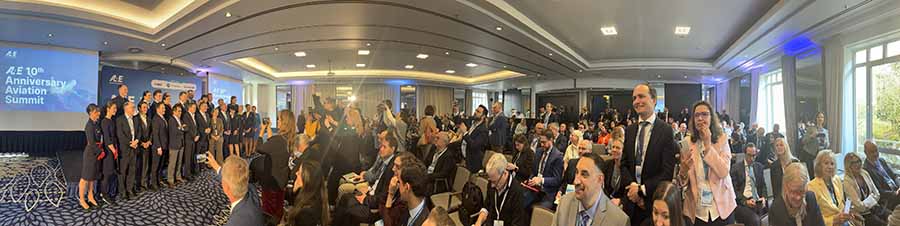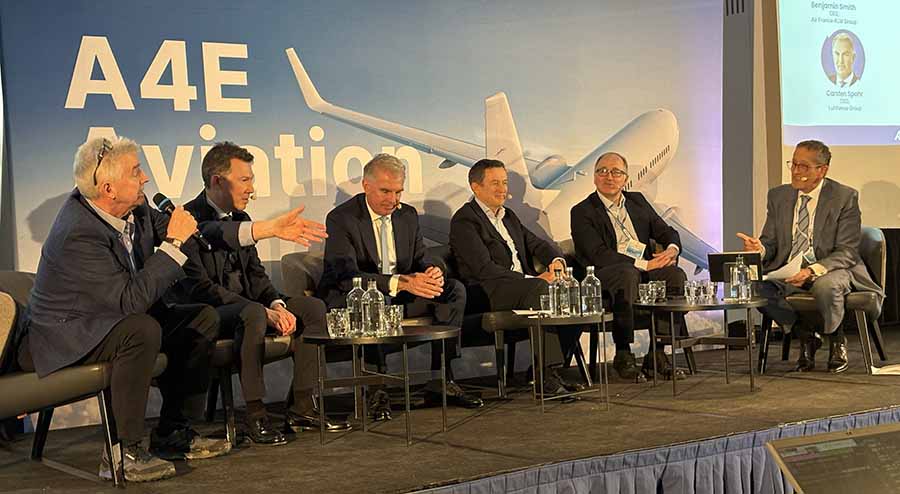
The A4E Airlines for Europe Aviation Summit in Brussels marked the organisation’s tenth anniversary on 19 March 2026 and brought together airline leaders policymakers and industry stakeholders to discuss the future of European aviation.
Andreas Carlson the Swedish Minister for Infrastructure and Housing confirmed that Sweden abolished its national aviation tax on 1 July 2025 to boost competitiveness strengthen connectivity and attract investment innovation and tourism. He revealed that the Swedish government reversed previous deprioritisation of aviation recognising its essential role in a country with long distances and sparsely populated areas. The move supports growth profitable operations and investment in modern aircraft while making Sweden more open and competitive globally.
The European Commissioner for Transport Adina Vălean confirmed that aviation represents one of Europe’s greatest collective achievements supporting millions of connections 15 million jobs and more than €1 trillion to the economy. She revealed plans for a new European aviation strategy to be presented in the autumn focused on ensuring competitiveness in a changing world. The strategy aims to reinforce leadership through innovation sustainability strategic autonomy and balanced external relations while addressing vulnerabilities from geopolitical tensions supply chain issues and higher regulatory costs compared to other regions.
- GOVERNMENTS RETHINKING AVIATION: Sweden is leading a shift away from flight shaming and aviation taxes, abolishing them despite its past association with Greta Thunberg and environmental activism. Michael O’Leary shared: “Sweden was the home of Greta Thunberg and all those, you know, people who should have spent more time in school and learning about the world rather than demonstrating, it was also the home of flight shaming here 5 years ago. And here you have the Swedes leading the charge, abolishing taxes.”
- ETS: There is growing governmental support for suspending or aligning ETS with global CORSIA standards, or even abolishing it to boost European competitiveness. Michael O’Leary shared: “You want to be very competitive, abolish the bloody thing altogether.”
- TURNING POINT: Europe has reached a turning point in recognising the limits of decreasing competitiveness, with recent events accelerating awareness among regulators, politicians, and the public. Carsten Spohr shared: “I think we will look at those years mid-2020s, one day as a turning point. I’m probably convinced. Never as fast as we wanted, never as extreme as we wanted, we all know that, but people have understood being not connected anymore.”
- CONNECTIVITY: Loss of connectivity in parts of Europe (e.g., Germany and Asia links) has been a key wake-up call, rather than industry failures or bankruptcies. Carsten Spohr shared: “In our case, it was loss of connectivity of certain parts for sure in Europe, Germany. And now this thing, I think, will be a wake-up call for the connectivity of Asia to Europe.”
- ATC: Air Traffic control under manning and frequent strikes cause 90pc of the delays in aviation in Europe. Ben Smith shared: “I don’t think we’d be talking about EU 261 if they fixed air traffic control. And it’s such a simple thing to fix, you know, turn up at the start of your shift, man the first wave and protect overfights,” Luis Gallego shared: “EU leaders must take this concern more seriously: require mandatory arbitration before a strike is even called, set a 21-day advance notice for any industrial action, protect overflights while ensuring local departures and arrivals are not impacted, and guarantee a right of redress for airlines.”
- FEES: High airport fees and taxation at hubs like Schiphol are reducing connectivity, forcing airlines to fly longer distances with fewer frequencies. Kenton Jarvis shared: “Amsterdam, Schiphol will be a perfect example. Those airport fees and … the taxation is incredibly high. And although we’re maintaining our 9 aircraft there at the moment, we’re flying further distances, which means we’re having less connectivity, and flying fewer frequencies on some other flights.”
- NETHERLANDS: Decisions by multiple Dutch bodies show a misalignment, negatively impacting national connectivity without apparent regard for the consequences. Ben Smith shared: “A complete misunderstanding or misalignment of what the impact of the decisions have on the connectivity of the Netherlands.”
- SCHIPHOL: Airlines like Air France-KLM will be forced to relocate capacity from high-cost bases like Schiphol due to unsustainable economics, including post-COVID loss repayments and fee hikes. Ben Smith shared: “It’s not leverage, we’re going to be forced to do anyways. We don’t have the profits out of KLM. We can’t justify the Capex, and we’ll move them to other, new airplanes, or even existing airplanes, to other bases. I mean, it’s just normal maths.”
- GROWTH: Europe’s carriers are not growing while Gulf carriers expand, exacerbating an unlevel playing field in connectivity to Asia and Southeast Asia. Ben Smith shared: “We’re not growing. Everyone around us is growing in particular, the Gulf carriers.”
- DEPENDENCY: Recent geopolitical events (e.g., capacity disruptions) highlight Europe’s dependence on Gulf hubs for eastern routes, serving as a stark wake-up call. Ben Smith shared: “It’s a big wake-up call for Europe when you have 100 wide bodies that come out of Europe immediately and that highlights the dependence on the Gulf for connectivity going eastbound.”
- MOOD: A different mood exists in Europe, driven by realisation that without changes in energy, security, consolidation, and environment strategies, the continent risks irrelevance globally. Luis Gallego shared: “I think that we see a different mood, but it’s not, to be honest, because all the messages that we have repeated for 10 years is more because Europe has realised that, or we change the strategy for energy, security, consolidation, environment, or we are irrelevant in this world.”
- EFFICIENCY: Airlines must focus on internal efficiency rather than just blaming others, amid rising costs from staff, ETS, APD, and environmental taxes that fail to support SAF production. Luis Gallego shared: “All the carriers, I think we need to look inside what we can do to be more competitive ourselves, not to try to contaminate the others because if the others are more efficient, what we have to do is to be more efficient.”
- WAR: The war has accelerated awareness of wrong policy directions but should not be seen as a business opportunity; capacity will return, but the wake-up on over-regulation may endure. Carsten Spohr shared: “This war has accelerated people to understand that we have gone the wrong direction. The war itself, capacity will come back. One day, people will forget and have that vacation there. That’s all good. But I think it helped to wake up regulators, the media, politicians, maybe even voters in Europe, that this is going the wrong way.”