- IATA reports 0.2pc passenger demand growth for July 2026
- European carriers see 3.1pc demand increase
- Europe-Asia traffic grows 12.1pc as strongest corridor
- North American carriers experience 2.3pc demand decrease
- Domestic demand grows 0.6pc with China and Brazil leading
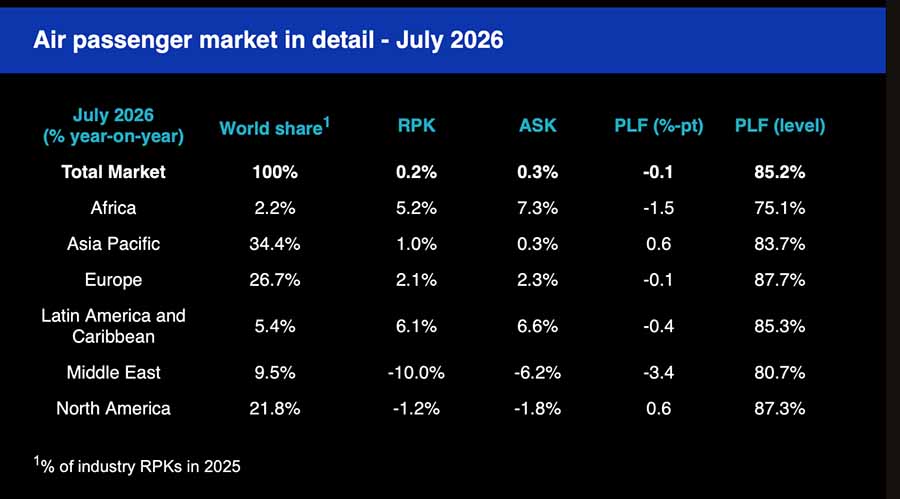
The International Air Transport Association has released data for July 2026 global passenger demand showing total demand up 0.2pc compared to July 2025. Total capacity increased 0.3pc year-on-year, with the load factor reaching 85.2pc, down 0.1 percentage points compared to July 2025. Excluding the Middle East, demand grew by 1.2pc, reflecting the significant impact of regional disruptions on overall performance.
European carriers saw a 3.1pc year-on-year increase in demand, with capacity rising 3.2pc and the load factor at 87.1pc. Passenger traffic between Europe and Asia grew 12.1pc, representing the strongest expansion of any major international corridor. North American carriers experienced a 2.3pc decrease in demand, with the key transatlantic corridor falling by 2.2pc, including notable declines in traffic from England, France and Spain. Middle Eastern carriers saw a 9.5pc year-on-year decrease in demand, though the decline continues to moderate after double-digit falls earlier in the year.
Domestic demand grew 0.6pc compared to July 2025, with China and Brazil recording strong growth while the United States, Australia and India incurred decreases. The load factor for domestic markets reached 85.3pc, up 0.3 percentage points during the same reference period. The peak Northern summer travel season has delivered mostly positive results, with overall growth achieved despite collective declines by carriers in North America and the Middle East. Carriers express confidence in demand for the final part of the year with an almost 3pc expansion of seat capacity in September.
Marie Owens Thomsen shared: “The peak Northern summer travel season is a mostly positive story for air travel, with overall growth of 0.2pc in July achieved despite year-on-year collective declines by carriers in North America and the Middle East.”