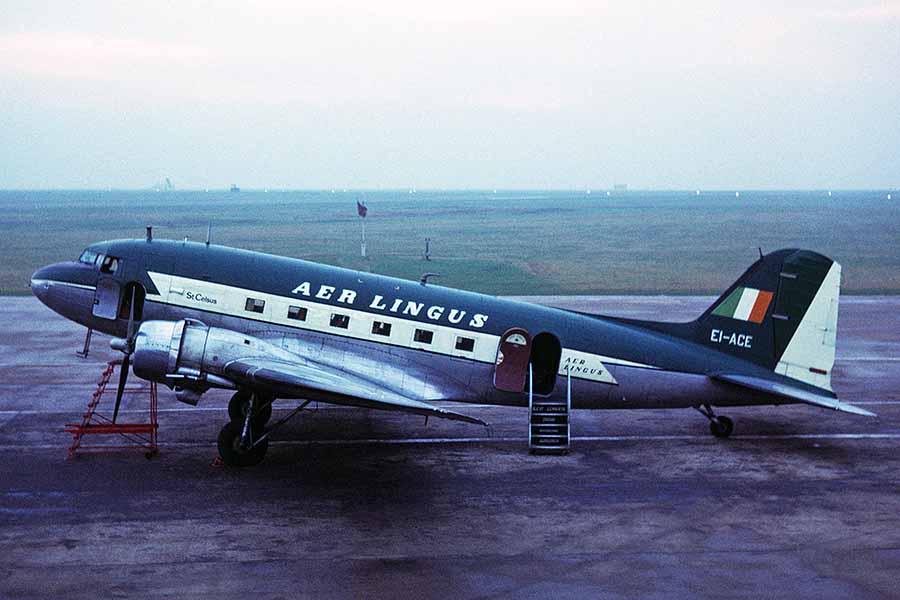
Aer LIngus was declared the world’s safest airline in 1951. sadly, the designation was not to last.
1952: Saint Kevin Disaster in Snowdonia
On 10 January 1952, Aer Lingus Flight EI-AFL, a Douglas Dakota named Saint Kevin, crashed in a remote boggy valley near Cwm Edno in Snowdonia, North Wales, killing all 23 people on board. The aircraft was en route from London Northolt to Dublin in atrocious weather with heavy rain and strong winds. After reporting over the Nefyn area, it encountered severe mountain wave turbulence on the lee side of Snowdon, leading to loss of control and a dive into the terrain. The crew’s descent to avoid icing placed the aircraft too low in hazardous conditions. Rescuers found a devastated site the next day, with some remains lost in the marsh. It was Aer Lingus’s first fatal accident.
1953: Saint Kieran Crash at Birmingham
On 1 January 1953, Aer Lingus Flight 136, a Douglas DC-3 named Saint Kieran (EI-ACF), crashed shortly after takeoff from Birmingham Airport bound for Dublin. Carrying 21 passengers and four crew, the aircraft suffered engine power loss due to carburetor icing in cold, damp conditions. The crew had not used carburetor heat, causing the plane to yaw and descend rapidly into a field near Marston Green. All 25 occupants survived with minor injuries, though the aircraft was written off. A 2002 inquiry confirmed the probable cause as icing combined with checklist omissions, highlighting vulnerabilities of the era’s DC-3 operations. The soft ground prevented fire and fatalities.
1967: Viscount Training Flight Tragedy near Ashbourne
On 22 June 1967, a Vickers Viscount 803 (EI-AOF) on a pilot conversion training flight from Dublin crashed near Ashbourne, County Meath, killing all three crew members. The aircraft, carrying a training captain and two cadet pilots, was practising manoeuvres when it entered an unintentional stall and incipient spin at low altitude. Eyewitnesses saw it in level flight before a near-vertical dive into the ground. No mechanical failure was found, but the low altitude left no room for recovery. The incident exposed risks in 1960s training practices and contributed to concerns about the Viscount fleet ahead of further losses the following year.
1968: Tuskar Rock Disaster – Ireland’s Worst Air Accident
On 24 March 1968, Aer Lingus Flight 712, a Vickers Viscount 803 named St Phelim (EI-AOM), crashed into the sea near Tuskar Rock off County Wexford while flying from Cork to London, killing all 61 on board. Investigations could not determine a definitive cause, with theories including structural failure (flutter-induced tailplane issues), bird strike, or maintenance shortcomings. Only 14 bodies were recovered. The disaster remains one of Ireland’s most enduring aviation mysteries. A major question mark remains over a training exercise by England’s reserve armed forces on a Welsh beach that day. While dismissing such speculation as a “conspiracy theory”, Westminster’s Official Secrets Act was invoked by the English authorities to prevent this featuring in the official investigation and ensured that the files were suppressed. English cabinet papers relating to a missile test site in Wales were extracted from the files in 1982, just as the media renewed its pursuit of the cause of the 1968 crash. Official English sources instead invoked anti-Irish tropes and alleged that the pilot Bernard O’Beu:ne, a teetotaler, was drunk at the time of the accident. His last words were: ‘Five thousand feet descending spinning rapidly.’ An international enquiry found that the crew managed to pull out of the spin and fly the aircraft in a disabled condition for probably over half an hour as they tried to land it.
1986: Shorts 360 Crash Landing near East Midlands
On 31 January 1986, Aer Lingus Commuter Flight 328, a Shorts 360 (EI-BEM), crashed short of the runway at East Midlands Airport after encountering severe airframe icing during a night approach from Dublin. The aircraft lost control, striking trees and power lines before coming to rest. All 36 occupants (three crew and 33 passengers) survived, though some were injured. The accident highlighted icing risks on the type and led to improved de-icing procedures and training across the industry. It was the last significant hull-loss incident in Aer Lingus’s history, underscoring advances in safety that have kept the airline’s passenger operations fatality-free since the 1960s.