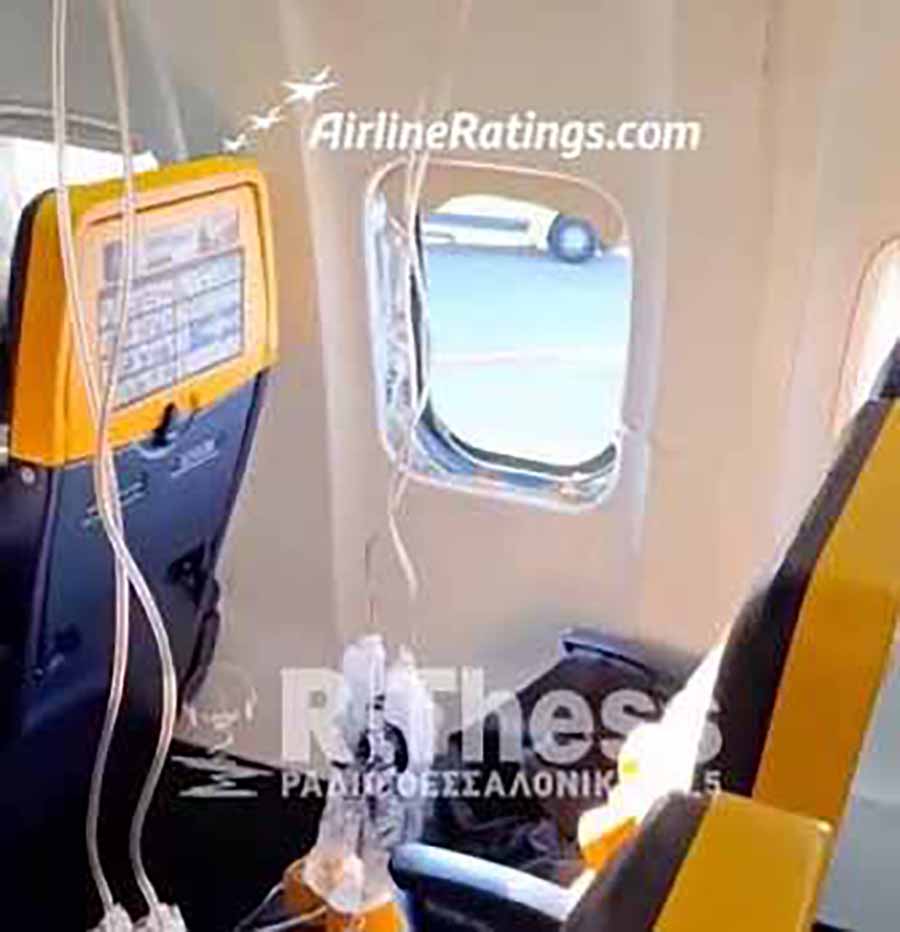
- A cabin window shattered on Ryanair flight FR1879 shortly after departure
- Flight was from Thessaloniki to Memmingen
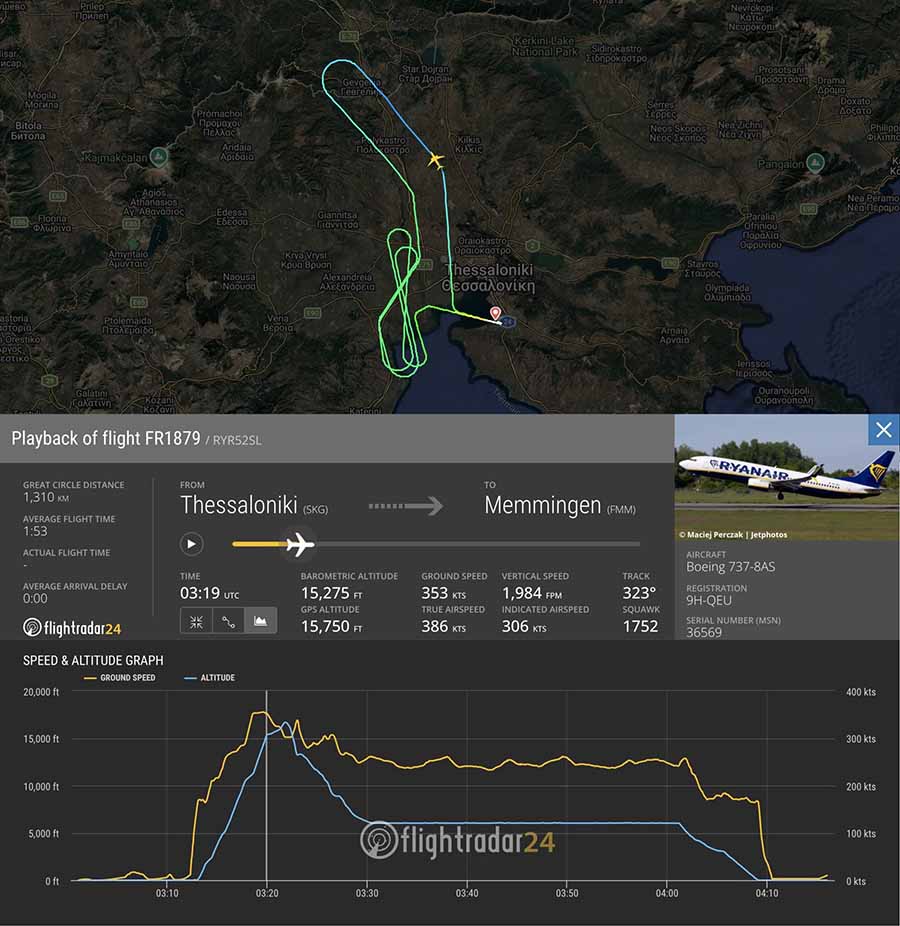
- The aircraft 9H-QEU reached 16,000 feet before descent.
- Crew and passengers pulled the affected man back inside.
- The flight landed safely after burning fuel.
- One passenger received hospital treatment.
- Aircraft 9H-QEU experienced unrelated return to departure on Thursday
A Ryanair Malta Air Boeing 737-800 has returned to Thessaloniki after a cabin window shattered in flight.
The incident happened on flight FR1879 six minutes after departure while the aircraft climbed through 15,000 feet. Multiple reports claim that a passengers and crew pulled a man back into the cabin after he became partially stuck in the broken window.
Four passengers were taken to the AHEPA University General Hospital as a precaution. Most were treated and released, while one remained for further medical checks. The man nearest the window, a 61 year old Serbian passenger received hospital treatment for a suspected neck injury., fiction burns and shock.
The aircraft, registration 9H-QEU, descended to 6,000 feet to burn fuel for 30 minutes before landing safely at 04:09 UTC. It was airborne for just more than an hour.
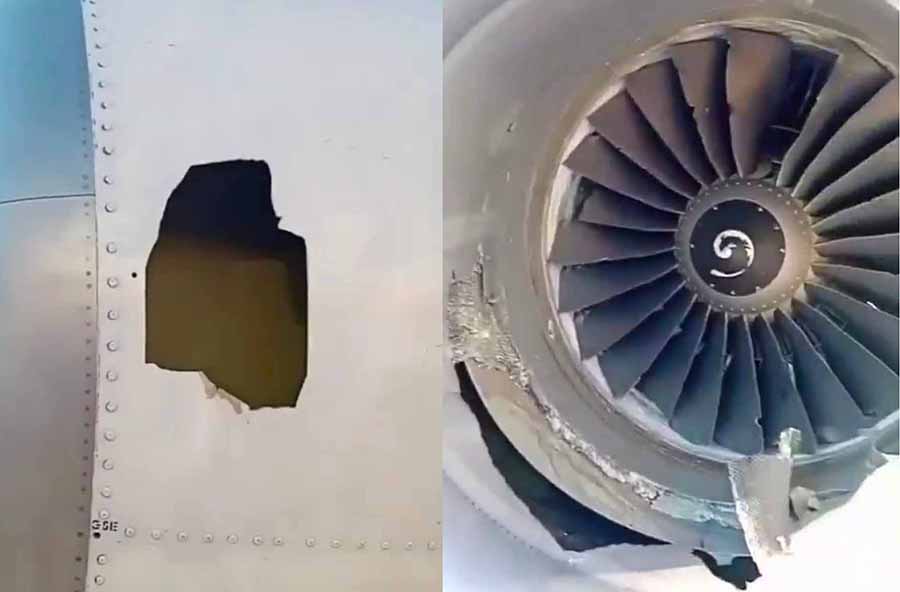
According to initial reports, the pilots detected the problem while the aircraft was over North Macedonia and decided to return to Thessaloniki after the malfunction could not be resolved in the air. During the descent, part of an apparently damaged engine reportedly detached and struck a cabin window, causing minor injuries to a passenger. Officials said the incident did not involve any breach of the aircraft’s fuselage.
Reports suggest the breach occurred while the aircraft was climbing through 15,000 to 16,000 feet (approximately 4,500 to 4,900 meters).
Oxygen masks deployed in the cabin. The flight originally headed to Memmingen. A replacement aircraft departed later the same morning. Ryanair confirmed one passenger requested medical assistance.
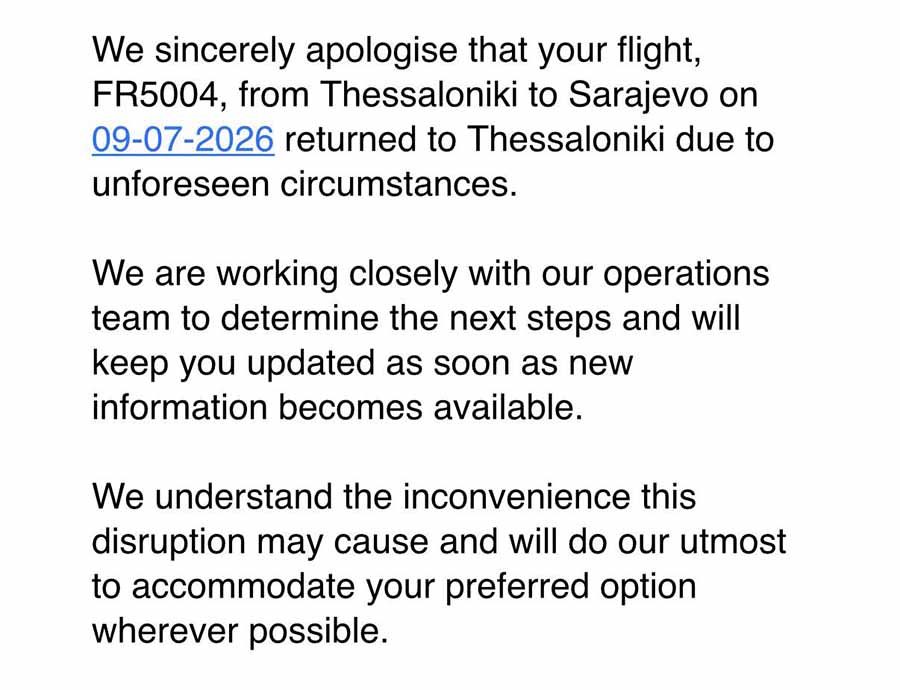
The aircraft 9H-QEU was forced to return to departure airport when operating a Thessaloniki-Sarajevo flight on Thursday. A passenger was arrested on the return to Thessaloniki.
Social media and local descriptions of events suggested that a so-called uncontained engine failure may have occurred to break the window. Aircraft 9H-QEH was delivered to Boeing in March 2018. It is equipped with two CFM56-7B engines manufactured by CFM International. Footage of the engine failure reportedly shows one main fan blade missing
Ryanair, which operated 116,800 flights per month, has an unblemished safety record. When on 10 November 2008, Ryanair Flight 4102 from Frankfurt–Hahn Airport, in Hahn, Rhineland-Palatinate to Rome Ciampino Airport, in Rome, Italy, suffered multiple bird strikes while landing, it was the only prevoius case where passengers were treated for minor injuries afetr an onboard incident, two crew and eight passengers.
In a statement, Ryanair shared that its Friday morning flight from the Greek city of Thessaloniki to Germany’s Memmingen returned “shortly after take-off when a passenger window dislodged in flight”.
Uncontained engine failure
An uncontained engine failure is a rare but severe event where turbine engine blades or internal components break apart and shatter through the engine’s thick containment casing. High-speed shrapnel can puncture fuel lines, damage control systems, or penetrate the pressurized passenger cabin. engine when internal components, such as fan blades or turbine discs, fracture, break free from rotational speeds, and burst through the engine’s outer casing.
Unlike contained failures—where debris remains safely inside the engine or exits the tailpipe—uncontained debris travels at high velocities and poses a severe risk to the aircraft. This flying shrapnel can pierce the fuselage, damage control surfaces (like the horizontal stabilizer), and sever critical flight systems such as hydraulic lines, fuel lines, and electrical wiring. Though statistically rare due to rigorous industry manufacturing and inspection standards, such events can lead to rapid depressurisation or fire
A report after two uncontained engine failure incidents impacting Southwest Ailirnes on August 27, 2016 and April 17, 2018 recommended that Boeing should develop and install a redesigned fan cowl structure due to the cowling latch’s vulnerability in a fan blade outage.
In 2925 eight Boeing 737-800 aircraft were temporarily removed from service following a string of four CFM56-7B engine failures that occurred well before the manufacturer’s recommended service interval.
CFM International is headquartered in Cincinnati, Ohio at GE Aerospace’s campus), with its registered corporate office located in Paris, France. The company operates as a successful 50/50 joint venture between GE Aerospace (USA) and Safran Aircraft Engines (France
Decompression
The Alaska Airlines Flight 1282 rapid decompression incident on January 5, 2024, resulted in minor injuries to seven passengers and one flight attendant, extensive cabin damage, widespread grounding of Boeing 737 MAX 9 aircraft, and severe legal and systemic safety reviews for Boeing. Because the mid-air door plug blowout occurred at a relatively low altitude of approximately 16,000 feet shortly after takeoff, the physical consequences were significantly less severe than they would have been at a standard cruising altitude.